


The 3-Line Summary
- The 9th ArmIGF met on 5 November 2024 at the Yerevan Marriott under the theme 'Cyber Reality and Secure Digital Future', with 137 in-person and 15 online participants and British Ambassador John Gallagher at the opening.
- The agenda: the 'Digital Navy' vision of landlocked Armenia as a data-transit hub, personal data protection under newly adopted laws, international cybersecurity cooperation, WSIS+20 and the Global Digital Compact, and a ccTLD strategy panel uniting the .ru, .ge, .rs and .uz registries.
- Marking the .am domain's 30th anniversary as the UN's internet-governance review loomed, it showed a small country using its national IGF as digital diplomacy.
Welcome — this is the Japan IGF Support Organization. This in-depth report on 9th Armenian Internet Governance Forum (ArmIGF 2024) draws on official outputs, session records and on-site reporting. In a hurry? The three lines above and the diagrams carry the gist.
Conference at a Glance (from official records)
| Item | Detail |
|---|---|
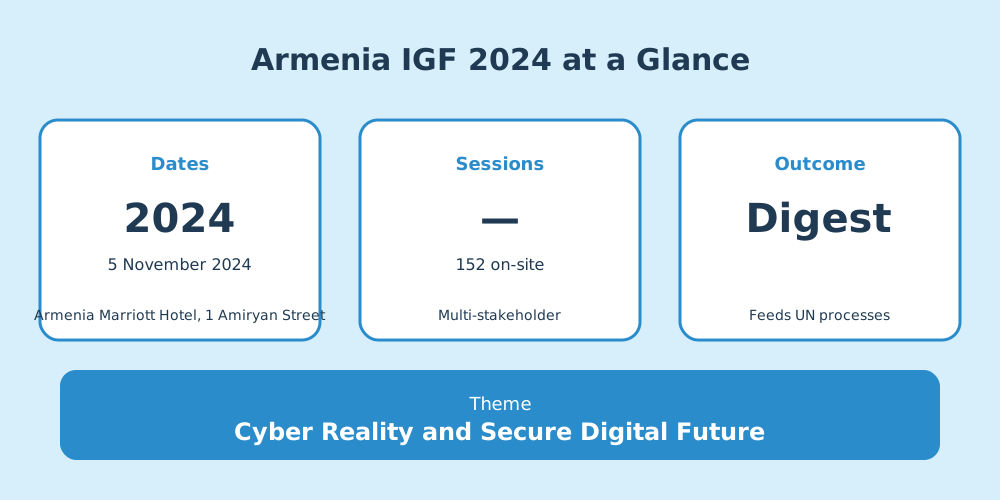
| Official name | 9th Armenian Internet Governance Forum (ArmIGF 2024) |
| Dates | 5 November 2024 |
| Venue | Armenia Marriott Hotel, 1 Amiryan Street, Yerevan (hybrid) |
| Theme | Cyber Reality and Secure Digital Future |
| Participants | 152 |
| Host | The Ministry of High-Tech Industry, the Internet Society NGO and the ISOC Armenia Chapter (the inter-agency ArmIGF group) |
| Note | Coincided with the 30th anniversaries of the .am ccTLD and the Internet Society NGO |
(See the source list at the end of this article.)
Discussion Digest — from the Session Records
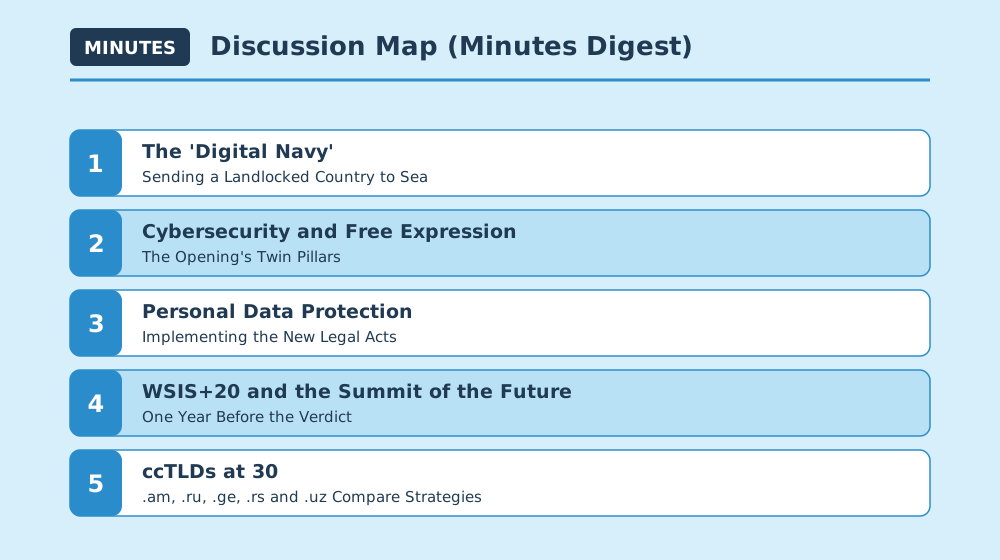
Key exchanges extracted from session records and transcripts.
1. The 'Digital Navy' — Sending a Landlocked Country to Sea
Sessions: Panel 'Armenia at a Digital Crossroad — how to build and lead the Armenian Digital Navy?' (10:45–12:00, moderated by RIPE NCC's Vahan Hovsepyan)
- Framed around building a 'digital fleet' for exponential small-country growth, the ministry's digitalisation chief and a national-security expert debated a regional leadership strategy [2][1]
- Hovsepyan laid out the case — Europe–Asia crossroads geography, proximity to Russian, Iranian and Middle Eastern markets, and the OVIO Tier 3 data centre with 200 collocation racks — for Armenia as a data-transit hub [2][1]
- Following 2023's Black Sea route pitch, connectivity-as-grand-strategy led the agenda for the second straight year [2][1]
2. Cybersecurity and Free Expression — The Opening's Twin Pillars
Sessions: Opening ceremony (10:00–10:45) and panel 'Cybersecurity Challenges and Issues: Global Best Practices and International Collaboration' (14:00–15:00)
"We believe the Internet should be a space where people can express themselves freely and feel completely safe. In our digitalization agenda, we place great emphasis on staying ahead in terms of cybersecurity and ensuring a cyber-safe environment when developing digital solutions (official report)"
— Gevorg Mantashyan (First Deputy Minister of High-Tech Industry) [2][4]
"Technology alone cannot solve these issues. We need a collective approach that includes collaboration among stakeholders — government bodies, businesses, civil society and individual users (official report)"
— Ralph Yirikian (General Director, Ucom) [2][4]
- Mantashyan described machine-learning and data-analysis tools deployed against misinformation and online threats, while insisting the free-and-open-internet principles stay intact [2][4]
- Ambassador John Gallagher argued digital progress requires collaboration across governments, business, civil society and individuals, reaffirming UK engagement [2][4]
- The afternoon panel gathered practitioners from multiple countries on international cybersecurity best practice [2][4]
3. Personal Data Protection — Implementing the New Legal Acts
Sessions: Panel 'Issues of Personal Data Protection in Newly Adopted Legal Acts: Challenges and Solutions' (12:00–13:00, moderated by Gevorg Hayrapetyan)
- Chaired by data-protection chief Gevorg Hayrapetyan, the panel — including security expert Samvel Martirosyan — worked through compliance and privacy challenges under newly adopted legislation [1][2]
- With data protection recurring in 2018 (GDPR), 2021 (e-health) and 2023–24 (new laws), the forum has become the country's standing checkpoint on the gap between statute and practice [1][2]
4. WSIS+20 and the Summit of the Future — One Year Before the Verdict
Sessions: Session 'WSIS+20 updates, Future of the IGF, Global Digital Compact and analysis of the Summit of the Future' (15:00–16:00, moderated by ICANN's Mikhail Anisimov)
- ICANN's UN-engagement VP Veni Markovski, IGFSA chair Amrita Choudhury and GFCE's Chris Buckridge (all online) joined MP Aleksey Sandikov to assess the Global Digital Compact adopted at the September 2024 Summit of the Future and the road to the 2025 WSIS+20 review, including the IGF's mandate renewal [2][1]
- The session framed these milestones as decisive for post-2025 internet governance — the national IGF acting as a local qualifier for the UN process [2][1]
5. ccTLDs at 30 — .am, .ru, .ge, .rs and .uz Compare Strategies
Sessions: Panel 'National Content and ccTLDs: Strategies for Growth and Overcoming Challenges' (16:15–17:00, moderated by Maria Kolesnikova)
- Marking .am's 30th birthday, registry figures from .ru/.рф, .ge, .rs and .uz compared growth strategies; Coordination Center director Andrey Vorobyov congratulated the registry on three decades of partnership [2][1][3]
- ISOC NGO's Kristina Hakobyan argued that building local content and national digital identity on .am requires a collective effort across stakeholders [2][1][3]
- ISOC chair Igor Mkrtumyan reviewed thirty years of the NGO and the ccTLD, urging plans for the next decades, while ISOC's Nick Hyrka reminded the room that roughly a third of humanity remains unconnected or badly connected [2][1][3]
Three-Minute Short Talk — Your Questions Answered
Q. What did this meeting decide?
A. Nothing binding — but weeks after the UN Summit of the Future and a year before WSIS+20, Armenia's public and private sectors audited the national digital strategy with international guests, under the theme 'Cyber Reality and Secure Digital Future'.
Q. What stood out?
A. The 'Digital Navy': a landlocked country openly plotting to become an intercontinental data-transit hub on the strength of geography and a Tier 3 data centre.
Q. Why should I care?
A. The ccTLD-at-30 strategy panel is every country's domain-future debate, and the WSIS+20/IGF-mandate discussion here decided the terms on which global internet governance would be renegotiated in 2025.
What Is Armenia IGF? (for first-time readers)
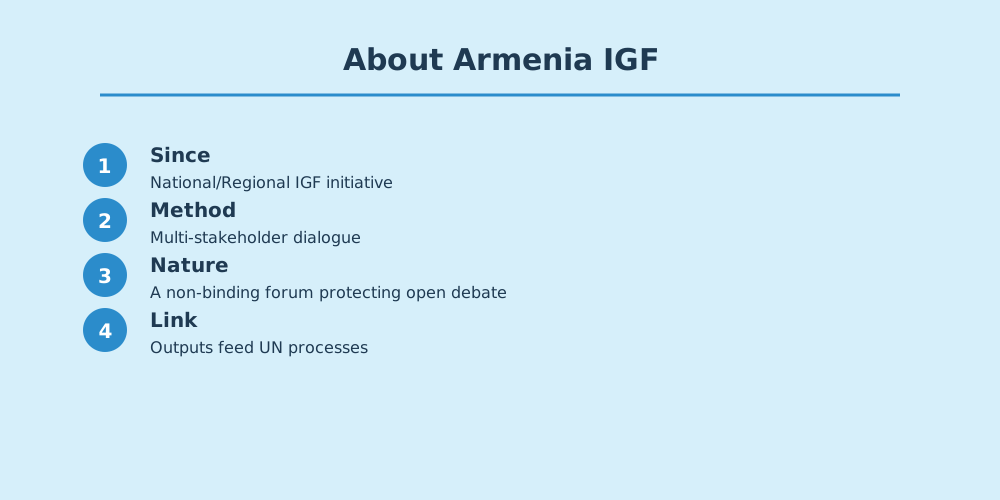
Armenia IGF is a National or Regional IGF Initiative (NRI), aligning local internet governance discussion with global IGF principles.
Why It Matters to You
What was discussed here becomes the baseline for national digital policy, platform rules and AI regulation worldwide within a few years. The principles confirmed at the 2024 meeting are the foundation of the "next rules" for the phones, social platforms and AI services you use every day.
Sources & References
- The 9th Armenian Internet Governance Forum(公式ページ・プログラムと登壇者) — ArmIGF公式サイト (accessed 2026-07-11)
- ArmIGF 2024 Report "Cyber reality and secure digital future"(公式報告書・英語・85ページ) — ArmIGF公式サイト (accessed 2026-07-11)
- WEBCAST NOV 5: Armenia Internet Governance Forum 2024(中継案内・セッション詳細) — ISOC Live (accessed 2026-07-11)
- Deputy Minister of High-Tech Industry attends ArmIGF2024 — Armenpress(アルメニア国営通信) (accessed 2026-07-11)
Quotes are translated or condensed from the records listed above. Bracketed numbers [n] refer to the source list.
Related links
- IGF official (NRI list): https://www.intgovforum.org/en/content/national-and-regional-igf-initiatives
- Japan IGF: https://japanigf.jp/
- Yuki Nakazawa's blog: https://nkzw.jp/category/igf/
Revision History
Rev. 1 — published 22 June 2024, 11:00 (Article published)
Rev. 2 — updated 17 July 2026, 12:32 (Fully revised into the in-depth edition: added the 3-line summary, minutes digest, short talk, source list and diagrams (all quotes verified against the listed sources))
— 中澤祐樹

