


The 3-Line Summary
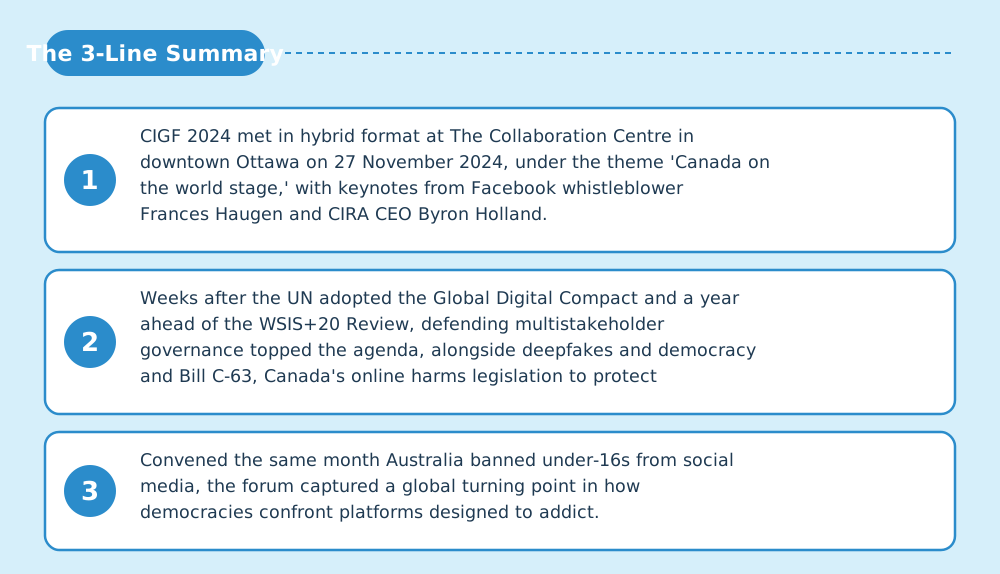
- CIGF 2024 met in hybrid format at The Collaboration Centre in downtown Ottawa on 27 November 2024, under the theme 'Canada on the world stage,' with keynotes from Facebook whistleblower Frances Haugen and CIRA CEO Byron Holland.
- Weeks after the UN adopted the Global Digital Compact and a year ahead of the WSIS+20 Review, defending multistakeholder governance topped the agenda, alongside deepfakes and democracy and Bill C-63, Canada's online harms legislation to protect children on social media.
- Convened the same month Australia banned under-16s from social media, the forum captured a global turning point in how democracies confront platforms designed to addict.
Welcome — this is the Japan IGF Support Organization. This in-depth report on Canadian Internet Governance Forum 2024: Canada on the world stage draws on official outputs, session records and on-site reporting. In a hurry? The three lines above and the diagrams carry the gist.
Conference at a Glance (from official records)
| Item | Detail |
|---|---|
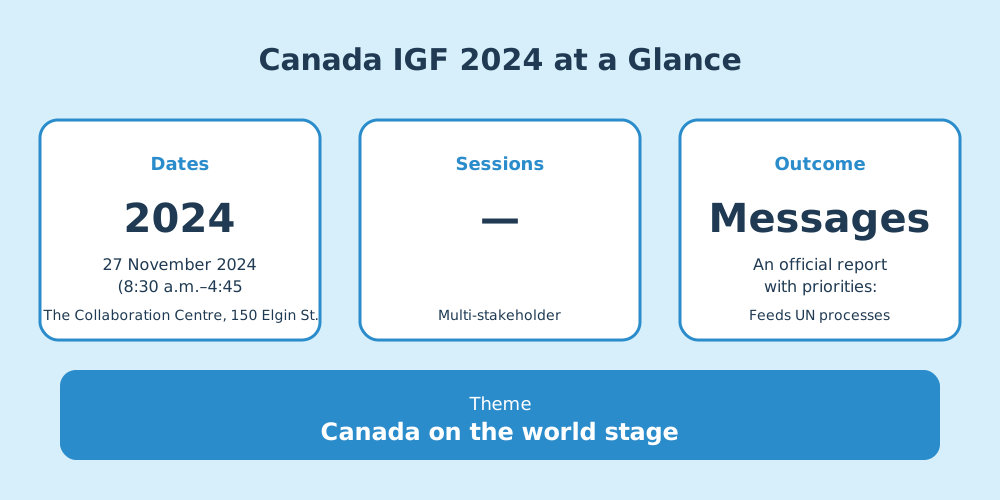
| Official name | Canadian Internet Governance Forum 2024: Canada on the world stage |
| Dates | 27 November 2024 (8:30 a.m.–4:45 p.m. ET) |
| Venue | The Collaboration Centre, 150 Elgin St. (8th floor), downtown Ottawa, Ontario |
| Theme | Canada on the world stage |
| Format | Hybrid (in person and online, livestreamed on YouTube) |
| Host | CIGF multi-stakeholder All-Hands Committee chaired by Georgia Evans (CIRA), with CIRA as presenting sponsor |
| Outcome | An official report with priorities: defending multistakeholderism in the WSIS+20 Review, bringing youth into governance dialogue, and principles-based, technology-neutral online harms regulation |
(See the source list at the end of this article.)
Discussion Digest — from the Session Records
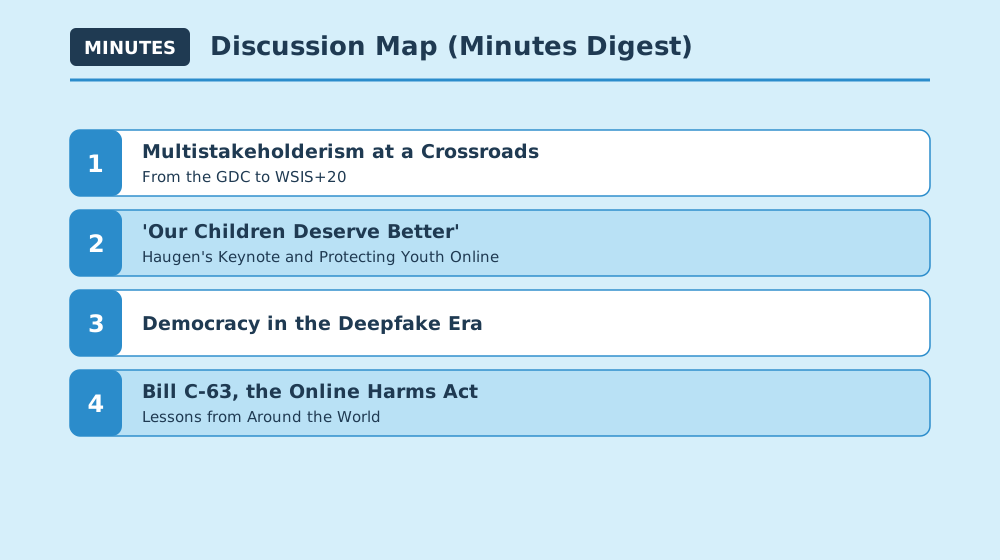
Key exchanges extracted from session records and transcripts.
1. Multistakeholderism at a Crossroads — From the GDC to WSIS+20
Sessions: Keynote 1 'How to secure the future of a free and open internet' (Byron Holland, CIRA) and Panel 3 'Shaping our shared digital future' (Charles Noir of CIRA, Sarah Wyld of Tucows, Natalie Campbell of the Internet Society, Kelly Anderson of Global Affairs Canada; moderated by Aaron Shull of CIGI)
- The UN General Assembly's adoption of the Global Digital Compact in September 2024 — recognising that internet governance must continue to be global and multistakeholder in nature — was hailed as a milestone, even as the GDC process exposed the persistence of well-resourced Member States pushing multilateral control [1][2]
- The 2025 WSIS+20 Review was framed as the decision point on whether the multistakeholder community keeps its say or governments gain more influence over the internet's day-to-day operation, with Canadian operators joining the Technical Community Coalition for Multistakeholderism (TCCM) [1][2]
- Geopolitics, state cyber operations, climate damage to physical infrastructure and consolidation in technology markets were mapped as the main threats to a free and open internet [1][2]
2. 'Our Children Deserve Better' — Haugen's Keynote and Protecting Youth Online
Sessions: Keynote 2 'Our children deserve better' (Frances Haugen, McGill Centre for Media, Technology and Democracy) and the Youth Spotlight readout by Dana Cramer of Youth IGF Canada
- Social media business models that maximise viewing for ad revenue make their technology addictive by design, panellists argued, with algorithms steering users towards progressively more extreme content and measurably harming children's mental health [1][2]
- Signs of pushback were noted: Australia's November 2024 law banning under-16s from social media and Meta's restrictive Instagram teen accounts [1][2]
- Children and youth — largely excluded from internet governance consultations to date — must be brought into the dialogue, a point underscored by the Youth IGF Canada readout on the programme [1][2]
3. Democracy in the Deepfake Era
Sessions: Panel 2 'How democracy is faring in the deepfake era' (Suzie Dunn of Dalhousie University, investigative journalist Justin Ling, Marlene Floyd of Microsoft Canada; moderated by Victoria Kuketz)
- Generative AI now lets bad actors flood platforms with misinformation at scale, spreading anti-democratic narratives and undermining trust in institutions, the panel reported [1][2]
- Election integrity headlined the 2024 agenda, with deepfake-driven political disinformation dissected in detail [1][2]
- Rebuilding trust through transparency and accountability, and nationwide media and digital literacy programmes, were named priority responses [1][2]
4. Bill C-63, the Online Harms Act — Lessons from Around the World
Sessions: Panel 4 'Lessons from the globe: How the Online Harms Act will work in practice' (Chantal Bernier of Dentons, Cynthia Khoo of Citizen Lab, Open Ripley of Justice Canada, Kathryn Hill of MediaSmarts; moderated by Stephanie Taylor of the National Post)
- Bill C-63, holding social media platforms accountable for harmful content, was broadly welcomed as a positive step — but legislation alone is not enough, panellists argued, without ongoing collaboration between government, companies and the multistakeholder community, plus education [1]
- Regulation should be technology-neutral and principles-based, built on consultation with youth and marginalised communities, with lessons available from Australia, France and Germany [1]
- The official report notes that Bill C-63 subsequently died when Parliament was prorogued after CIGF 2024 was held [1]
Three-Minute Short Talk — Your Questions Answered
Q. What was the theme?
A. 'Canada on the world stage.' With the UN's WSIS+20 Review a year away, the central question was how to defend multistakeholder internet governance against a push for greater government control.
Q. What was the highlight?
A. Facebook whistleblower Frances Haugen's keynote, 'Our children deserve better' — a head-on debate about regulating platforms whose engagement algorithms are addictive by design.
Q. Why should I care?
A. Child-safety rules for social media went global after Australia's under-16 ban that same month, and the WSIS+20 fight over the IGF's future affects internet governance in every country.
What Is Canada IGF? (for first-time readers)
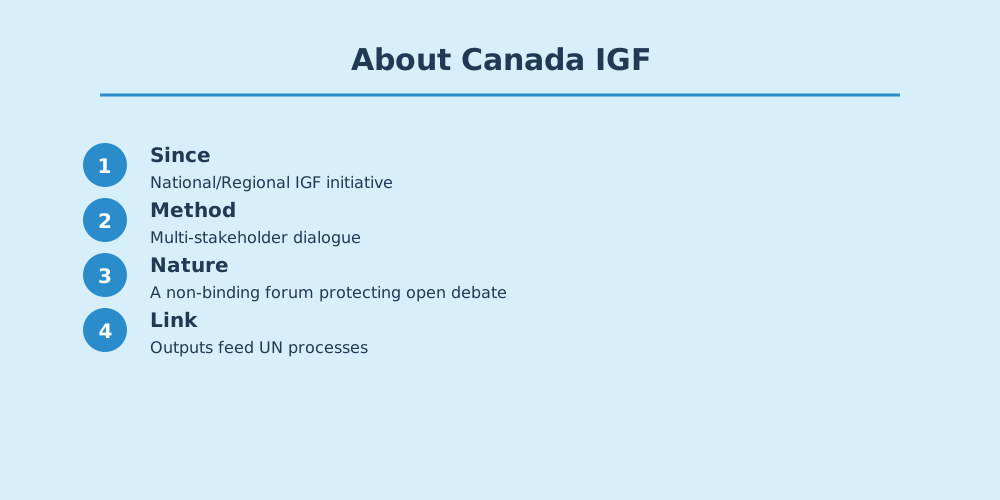
Canada IGF is a National or Regional IGF Initiative (NRI), aligning local internet governance discussion with global IGF principles.
Why It Matters to You
What was discussed here becomes the baseline for national digital policy, platform rules and AI regulation worldwide within a few years. The principles confirmed at the 2024 meeting are the foundation of the "next rules" for the phones, social platforms and AI services you use every day.
Sources & References
- Canadian IGF 2024: Canada on the world stage (official report) — Canadian IGF (accessed 2026-07-11)
- Ottawa hosts digital policy leaders at top Canadian conference on internet governance — CIRA (accessed 2026-07-11)
- 2024 Canadian IGF(エンゲージメントカレンダー) — ICANN (accessed 2026-07-11)
- Canadian IGF — Past Events — Canadian IGF (accessed 2026-07-11)
- Canada IGF(NRI記録) — UN IGF Secretariat (accessed 2026-07-11)
Quotes are translated or condensed from the records listed above. Bracketed numbers [n] refer to the source list.
Related links
- IGF official (NRI list): https://www.intgovforum.org/en/content/national-and-regional-igf-initiatives
- Japan IGF: https://japanigf.jp/
- Yuki Nakazawa's blog: https://nkzw.jp/category/igf/
Revision History
Rev. 1 — published 21 July 2024, 15:00 (Article published)
Rev. 2 — updated 16 July 2026, 20:09 (Fully revised into the in-depth edition: added the 3-line summary, minutes digest, short talk, source list and diagrams (all quotes verified against the listed sources))
— 中澤祐樹

