


The 3-Line Summary
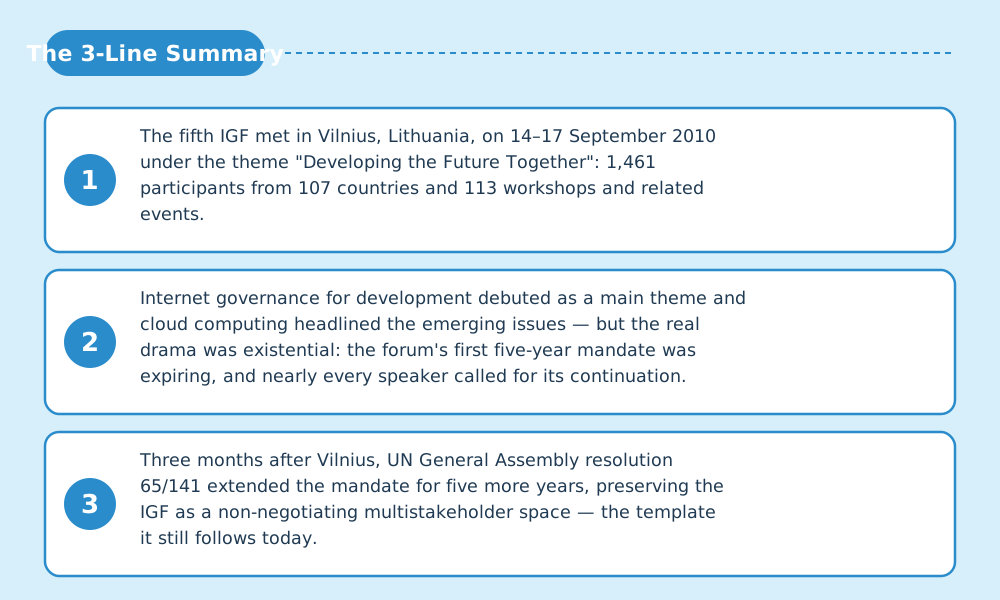
- The fifth IGF met in Vilnius, Lithuania, on 14–17 September 2010 under the theme "Developing the Future Together": 1,461 participants from 107 countries and 113 workshops and related events.
- Internet governance for development debuted as a main theme and cloud computing headlined the emerging issues — but the real drama was existential: the forum's first five-year mandate was expiring, and nearly every speaker called for its continuation.
- Three months after Vilnius, UN General Assembly resolution 65/141 extended the mandate for five more years, preserving the IGF as a non-negotiating multistakeholder space — the template it still follows today.
Welcome — this is the Japan IGF Support Organization. This in-depth report on Global IGF 2010 in Vilnius draws on official outputs, session records and on-site reporting. In a hurry? The three lines above and the diagrams carry the gist.
Conference at a Glance (from official records)
| Item | Detail |
|---|---|
| Edition | Fifth IGF — final year of the original five-year mandate |
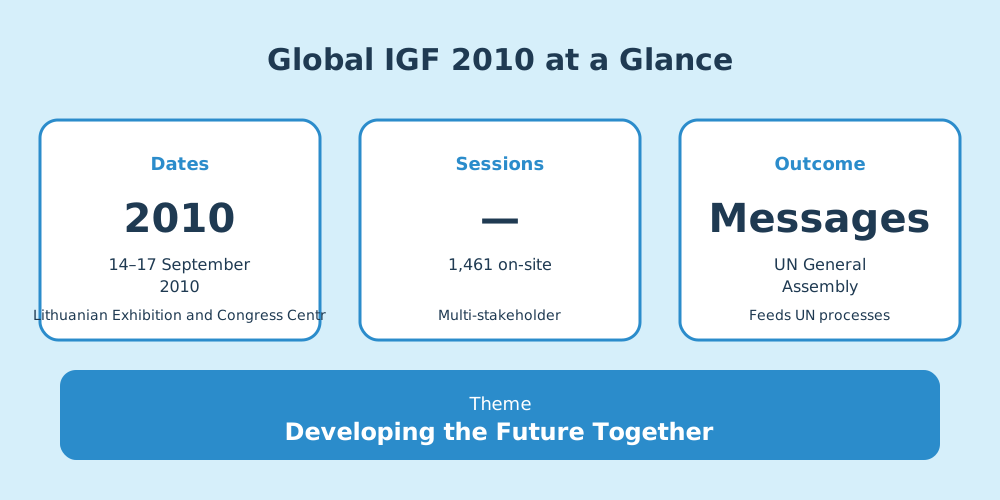
| Dates | 14–17 September 2010 |
| Venue | Lithuanian Exhibition and Congress Centre LITEXPO, Vilnius, Lithuania |
| Theme | Developing the Future Together |
| Participants | 1,461 (1,461 registered participants excluding host-country staff, security and secretariat (1,993 badges issued in total)) |
| Badges issued | 1,993 |
| Countries | 107 |
| Workshops | 113 (Workshops, best practice forums, dynamic coalition meetings and open forums combined) |
| Remote hubs | 32 |
| Host | Government of Lithuania (Ministry of Transport and Communications) and the United Nations; chaired by Minister Eligijus Masiulis |
| Outcome | UN General Assembly resolution 65/141 (adopted 20 December 2010) extended the IGF mandate for a further five years |
(See the source list at the end of this article.)
Discussion Digest — from the Session Records
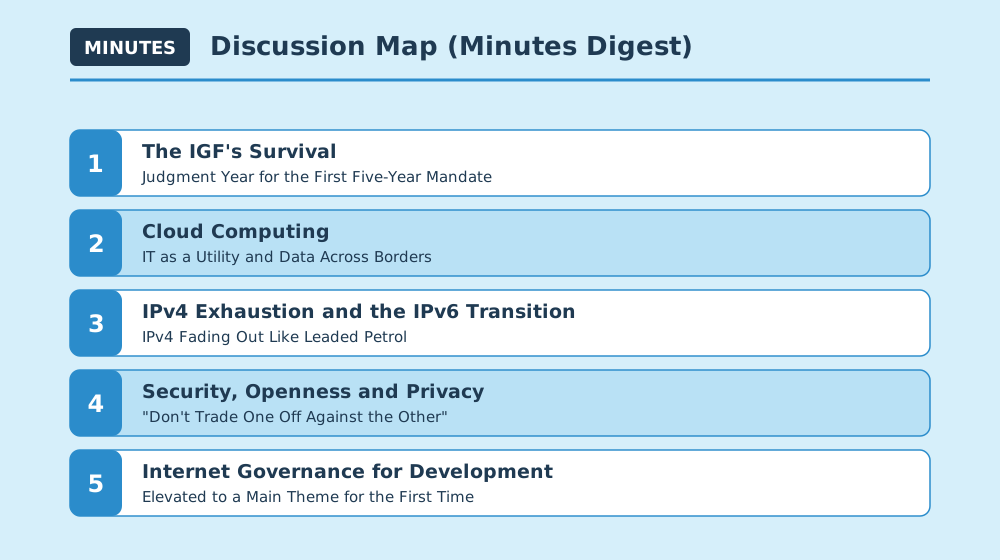
Key exchanges extracted from session records and transcripts.
1. The IGF's Survival — Judgment Year for the First Five-Year Mandate
Sessions: Main session "Taking Stock of Internet Governance and the Way Forward", introductory session "Setting the Scene", opening and closing ceremonies
"(On the official proceedings book covering the IGF's first years) it captures the process of the IGF in a "manner that could be called continuity in change""
— N. Ravi Shanker (Joint Secretary, Department of Information Technology, Government of India) [1][4][7]
"Let us not waste time talking about the youth, but let the youth talk"
— A youth coalition member (recorded unnamed in the Chairman's Summary) [1][4][7]
- Opening the meeting, UN Assistant Secretary-General Jomo Kwame Sundaram reminded participants that the original mandate expired that year, that the Secretary-General had recommended extension with improvements, and that the General Assembly would decide by the end of 2010 — giving the whole meeting an eve-of-judgment atmosphere [1][4][7]
- Nearly every speaker backed continuation; Kenya offered to host the 2011 meeting and Azerbaijan proposed Baku for 2012 "provided the mandate were renewed". Japan's government representative cited its network-cost study group and public-private IPv6 deployment work and declared support for continuing the IGF [1][4][7]
- At the closing ceremony Lithuania pledged to argue at the General Assembly for renewing the IGF as a platform for non-binding multistakeholder dialogue; three months later, on 20 December 2010, resolution 65/141 extended the mandate for five years [1][4][7]
2. Cloud Computing — IT as a Utility and Data Across Borders
Sessions: Emerging issues main session "Cloud Computing"
- Panellists likened the cloud to electricity distribution — users no longer need to run their own IT infrastructure — while others asked whether a few large firms would come to dominate it like the big utilities [1]
- Data location and jurisdiction emerged as the biggest unresolved issue: a search that would require a warrant on a personal computer could reach cloud-stored data without one, prompting calls for cloud data to enjoy the same safeguards as data on our desks and hard drives [1]
- The West African IGF reported alarm that data from and about Africa was being hosted in clouds outside the region, with nobody really knowing where the data were [1]
3. IPv4 Exhaustion and the IPv6 Transition — IPv4 Fading Out Like Leaded Petrol
Sessions: Main session "Managing Critical Internet Resources"
- A survey of more than 1,500 organisations across 140 economies found a significant share already deploying IPv6 — and that costs were often lower than anticipated [1]
- A moderator compared the transition to the switch from leaded to unleaded petrol: scarce at first, then suddenly the old standard becomes hard to find — and speakers urged governments to require IPv6-readiness in public procurement [1]
- The operator of Haiti's ccTLD recounted keeping the domain running despite the January 2010 earthquake, crediting hurricane-honed preparedness and geographic network diversity [1]
4. Security, Openness and Privacy — "Don't Trade One Off Against the Other"
Sessions: Main session "Security, Openness and Privacy"
- Frank La Rue, UN Special Rapporteur on Freedom of Expression and a session moderator, argued that privacy is a fundamental, permanent right and security a precondition for exercising all rights — so the task is not to balance one against the other but to enhance both simultaneously [1][5]
- A Lithuanian participant, recalling the 2007 cyber attacks on Estonia, warned that a botnet could be rented for a few hundred euros a day and that professionals, not amateurs, ran such attacks — freedoms matter, but malicious behaviour must be prosecutable [1][5]
- Remote hubs in Dhaka (where 44 people watched together) and Jakarta both insisted privacy and security should not be presented as a trade-off, showing how the 32 remote hubs fed directly into the main-session debate [1][5]
5. Internet Governance for Development — Elevated to a Main Theme for the First Time
Sessions: Main session "Internet Governance for Development (IG4D)"
- After two years of workshops pressing for development to be more central to the IGF, IG4D became a main-session theme for the first time in 2010, with calls for governance mechanisms that adequately and proportionally represent developing countries [1]
- A large Indian telecom operator's practice of giving free access to one social network while charging for all other traffic was cited as evidence that, in developing regions, net neutrality is a question of corporate control [1]
- Participants noted that marginalised groups will never attend the IGF directly however open it becomes — they must be represented not only through governments but through diverse civil society groups, in the spirit of "deepening democracy" [1]
Three-Minute Short Talk — Your Questions Answered
Q. So what did the conference actually decide?
A. The IGF never "decides" anything — but in 2010 its own fate was on the line. Its first five-year mandate was expiring, and nearly everyone in Vilnius backed continuation. Three months later, UN General Assembly resolution 65/141 extended the forum for five more years.
Q. What was the most contentious topic?
A. Whether a forum that produces no negotiated outcomes is worth keeping. Reformers wanted the IGF to issue recommendations; defenders argued that pressure-free dialogue is precisely what makes frank multistakeholder debate possible. The defenders' model prevailed.
Q. Why should I care?
A. The question Vilnius raised about cloud computing — whose laws protect your data once it leaves your device? — is exactly the question every smartphone and cloud user still lives with today.
What Is Global IGF? (for first-time readers)
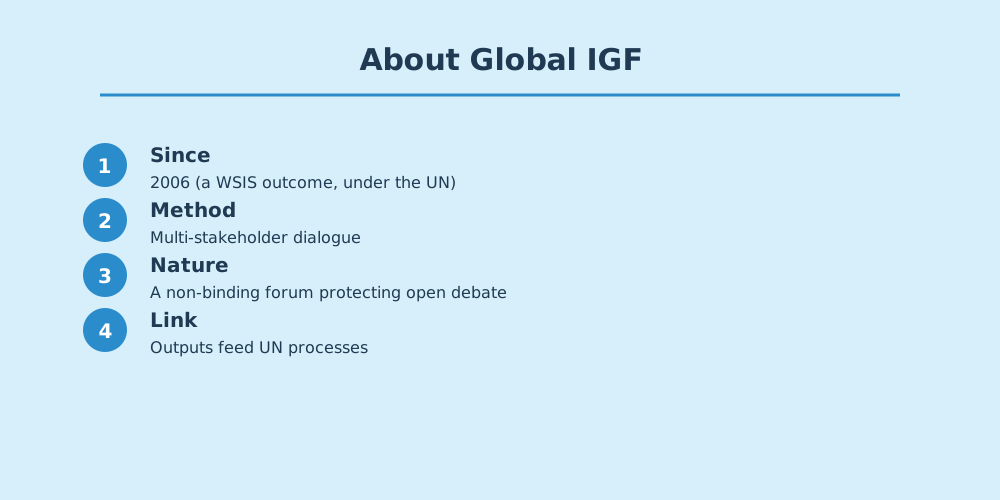
Global IGF has met annually under UN auspices since 2006 — the one global conference where governments, business, civil society, the technical community and youth debate internet governance as equals (the multistakeholder model).
Why It Matters to You
What was discussed here becomes the baseline for national digital policy, platform rules and AI regulation worldwide within a few years. The principles confirmed at the 2010 meeting are the foundation of the "next rules" for the phones, social platforms and AI services you use every day.
Sources & References
- Fifth Meeting of the Internet Governance Forum, Vilnius — Chairman's Summary (Expanded Version) — UN IGF Secretariat / wgig.org アーカイブ (accessed 2026-07-10)
- The IGF 2010 Meeting — UN IGF Secretariat (accessed 2026-07-10)
- Internet Governance Forum — IGF V, Vilnius, Lithuania 2010 — en (accessed 2026-07-10)
- UNGA Resolution 65/141 (Information and communications technologies for development) — DiploFoundation (accessed 2026-07-10)
- Internet Governance Forum 2010: Pre-event on human rights — APC (accessed 2026-07-10)
- 2010 Annual Symposium (Vilnius, Lithuania) — held at LITEXPO in conjunction with the IGF — GigaNet (accessed 2026-07-10)
- IGF 2010 Opening Ceremony (transcript) — UN IGF Secretariat (accessed 2026-07-10)
Quotes are translated or condensed from the records listed above. Bracketed numbers [n] refer to the source list.
Related links
- IGF official (NRI list): https://www.intgovforum.org/en/content/national-and-regional-igf-initiatives
- Japan IGF: https://japanigf.jp/
- Yuki Nakazawa's blog: https://nkzw.jp/category/igf/
Revision History
Rev. 1 — published 14 September 2010, 15:00 (Article published)
Rev. 2 — updated 10 July 2026, 14:28 (Fully revised into the in-depth edition: added the 3-line summary, minutes digest, short talk, source list and diagrams (all quotes verified against the listed sources))
— 中澤祐樹

