


The 3-Line Summary
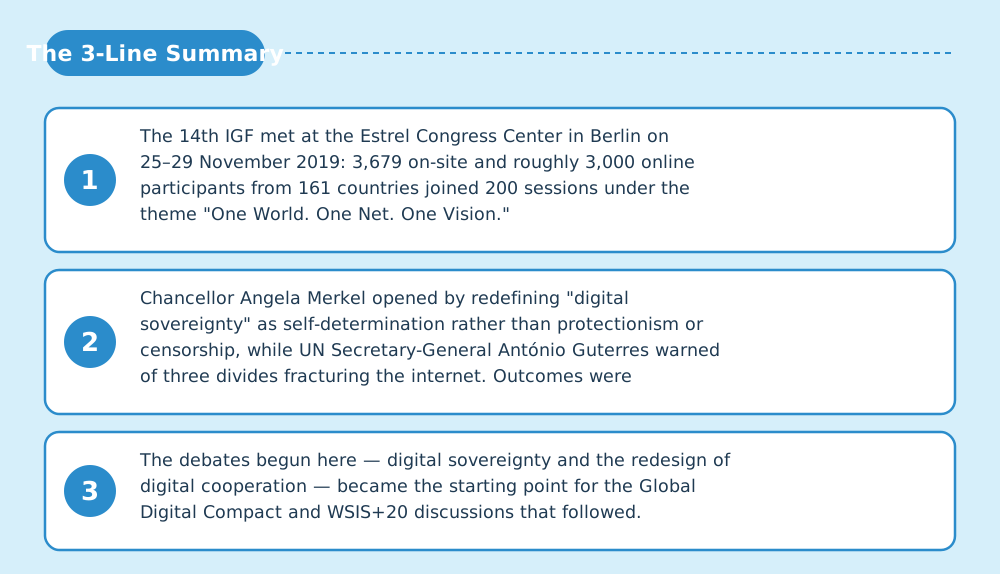
- The 14th IGF met at the Estrel Congress Center in Berlin on 25–29 November 2019: 3,679 on-site and roughly 3,000 online participants from 161 countries joined 200 sessions under the theme "One World. One Net. One Vision."
- Chancellor Angela Merkel opened by redefining "digital sovereignty" as self-determination rather than protectionism or censorship, while UN Secretary-General António Guterres warned of three divides fracturing the internet. Outcomes were distilled into the Berlin IGF Messages, and the High-Level Panel's "IGF Plus" proposal dominated the corridors.
- The debates begun here — digital sovereignty and the redesign of digital cooperation — became the starting point for the Global Digital Compact and WSIS+20 discussions that followed.
Welcome — this is the Japan IGF Support Organization. This in-depth report on Global IGF 2019 in Berlin draws on official outputs, session records and on-site reporting. In a hurry? The three lines above and the diagrams carry the gist.
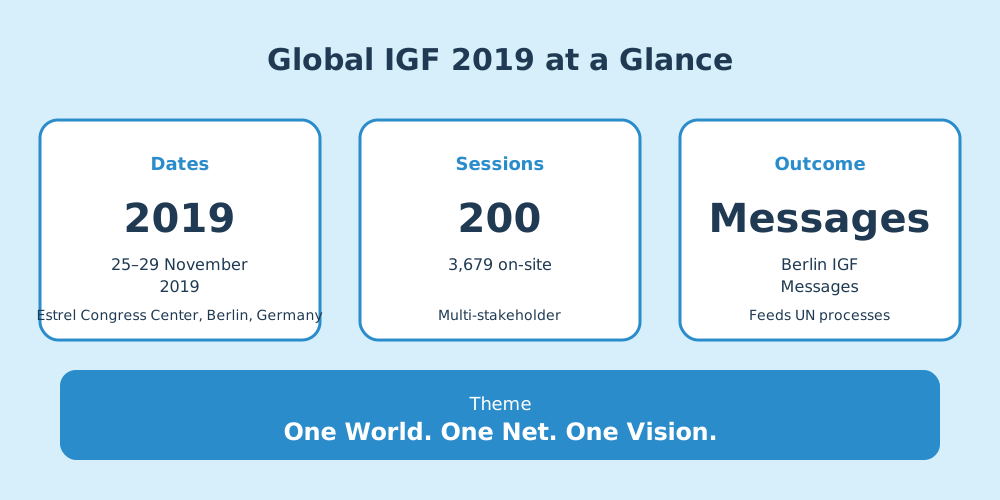
Conference at a Glance (from official records)
| Item | Detail |
|---|---|
| Edition | 14th annual IGF meeting |
| Dates | 25–29 November 2019 |
| Venue | Estrel Congress Center, Berlin, Germany |
| Theme | One World. One Net. One Vision. |
| On-site participants | 3,679 |
| Online participants | 2,952 |
| Countries | 161 |
| Sessions | 200 |
| Host | Government of Germany and the United Nations |
| Outcome | Berlin IGF Messages (one per thematic track) and the Chair's Summary |
(See the source list at the end of this article.)
Discussion Digest — from the Session Records
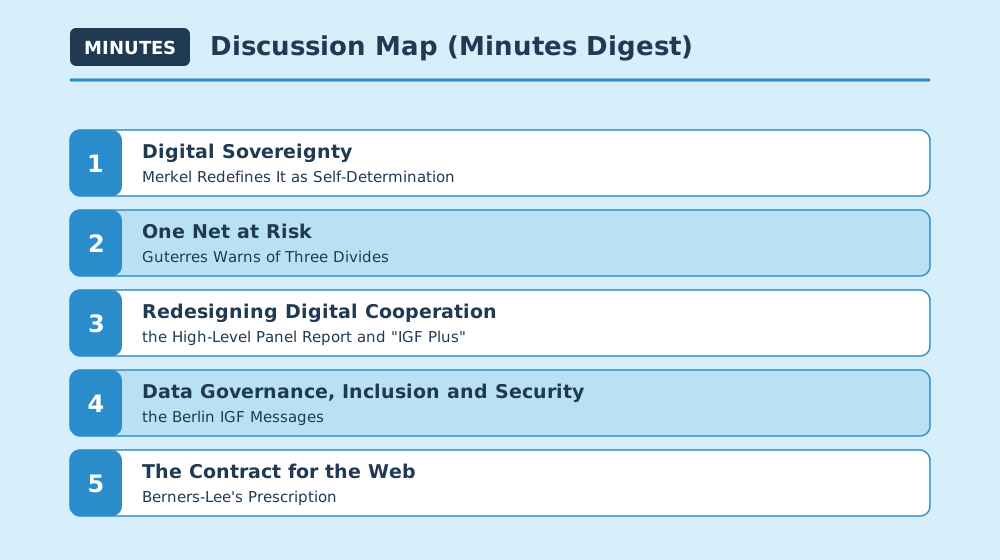
Key exchanges extracted from session records and transcripts.
1. Digital Sovereignty — Merkel Redefines It as Self-Determination
Sessions: Opening Ceremony (26 November, Estrel Congress Center)
"Digital sovereignty does not mean protectionism, or that state authorities say what information can be disseminated – censorship, in other words; rather, it describes the ability both of individuals and of society to shape the digital transformation in a self-determined way"
— Angela Merkel (Chancellor of Germany) [1][3]
"We should all be determined to protect the heart of the internet as a global public good"
— Angela Merkel (Chancellor of Germany) [1][3]
- The speech was credited with turning "digital sovereignty" into an international policy term — a third way between state-controlled internets and calls for European technological self-reliance [1][3]
- Merkel also insisted the internet "cannot and must not be shaped by states and governments alone," reaffirming the multistakeholder model [1][3]
- Speaking in the city where the Wall fell 30 years earlier, she warned that the consequences of an increasingly fragmented internet "can never be good" — a distinctly German framing [1][3]
2. One Net at Risk — Guterres Warns of Three Divides
Sessions: Opening Ceremony (26 November)
"There is a profound digital divide; a social divide; and a political divide"
— António Guterres (UN Secretary-General) [2][3]
"There is also a tendency to create some virtual walls in the internet, also to separate people"
— António Guterres (UN Secretary-General) [2][3]
- Guterres noted that some 3.6 billion people still lack affordable internet access, and that 80% of the population in 47 least-developed countries remains offline [2][3]
- He warned that geopolitical rivalry could tear the free and open internet apart, calling for "a future with one world, one net, one vision" [2][3]
3. Redesigning Digital Cooperation — the High-Level Panel Report and "IGF Plus"
Sessions: Main Session "Digital Cooperation and Internet Governance" (26 November, Convention Hall II) and others
- "IGF Plus" — the upgrade proposed in the June 2019 report of the UN Secretary-General's High-Level Panel on Digital Cooperation, "The Age of Digital Interdependence" — was mentioned more than 60 times, making it the meeting's biggest talking point [4][5]
- Guterres announced plans to appoint a dedicated UN Technology Envoy, and Anriette Esterhuysen of South Africa was named the new chair of the IGF's Multistakeholder Advisory Group [4][5]
- Whether a talk-shop IGF could deliver tangible policy outputs became the question that carried into the Global Digital Compact debates [4][5]
4. Data Governance, Inclusion and Security — the Berlin IGF Messages
Sessions: Sessions across the three thematic tracks: Data Governance, Digital Inclusion, and Security, Safety, Stability & Resilience
- On data governance, discussions moved past the "data is the new oil" analogy toward recognising that different data types need different policies — sensitive data close to its subjects, scientific data openly shared [4][5][7]
- Digital inclusion was framed beyond connectivity to cover gender, education and local languages, and Germany pledged USD 1.65 million over three years to support Global South participation [4][5][7]
- Distilled from session reports, the Berlin IGF Messages documented each track and became the template for the IGF's outcome documents in later years [4][5][7]
5. The Contract for the Web — Berners-Lee's Prescription
Sessions: Contract for the Web launch (25 November, in Berlin as the IGF opened) and related sessions
- Web inventor Tim Berners-Lee launched the Contract for the Web — nine principles, three each for governments, companies and citizens — timed to the IGF's opening in Berlin [8][5]
- More than 150 organisations, including Google, Microsoft and Facebook, backed it at launch, aiming to reclaim the web as a force for good against disinformation, surveillance and political manipulation [8][5]
- A UN forum and a civil-society initiative converging on Berlin in the same week pushed the sense of a web in crisis into mainstream headlines [8][5]
Three-Minute Short Talk — Your Questions Answered
Q. So what did the conference actually decide?
A. The IGF doesn't 'decide' — it's the UN's forum where governments, companies and civil society talk as equals. This year's discussions were distilled into the Berlin IGF Messages, and the 'IGF Plus' proposal to strengthen the forum itself gained real momentum.
Q. What was the most contentious topic?
A. What 'digital sovereignty' means. Merkel defined it as self-determination — not protectionism, not censorship — but with state-controlled internets and 'splinternet' fears in the background, the debate over whose sovereignty it is kept going.
Q. Why should I care?
A. The question that took off here — how far states should reach into data and the network — became a wellspring of today's data strategies, platform regulation and digital-sovereignty policies worldwide.
What Is Global IGF? (for first-time readers)
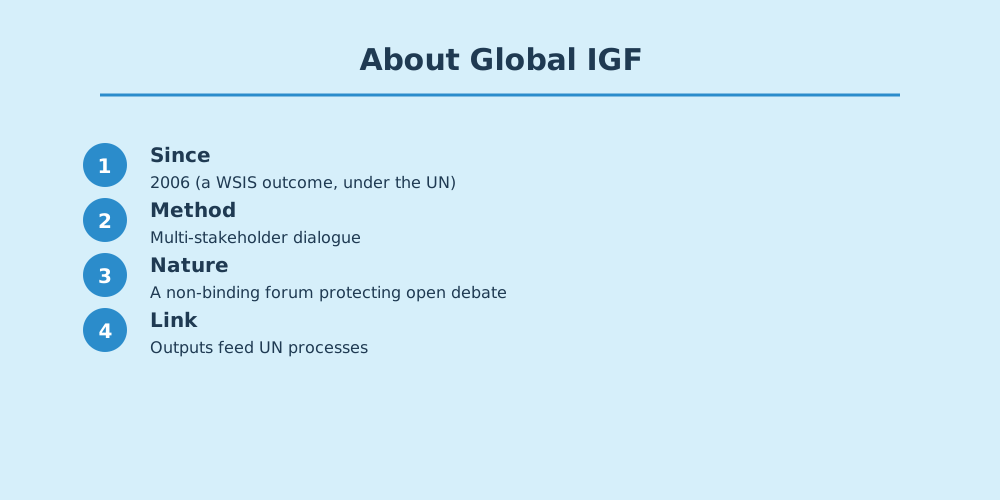
Global IGF has met annually under UN auspices since 2006 — the one global conference where governments, business, civil society, the technical community and youth debate internet governance as equals (the multistakeholder model).
Why It Matters to You
What was discussed here becomes the baseline for national digital policy, platform rules and AI regulation worldwide within a few years. The principles confirmed at the 2019 meeting are the foundation of the "next rules" for the phones, social platforms and AI services you use every day.
Sources & References
- Speech by Federal Chancellor Dr Angela Merkel opening the 14th Annual Meeting of the Internet Governance Forum in Berlin on 26 November 2019 — bundesregierung.de (accessed 2026-07-10)
- Secretary-General's remarks to the Internet Governance Forum [as delivered] — United Nations (accessed 2026-07-10)
- IGF 2019 – Opening ceremony (session report) — DiploFoundation (accessed 2026-07-10)
- IGF 2019 Final Report — DiploFoundation (accessed 2026-07-10)
- Internet Governance Forum: We must act now to tackle the threats of cyberspace — UN DESA (accessed 2026-07-10)
- IGF 2019 Participation & Programme Statistics — UN IGF Secretariat (accessed 2026-07-10)
- Berlin IGF Messages — UN IGF Secretariat (accessed 2026-07-10)
- Contract for the Web — en (accessed 2026-07-10)
Quotes are translated or condensed from the records listed above. Bracketed numbers [n] refer to the source list.
Related links
- IGF official (NRI list): https://www.intgovforum.org/en/content/national-and-regional-igf-initiatives
- Japan IGF: https://japanigf.jp/
- Yuki Nakazawa's blog: https://nkzw.jp/category/igf/
Revision History
Rev. 1 — published 25 November 2019, 17:00 (Article published)
Rev. 2 — updated 10 July 2026, 14:28 (Fully revised into the in-depth edition: added the 3-line summary, minutes digest, short talk, source list and diagrams (all quotes verified against the listed sources))
— 中澤祐樹

