

The 3-Line Summary
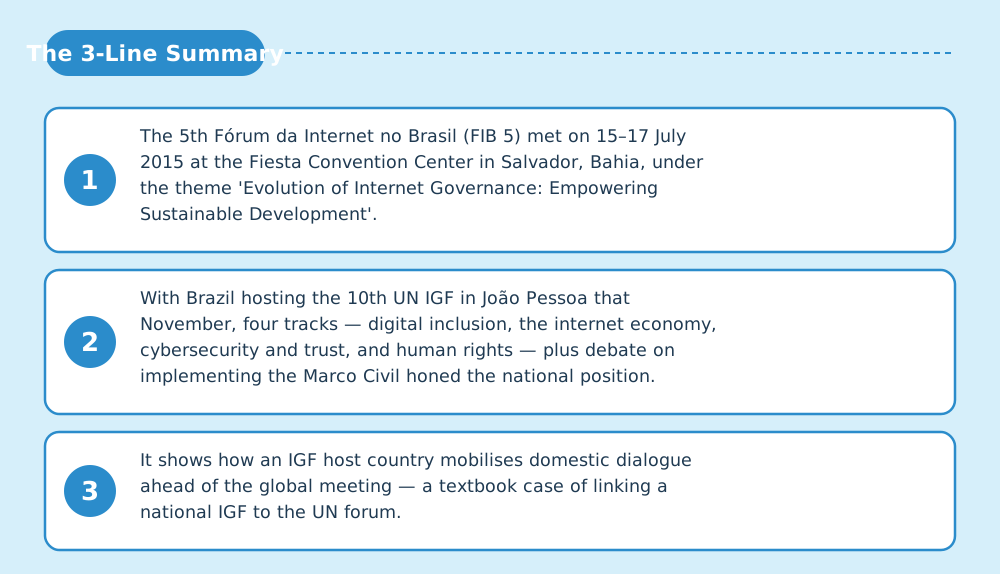
- The 5th Fórum da Internet no Brasil (FIB 5) met on 15–17 July 2015 at the Fiesta Convention Center in Salvador, Bahia, under the theme 'Evolution of Internet Governance: Empowering Sustainable Development'.
- With Brazil hosting the 10th UN IGF in João Pessoa that November, four tracks — digital inclusion, the internet economy, cybersecurity and trust, and human rights — plus debate on implementing the Marco Civil honed the national position.
- It shows how an IGF host country mobilises domestic dialogue ahead of the global meeting — a textbook case of linking a national IGF to the UN forum.
Welcome — this is the Japan IGF Support Organization. This in-depth report on 5th Brazilian Internet Forum (V Fórum da Internet no Brasil) draws on official outputs, session records and on-site reporting. In a hurry? The three lines above and the diagrams carry the gist.
Conference at a Glance (from official records)
| Item | Detail |
|---|---|
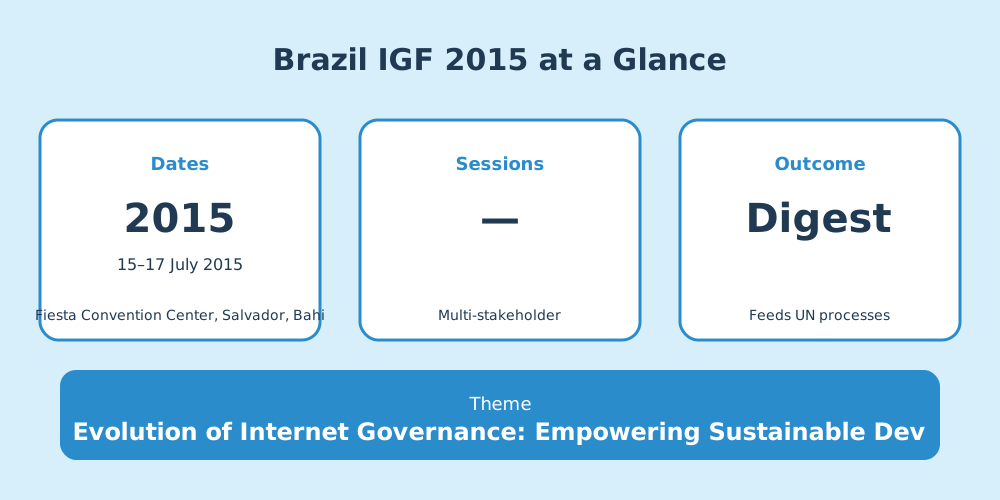
| Official name | 5th Brazilian Internet Forum (V Fórum da Internet no Brasil) |
| Dates | 15–17 July 2015 |
| Venue | Fiesta Convention Center, Salvador, Bahia, Brazil |
| Theme | Evolution of Internet Governance: Empowering Sustainable Development |
| Tracks | 4 |
| Host | Brazilian Internet Steering Committee (CGI.br) |
| Note | 20th anniversary of CGI.br (founded 1995) |
(See the source list at the end of this article.)
Discussion Digest — from the Session Records
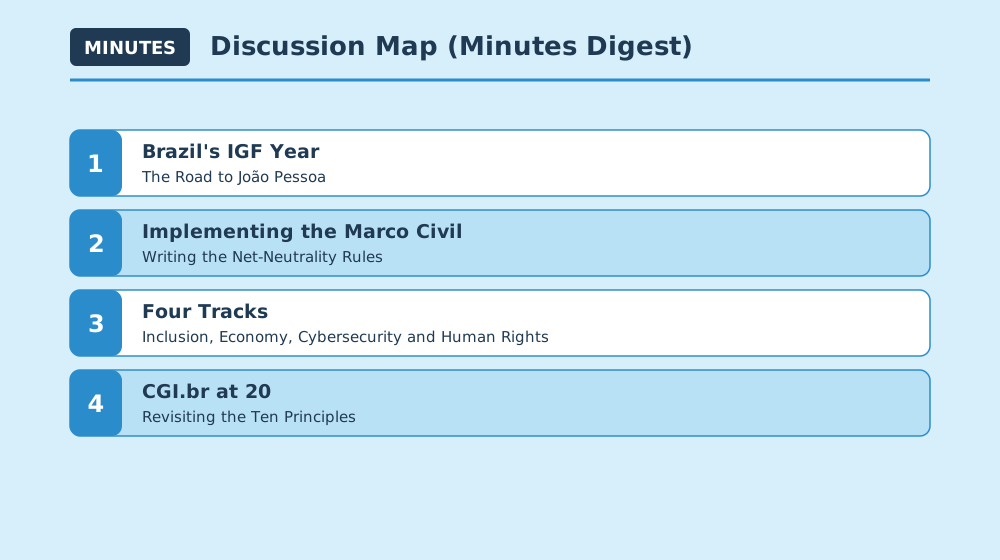
Key exchanges extracted from session records and transcripts.
1. Brazil's IGF Year — The Road to João Pessoa
Sessions: Opening session and others
"We are one of the few countries in the world that coordinates the allocation of IP numbers itself and treats these resources as community assets for the development of Brazil's internet"
— Carlos A. Afonso (CGI.br board member, Nupef Institute) [2][3][4]
- With the 10th UN IGF set for João Pessoa in November 2015, FIB 5 was explicitly framed as the national preparatory meeting [2][3][4]
- After NETmundial (2014) and the Marco Civil, momentum built to showcase Brazil's multistakeholder model at the global IGF [2][3][4]
- Executive Secretary Hartmut Glaser stressed the need for continuous dialogue with internet users [2][3][4]
2. Implementing the Marco Civil — Writing the Net-Neutrality Rules
Sessions: Early programme, including the 16 July debate on Marco Civil regulation and net neutrality
- A year after enactment, the Marco Civil's implementing decree was under public consultation, and the forum debated net-neutrality regulation head-on [1][3]
- How far to allow neutrality exceptions and how to detail data-handling rules were the questions that led to Decree 8,771 in 2016 [1][3]
3. Four Tracks — Inclusion, Economy, Cybersecurity and Human Rights
Sessions: Parallel tracks and the track-report plenary
- Four parallel tracks — challenges of digital inclusion, the internet economy, cybersecurity and trust, and the internet and human rights — reported back to a closing plenary [2][3]
- Ambassador Benedicto Fonseca (Foreign Ministry), Colonel Ricardo Camelo (Army Cyber Defence Centre) and SaferNet president and CGI.br councillor Thiago Tavares shared the stage across government, military and civil society [2][3]
- Sessions on physical infrastructure rounded out the free-of-charge programme, which drew hundreds from government, business, academia, civil society and student ranks [2][3]
4. CGI.br at 20 — Revisiting the Ten Principles
Sessions: Co-located 3rd conference on CGI.br's principles, themed on diversity
- Marking 20 years of CGI.br, the forum hosted the third in a series of conferences on the committee's 2009 ten principles, this one devoted to diversity [2][3]
- The diversity principle was re-examined through cultural, regional and gender lenses as part of turning principles into practice [2][3]
Three-Minute Short Talk — Your Questions Answered
Q. What made 2015 special for Brazil?
A. Brazil was about to host the 10th UN Internet Governance Forum in João Pessoa that November. FIB 5 served as the warm-up where the country refined its positions.
Q. What was debated?
A. Digital inclusion, the internet economy, cybersecurity and human rights — plus how to implement the year-old Marco Civil, especially the detailed rules for net neutrality.
Q. Why does it matter elsewhere?
A. It is the template for how an IGF host country mobilises national dialogue before the global meeting — the same pattern seen when Japan hosted the IGF in Kyoto in 2023.
What Is Brazil IGF? (for first-time readers)
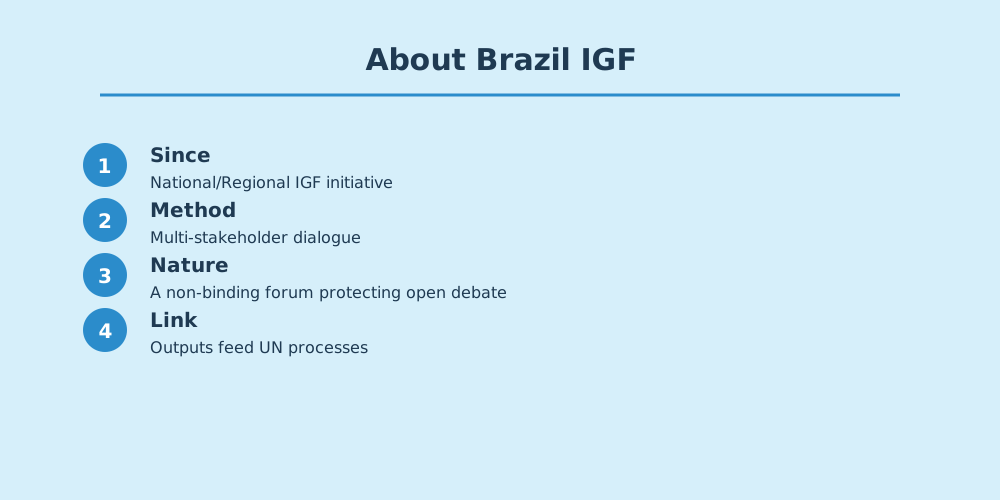
Brazil IGF is a National or Regional IGF Initiative (NRI), aligning local internet governance discussion with global IGF principles.
Why It Matters to You
What was discussed here becomes the baseline for national digital policy, platform rules and AI regulation worldwide within a few years. The principles confirmed at the 2015 meeting are the foundation of the "next rules" for the phones, social platforms and AI services you use every day.
Sources & References
- V Fórum da Internet no Brasil(公式サイト) — CGI.br(FIB公式サイト) (accessed 2026-07-11)
- Salvador recebe principal evento brasileiro de governança da Internet — CGI.br(プレスリリース) (accessed 2026-07-11)
- V Fórum da Internet inicia debates para o IGF 2015 — CGI.br(プレスリリース) (accessed 2026-07-11)
- [V Fórum da Internet no Brasil] Evolução da Governança da Internet: Empoderando o desenvolvimento sustentável — NIC.br(YouTube公式チャンネル) (accessed 2026-07-11)
- Edições — Fórum da Internet no Brasil — CGI.br(FIB公式サイト) (accessed 2026-07-11)
Quotes are translated or condensed from the records listed above. Bracketed numbers [n] refer to the source list.
Related links
- IGF official (NRI list): https://www.intgovforum.org/en/content/national-and-regional-igf-initiatives
- Japan IGF: https://japanigf.jp/
- Yuki Nakazawa's blog: https://nkzw.jp/category/igf/
Revision History
Rev. 1 — published 10 August 2015, 14:00 (Article published)
Rev. 2 — updated 16 July 2026, 20:09 (Fully revised into the in-depth edition: added the 3-line summary, minutes digest, short talk, source list and diagrams (all quotes verified against the listed sources))
— 中澤祐樹