


The 3-Line Summary
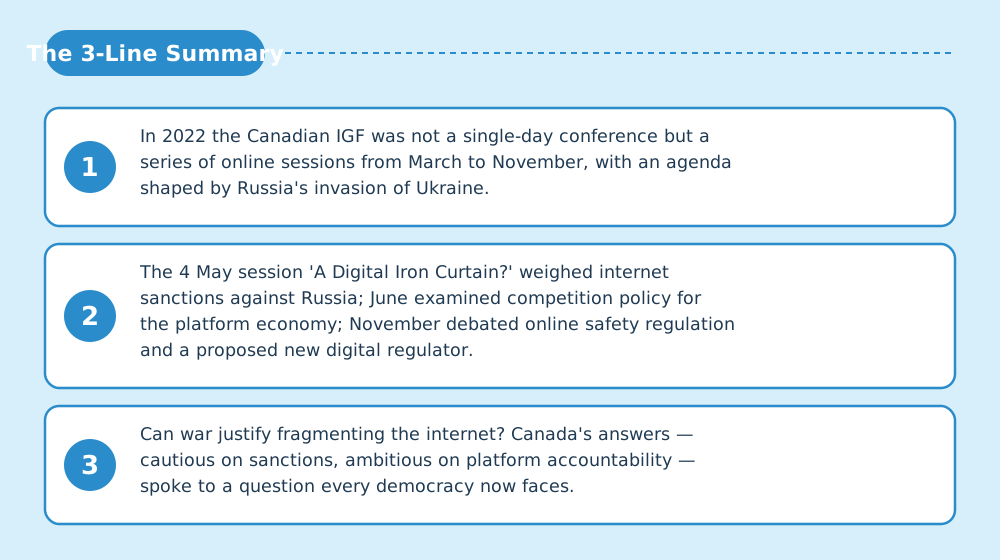
- In 2022 the Canadian IGF was not a single-day conference but a series of online sessions from March to November, with an agenda shaped by Russia's invasion of Ukraine.
- The 4 May session 'A Digital Iron Curtain?' weighed internet sanctions against Russia; June examined competition policy for the platform economy; November debated online safety regulation and a proposed new digital regulator.
- Can war justify fragmenting the internet? Canada's answers — cautious on sanctions, ambitious on platform accountability — spoke to a question every democracy now faces.
Welcome — this is the Japan IGF Support Organization. This in-depth report on Canadian Internet Governance Forum 2022 draws on official outputs, session records and on-site reporting. In a hurry? The three lines above and the diagrams carry the gist.
Conference at a Glance (from official records)
| Item | Detail |
|---|---|
| Official name | Canadian Internet Governance Forum 2022 |
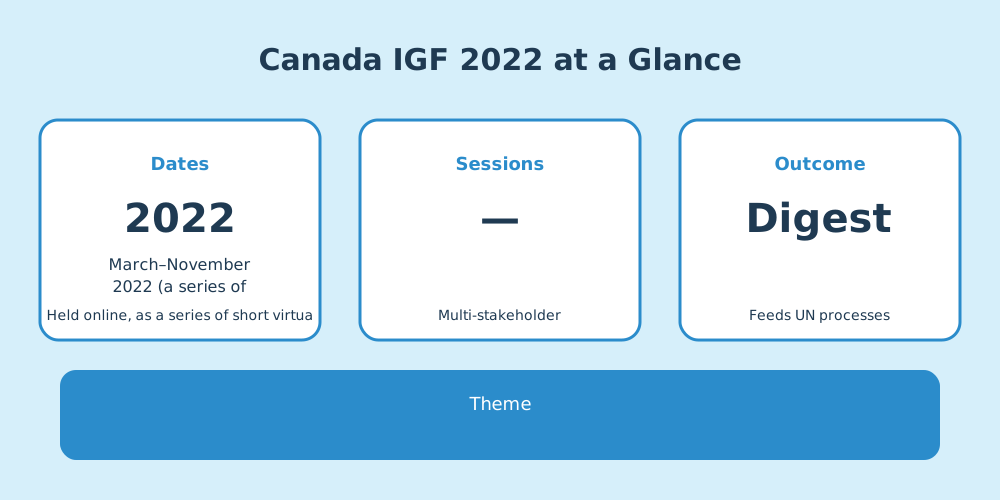
| Dates | March–November 2022 (a series of online sessions listed for March, May, June and November; the May session took place on 4 May) |
| Venue | Held online, as a series of short virtual events spread across the year |
| Theme | Regional governance themes |
| Host | CIGF steering committee, with secretariat support from CIRA |
(See the source list at the end of this article.)
Discussion Digest — from the Session Records
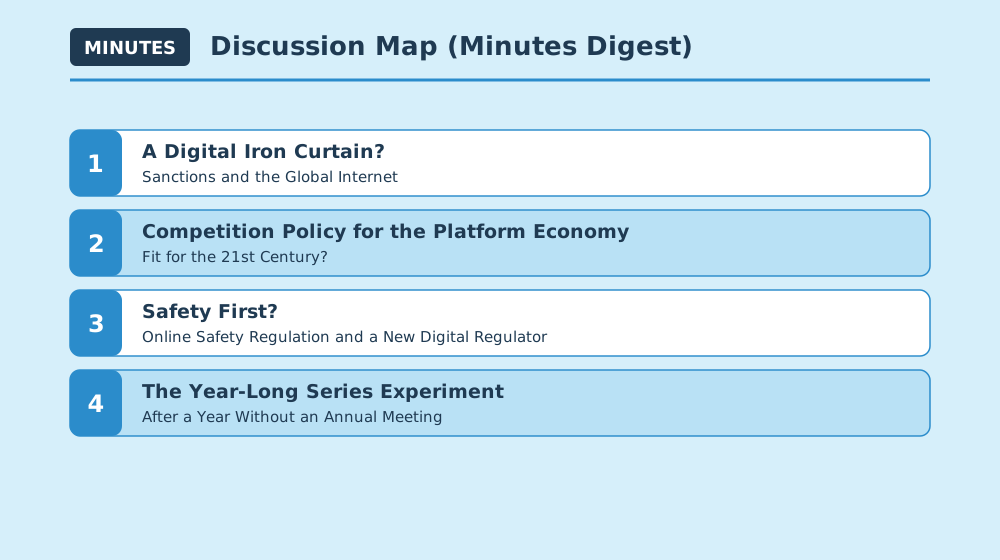
Key exchanges extracted from session records and transcripts.
1. A Digital Iron Curtain? — Sanctions and the Global Internet
Sessions: CIGF Talks 'A Digital Iron Curtain?: Sanctions and the Global Internet in Times of Conflict' (4 May 2022, online; Farzaneh Badii of Digital Medusa, Tim Denton of ISOC Canada, Dmitri Vitaliev of eQualitie, Job Snijders; moderated by Alyssa Quinn, CIRA)
- The session responded to Ukraine's formal requests that ICANN remove Russian ccTLDs and RIPE NCC suspend Russian IP addresses — internet-specific sanctions becoming a live policy question [1][5][6]
- Panellists concluded against disconnection: it would reinforce the narrative that the West is against Russia, cut dissidents off from outside information, and set a precedent for disconnecting other countries [1][5][6]
- The report records that when countries are unclear about sanctions impacting the internet, a vacuum is left for individual technology companies to decide — and weighed the merits and limits (effectiveness, mission creep) of the multistakeholder blocklist mechanism proposed in an open letter [1][5][6]
2. Competition Policy for the Platform Economy — Fit for the 21st Century?
Sessions: CIGF Talks 'A Canadian Competition Policy for the Platform Economy' (June 2022, online; Elisa Kearney of Davies, John Lawford of PIAC, Vass Bednar of McMaster, John Pecman; moderated by Alexandra Posadzki of the Globe and Mail)
- Three camps on Competition Act reform were mapped: status quo advocates favouring targeted revisions, neo-Brandeisians arguing Big Tech dominance stifles innovation, and proponents of the European model linking competition to broader social goals [2]
- Panellists distinguished privacy matters (the Tim Hortons app's location tracking) from competition issues (Amazon's use of third-party retailer data) [2]
- Reform, they argued, must reflect Canada's unique position as a federation and secondary market next to the US, with privacy and competition law reformed in coordination [2]
3. Safety First? — Online Safety Regulation and a New Digital Regulator
Sessions: CIGF Talks 'Safety First? Approaching Internet Regulation in Canada' (November 2022, online; Dr. Emily Laidlaw of the University of Calgary, moderated by Michael Lee-Murphy of The Wire Report)
- The session reported the two points of consensus from the government's Online Safety Expert Advisory Group, which Dr. Laidlaw co-chaired and which concluded in June 2022: a duty for companies to act responsibly, and a new regulator — not the CRTC [3]
- Obligations should be proportionate to risk; the report records that platform companies pose the most risk to Canadians online, while infrastructure intermediaries that do not host content should never be required to action content [3]
- Elon Musk's takeover of Twitter served as a case study in the crisis of institutional trust and the risks of platforms operating without legal oversight or mandate [3]
4. The Year-Long Series Experiment — After a Year Without an Annual Meeting
Sessions: The 2022 series as a whole (March, May, June and November sessions)
- After skipping the annual meeting in 2021 (holding only two CIGF Talks webinars), the CIGF adopted a new format for 2022: a series of short virtual events over the course of the year, as the official site explained [4][5]
- The stated aims were more continuous engagement with the community and flexibility suited to the work-from-home environment [4][5]
- The series format lasted one year; in 2023 the CIGF returned to a single-day annual meeting — its first hybrid event after three years online [4][5]
Three-Minute Short Talk — Your Questions Answered
Q. Where was the Canadian IGF 2022 held?
A. Nowhere in particular — CIGF 2022 was a series of online sessions in March, May, June and November, a one-year experiment suited to the work-from-home era.
Q. What was the biggest controversy?
A. Internet sanctions after Russia's invasion of Ukraine. Should Russia be cut off from the global internet? Panellists said no: ineffective, isolating for dissidents, and corrosive to the internet's core principles.
Q. Why should I care?
A. Platform competition, online safety regulation and wartime internet sanctions are the same questions every democracy has been grappling with since 2022 — Canada's session-by-session answers make a useful comparison.
What Is Canada IGF? (for first-time readers)
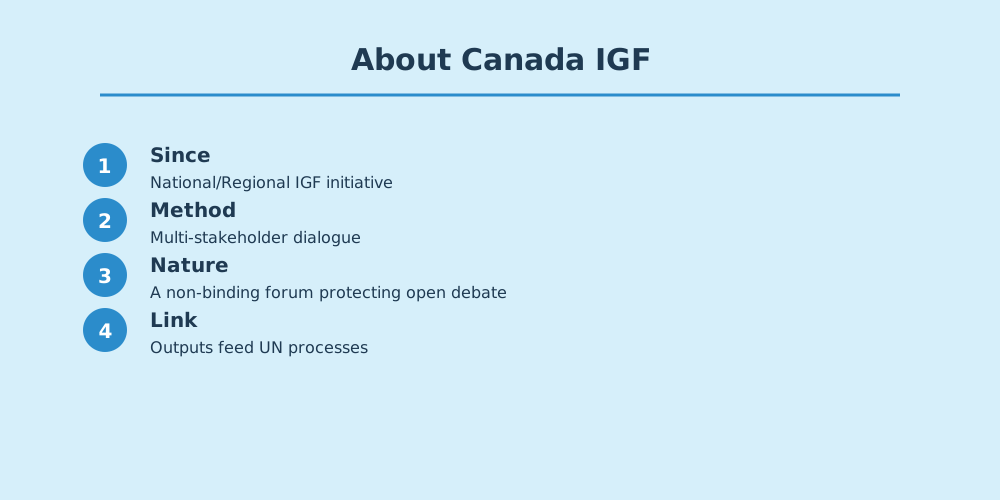
Canada IGF is a National or Regional IGF Initiative (NRI), aligning local internet governance discussion with global IGF principles.
Why It Matters to You
What was discussed here becomes the baseline for national digital policy, platform rules and AI regulation worldwide within a few years. The principles confirmed at the 2022 meeting are the foundation of the "next rules" for the phones, social platforms and AI services you use every day.
Sources & References
- A Digital Iron Curtain?: Sanctions and the Global Internet in Times of Conflict(2022年5月セッション報告) — Canadian IGF (accessed 2026-07-11)
- A Canadian Competition Policy for the Platform Economy(2022年6月セッション報告) — Canadian IGF (accessed 2026-07-11)
- Safety First? Approaching Internet Regulation in Canada(2022年11月セッション報告) — Canadian IGF (accessed 2026-07-11)
- Canadian IGF — Past Events(2022年4セッションの一覧) — Canadian IGF (accessed 2026-07-11)
- Canadian IGF ホームページ(2022年4月28日時点。連続バーチャル形式の告知) — カナダIGF(Internet Archive保存版) (accessed 2026-07-11)
- Canadian IGF Agenda(2022年5月14日時点。5月4日セッションの告知と登壇者) — カナダIGF(Internet Archive保存版) (accessed 2026-07-11)
Quotes are translated or condensed from the records listed above. Bracketed numbers [n] refer to the source list.
Related links
- IGF official (NRI list): https://www.intgovforum.org/en/content/national-and-regional-igf-initiatives
- Japan IGF: https://japanigf.jp/
- Yuki Nakazawa's blog: https://nkzw.jp/category/igf/
Revision History
Rev. 1 — published 5 October 2022, 14:00 (Article published)
Rev. 2 — updated 16 July 2026, 20:09 (Fully revised into the in-depth edition: added the 3-line summary, minutes digest, short talk, source list and diagrams (all quotes verified against the listed sources))
— 中澤祐樹

