


The 3-Line Summary
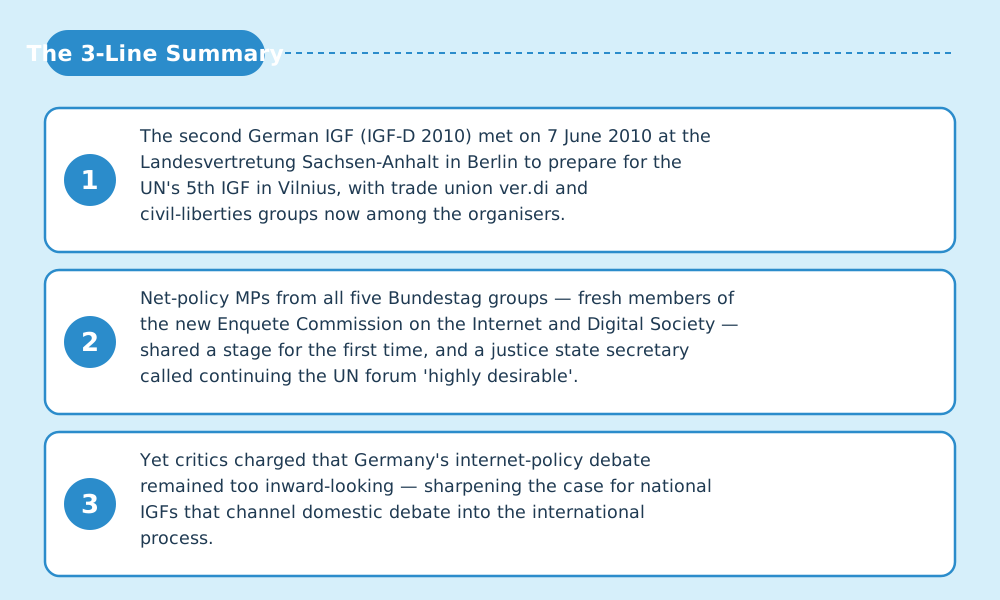
- The second German IGF (IGF-D 2010) met on 7 June 2010 at the Landesvertretung Sachsen-Anhalt in Berlin to prepare for the UN's 5th IGF in Vilnius, with trade union ver.di and civil-liberties groups now among the organisers.
- Net-policy MPs from all five Bundestag groups — fresh members of the new Enquete Commission on the Internet and Digital Society — shared a stage for the first time, and a justice state secretary called continuing the UN forum 'highly desirable'.
- Yet critics charged that Germany's internet-policy debate remained too inward-looking — sharpening the case for national IGFs that channel domestic debate into the international process.
Welcome — this is the Japan IGF Support Organization. This in-depth report on II. Internet Governance Forum Deutschland (IGF-D 2010) draws on official outputs, session records and on-site reporting. In a hurry? The three lines above and the diagrams carry the gist.
Conference at a Glance (from official records)
| Item | Detail |
|---|---|
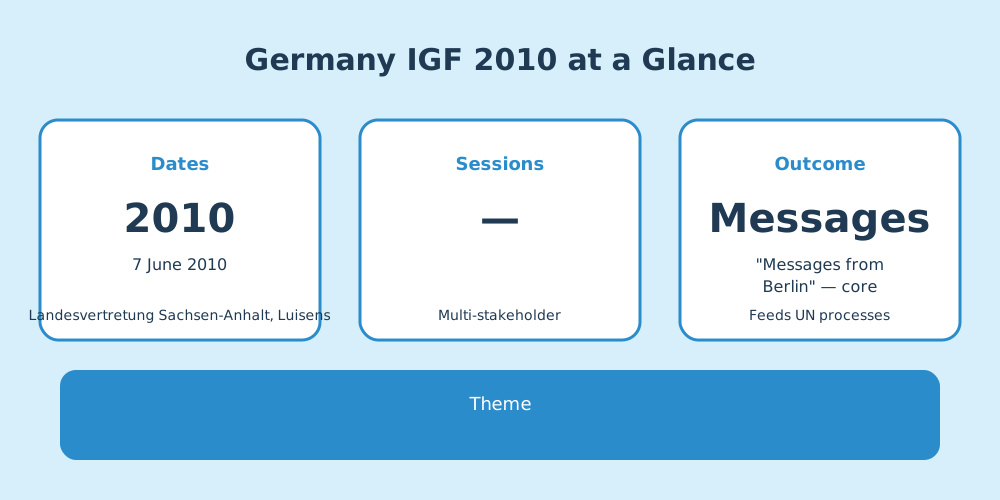
| Official name | II. Internet Governance Forum Deutschland (IGF-D 2010) |
| Dates | 7 June 2010 |
| Venue | Landesvertretung Sachsen-Anhalt, Luisenstraße 18, Berlin |
| Theme | Regional governance themes |
| Purpose | German preparatory summit for the 5th UN IGF in Vilnius, Lithuania (September 2010) |
| Host | eco, DGVN (German UN Association), Humanistische Union, ISOC.DE and the service-sector union ver.di |
| Outcome | "Messages from Berlin" — core statements contributed to the Vilnius IGF discussions |
(See the source list at the end of this article.)
Discussion Digest — from the Session Records
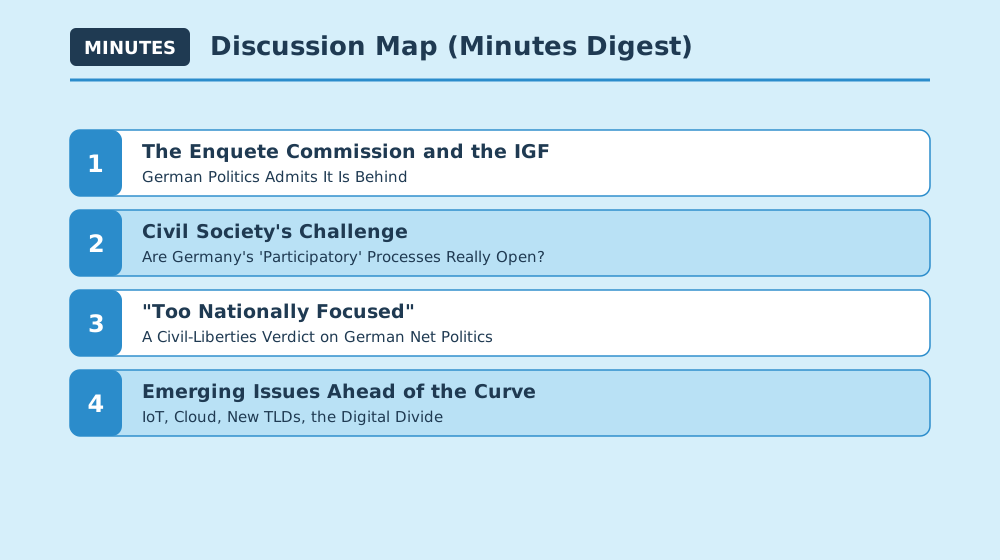
Key exchanges extracted from session records and transcripts.
1. The Enquete Commission and the IGF — German Politics Admits It Is Behind
Sessions: Party panel "From Berlin to Vilnius" (15:00–16:30, moderated by Stefan Krempl)
"(Continuing the UN forum is) highly desirable from the federal government's perspective"
— Max Stadler (Parliamentary State Secretary, Federal Ministry of Justice) [3][1]
"From forms of communication to social life and opinion-forming, much of what has developed on the internet must be absorbed into our existing system"
— Manuel Höferlin (Member of the Bundestag, FDP) [3][1]
- MPs from all five Bundestag groups on the brand-new Enquete Commission 'Internet and Digital Society' took the stage; the CDU's Thomas Jarzombek conceded there had been no cross-party internet strategy, and host minister Angela Kolb said German politics had so far 'failed' on the internet [3][1]
- Ironically, it emerged that no MP would attend the Vilnius IGF in September because it clashed with budget deliberations — the previous year Germany had sent a single economics-ministry official [3][1]
- Herbert Behrens (Left Party) proposed 'informational self-determination' as Germany's export item for the IGF [3][1]
2. Civil Society's Challenge — Are Germany's 'Participatory' Processes Really Open?
Sessions: Civil-society stakeholder session (11:30–12:45, moderated by Annette Mühlberg) and ensuing debate
- The multistakeholder format was played out domestically: netzpolitik.org founder Markus Beckedahl (digital natives), Google's Max Senges (business), DE-CIX's Harald Summa (technical community) and Sven Lüders of the Humanistische Union (civil rights) spoke for their constituencies [1][3][5]
- Beckedahl skewered the proliferation of official 'participation' formats — Enquete Commission, ministerial dialogue circles, the national IT Summit — as not genuinely open, saying civil society could scrap the IT Summit outright [1][3][5]
- Federal Data Protection Commissioner Peter Schaar lectured, and the freedom-and-security panel added Hamburg's justice senator and Christian Rickerts of Reporters Without Borders [1][3][5]
3. "Too Nationally Focused" — A Civil-Liberties Verdict on German Net Politics
Sessions: Overall assessment in the Humanistische Union's participant report
- In his report for the co-organising Humanistische Union, Sven Lüders noted participants' calls for 'international regulatory approaches, media-appropriate laws and digital participation' — while politicians showed 'good intentions, but without concrete design proposals' [4]
- His verdict that 'network policy discourse in Germany remains very nationally focused' was underlined by the fact that no federal politician would travel to Vilnius [4]
- With union ver.di among the organisers, the 2010 edition consolidated a coalition spanning industry, civil rights and labour [4]
4. Emerging Issues Ahead of the Curve — IoT, Cloud, New TLDs, the Digital Divide
Sessions: "The Future of the Internet: Emerging Issues" (16:45–18:00, introduced and moderated by Prof. Wolfgang Kleinwächter)
- The closing session debated the 2010 frontier: the Internet of Things, cloud computing, new top-level domains, rights and principles, the digital divide, lifelong media literacy, copyright and state databases [1][2]
- IGF Executive Coordinator Markus Kummer joined by video message, cementing the loop between the national meeting and the UN process in only its second edition [1][2]
- A report from the multistakeholder experiment 'Internet & Gesellschaft Collaboratory' pointed to permanent dialogue structures beyond annual meetings [1][2]
Three-Minute Short Talk — Your Questions Answered
Q. What did the meeting decide?
A. Nothing formally — it was Germany's rehearsal for the UN IGF in Vilnius, aligning government, business, civil society and unions. The results travelled to the UN as the 'Messages from Berlin'.
Q. What was the most telling moment?
A. MPs from all five Bundestag groups shared a stage for the first time — and then admitted none of them could attend Vilnius because of budget season. Germany's weak international engagement was laid bare.
Q. Why does it matter today?
A. This edition shows the national-IGF model maturing: unions and civil-liberties groups joined as organisers, a template later adopted by national IGFs worldwide, including Japan's.
What Is Germany IGF? (for first-time readers)
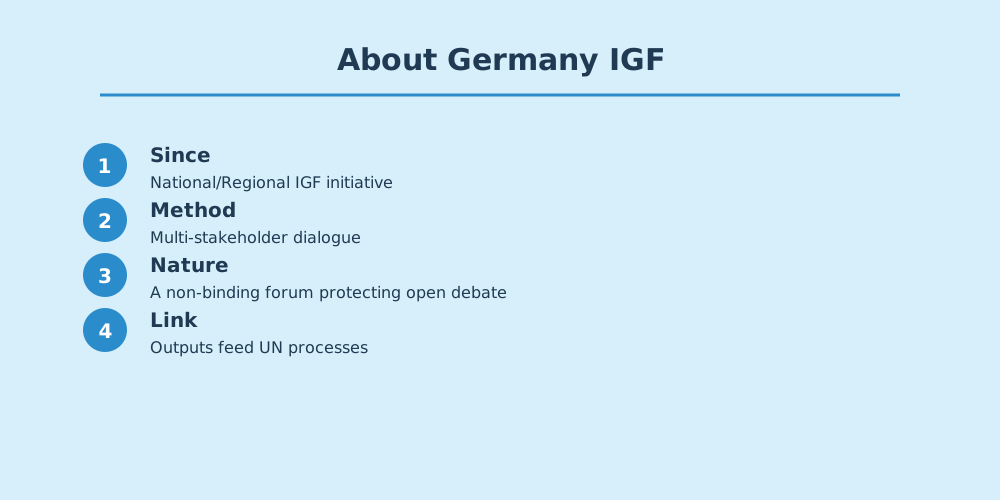
Germany IGF is a National or Regional IGF Initiative (NRI), aligning local internet governance discussion with global IGF principles.
Why It Matters to You
What was discussed here becomes the baseline for national digital policy, platform rules and AI regulation worldwide within a few years. The principles confirmed at the 2010 meeting are the foundation of the "next rules" for the phones, social platforms and AI services you use every day.
Sources & References
- Programm 2010 — Deutscher Vorbereitungsgipfel für das 5. Internet Governance Forum der Vereinten Nationen 2010 in Vilnius — IGF-D(旧公式サイト igf-d.de、Wayback Machine保存) (accessed 2026-07-11)
- IGF-D 2010 — II. Internet Governance Forum Deutschland(公式Historieページ、主催団体一覧) — IGF-D e.V.(2020年版公式サイト、Wayback Machine保存) (accessed 2026-07-11)
- Deutsche Politiker wollen Anschluss zum Internet Governance Forum halten(Monika Ermert, 2010-06-08) — heise online (accessed 2026-07-11)
- Internet Governance Forum Deutschland: Netzpolitik jenseits der Grenzen(Sven Lüders, Mitteilungen Nr. 208/209, 2010年7月) — Humanistische Union(人道主義同盟) (accessed 2026-07-11)
- Berichte vom Internet Governance Forum Deutschland(Markus Beckedahl, 2010-06-08) — netzpolitik.org (accessed 2026-07-11)
Quotes are translated or condensed from the records listed above. Bracketed numbers [n] refer to the source list.
Related links
- IGF official (NRI list): https://www.intgovforum.org/en/content/national-and-regional-igf-initiatives
- Japan IGF: https://japanigf.jp/
- Yuki Nakazawa's blog: https://nkzw.jp/category/igf/
Revision History
Rev. 1 — published 12 June 2010, 13:00 (Article published)
Rev. 2 — updated 16 July 2026, 20:09 (Fully revised into the in-depth edition: added the 3-line summary, minutes digest, short talk, source list and diagrams (all quotes verified against the listed sources))
— 中澤祐樹

