


The 3-Line Summary
- The sixth German IGF (IGF-D 2014) met on 11 June 2014 at Berlin's Factory start-up campus, opening an 'internet governance week' that continued with EuroDIG in the same city.
- In the first full edition after the Snowden disclosures, the UN-affiliated academic network GigaNet ran a session on state surveillance, and a panel dissected the outcome of Brazil's NETmundial conference.
- State Secretary Stefan Kapferer presented the government's Digital Agenda, and members of the Bundestag's new Digital Agenda committee took the stage — a snapshot of surveillance politics meeting governance reform.
Welcome — this is the Japan IGF Support Organization. This in-depth report on VI. Internet Governance Forum Deutschland (IGF-D 2014) draws on official outputs, session records and on-site reporting. In a hurry? The three lines above and the diagrams carry the gist.
📍 Held during the opening week of the Factory start-up campus; EuroDIG 2014 followed in Berlin on 12–13 June, with international speakers attending both
Conference at a Glance (from official records)
| Item | Detail |
|---|---|
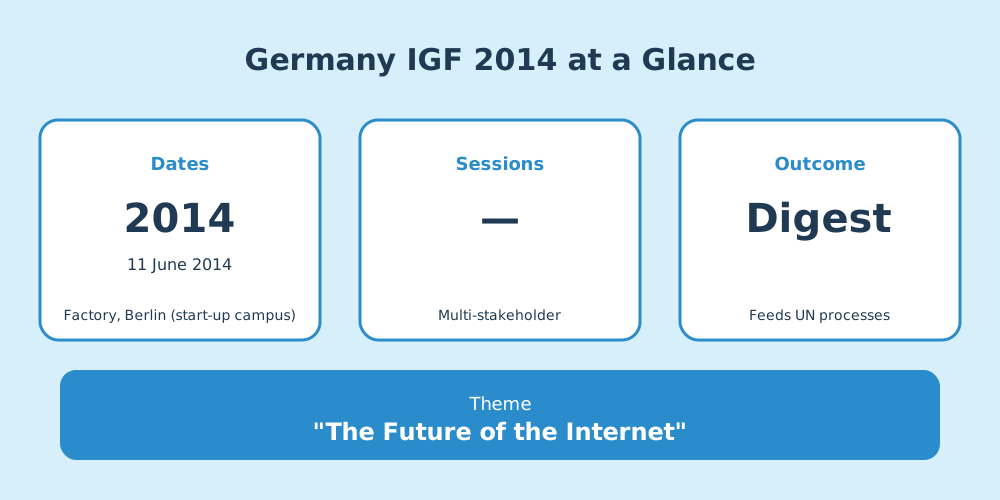
| Official name | VI. Internet Governance Forum Deutschland (IGF-D 2014) |
| Dates | 11 June 2014 |
| Venue | Factory, Berlin (start-up campus) |
| Theme | "The Future of the Internet" |
| Purpose | Germany's national meeting in the year of the 9th UN IGF in Istanbul, connecting the post-NETmundial governance debate to Germany |
(See the source list at the end of this article.)
Discussion Digest — from the Session Records
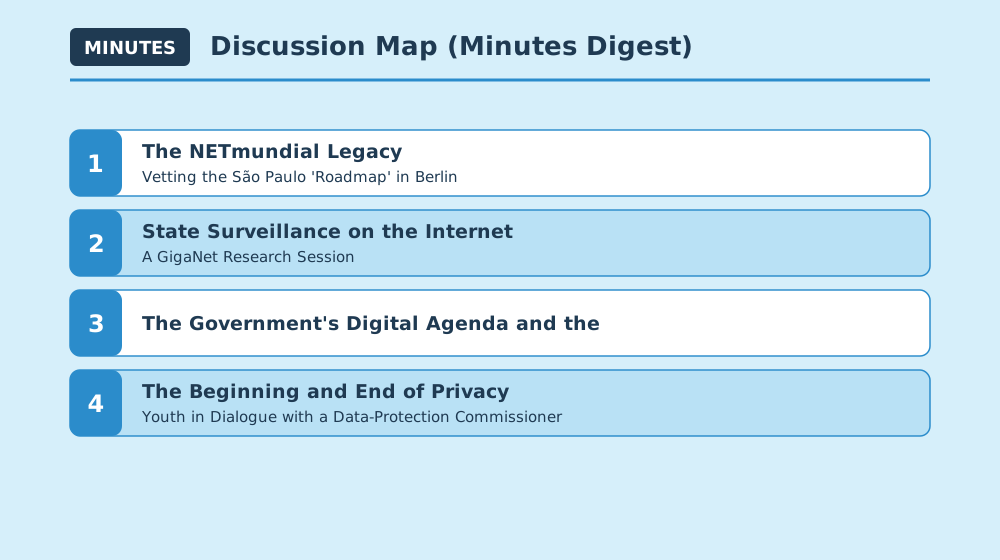
Key exchanges extracted from session records and transcripts.
1. The NETmundial Legacy — Vetting the São Paulo 'Roadmap' in Berlin
Sessions: Panel "The Brazilian Roadmap on the Future of the Internet" (12:00–13:00)
- The outcome of April 2014's NETmundial conference — convened by Brazil's President Rousseff and ICANN after the Snowden disclosures — was vetted by insiders, including WZB professor Jeanette Hofmann, civil-society co-chair at NETmundial [1][2]
- Ambassador Dirk Brengelmann (foreign office cyber envoy), ICANN VP Europe Jean-Jacques Sahel, the economics ministry's GAC representative Hubert Schöttner and eco chairman Michael Rotert debated governance reform caught between multilateralism and multistakeholderism [1][2]
- Coming weeks after the US announced it would relinquish IANA stewardship (March 2014), the panel put the post-US-primacy internet on a national IGF agenda for the first time [1][2]
2. State Surveillance on the Internet — A GigaNet Research Session
Sessions: "State Surveillance on the Internet" (13:45–15:15, hosted by GigaNet, moderated by Prof. Rolf Weber)
- GigaNet, the UN IGF's academic network, plugged directly into the national IGF — chair Milton Mueller (Syracuse University) and IETF researcher Avri Doria presented two research papers [1][2]
- The papers tackled the cutting edge of 2014: the IETF's post-Snowden drive to 'harden' internet standards through encryption, and DPI surveillance programmes run by ISPs in cooperation with national security agencies [1][2]
- SWP's Annegret Bendiek (also advising the foreign office's policy staff) and GigaNet's John Laprise joined the discussion; surveillance then dominated EuroDIG the next day [1][2]
3. The Government's Digital Agenda and the Bundestag's New Committee
Sessions: Opening speech by State Secretary Stefan Kapferer (10:10) and panel "A Different Digital Agenda?" (15:30–17:00)
- State Secretary Kapferer presented the federal Digital Agenda then in preparation (adopted August 2014), putting industrial net policy at the top of the day [1][2]
- The closing panel brought three members of the Bundestag's Digital Agenda committee, created in February 2014 — von Notz (Greens), Wawzyniak (Left) and Jarzombek (CDU/CSU) — to debate the committee's powers and role [1][2]
- According to a participant report, MPs candidly admitted they could not use encrypted email in parliament, and that only NSA-inquiry rapporteurs had been issued SecuSmart crypto phones [1][2]
4. The Beginning and End of Privacy — Youth in Dialogue with a Data-Protection Commissioner
Sessions: "The Beginning and End of Privacy" (10:30–11:30, Hamburg data-protection commissioner Prof. Johannes Caspar with youth representatives)
- Prof. Johannes Caspar — Hamburg's data-protection commissioner, known for enforcement against Facebook — debated on equal terms with youth representatives: deputy Juso chair Johannes Gorges, UN youth delegate Celina Greppler and graduate student Laura Montag [1][2]
- Per a participant report, Greppler reframed the media-literacy question: digitalisation affects every generation, so it is the older generations at risk of being left behind who need support, not the digital natives [1][2]
- Reporters Without Borders delivered an opening address, threading press-freedom concerns through the day [1][2]
Three-Minute Short Talk — Your Questions Answered
Q. What kind of meeting was this?
A. Germany's sixth national IGF, hosted at Berlin's Factory start-up campus on the eve of EuroDIG in the same city — day one of an internet-governance week that drew international researchers and officials to both.
Q. What was the main issue?
A. State surveillance after Snowden. The UN IGF's academic network GigaNet presented research on the IETF's encryption drive and on DPI surveillance programmes run jointly by ISPs and security agencies.
Q. Why does it matter?
A. The governance reforms debated here — NETmundial's roadmap, the IANA transition — went on to define how the global internet is run today.
What Is Germany IGF? (for first-time readers)
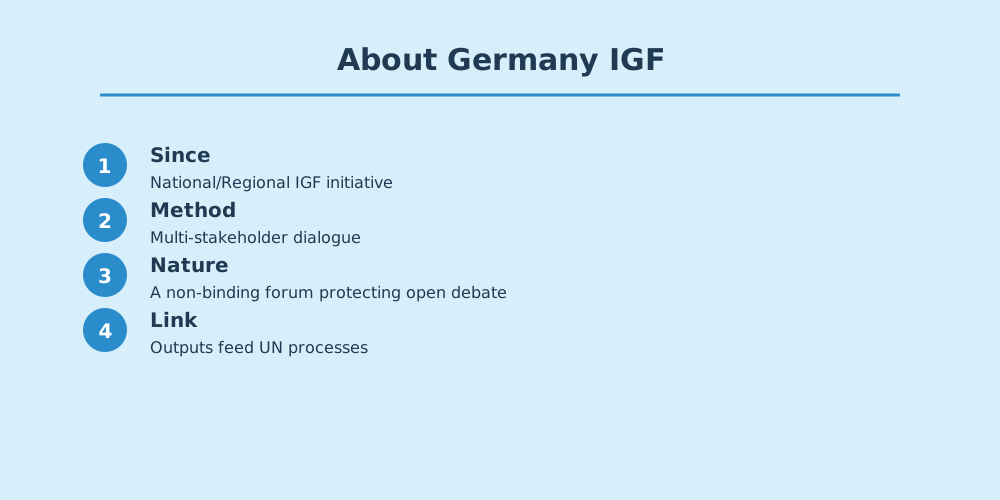
Germany IGF is a National or Regional IGF Initiative (NRI), aligning local internet governance discussion with global IGF principles.
Why It Matters to You
What was discussed here becomes the baseline for national digital policy, platform rules and AI regulation worldwide within a few years. The principles confirmed at the 2014 meeting are the foundation of the "next rules" for the phones, social platforms and AI services you use every day.
Sources & References
- IGF-D 2014 — VI. Internet Governance Forum Deutschland(公式Historieページ、全アジェンダ) — IGF-D e.V.(2020年版公式サイト、Wayback Machine保存) (accessed 2026-07-11)
- Internet Governance in Deutschland und Europa(Oliver Weyhmüller, 2014-06-15、IGF-D 2014とEuroDIG 2014の参加報告) — weyhmueller.de(個人ブログ、Wayback Machine保存) (accessed 2026-07-11)
- EuroDIG 2014(2014年6月12〜13日ベルリン開催の公式記録) — EuroDIG Wiki (accessed 2026-07-11)
- Internet Governance Forum Deutschland(IGF-D設立経緯・Messages from Berlinの仕組み) — DiploFoundation (accessed 2026-07-11)
Quotes are translated or condensed from the records listed above. Bracketed numbers [n] refer to the source list.
Related links
- IGF official (NRI list): https://www.intgovforum.org/en/content/national-and-regional-igf-initiatives
- Japan IGF: https://japanigf.jp/
- Yuki Nakazawa's blog: https://nkzw.jp/category/igf/
Revision History
Rev. 1 — published 7 June 2014, 10:00 (Article published)
Rev. 2 — updated 16 July 2026, 20:09 (Fully revised into the in-depth edition: added the 3-line summary, minutes digest, short talk, source list and diagrams (all quotes verified against the listed sources))
— 中澤祐樹

