

The 3-Line Summary
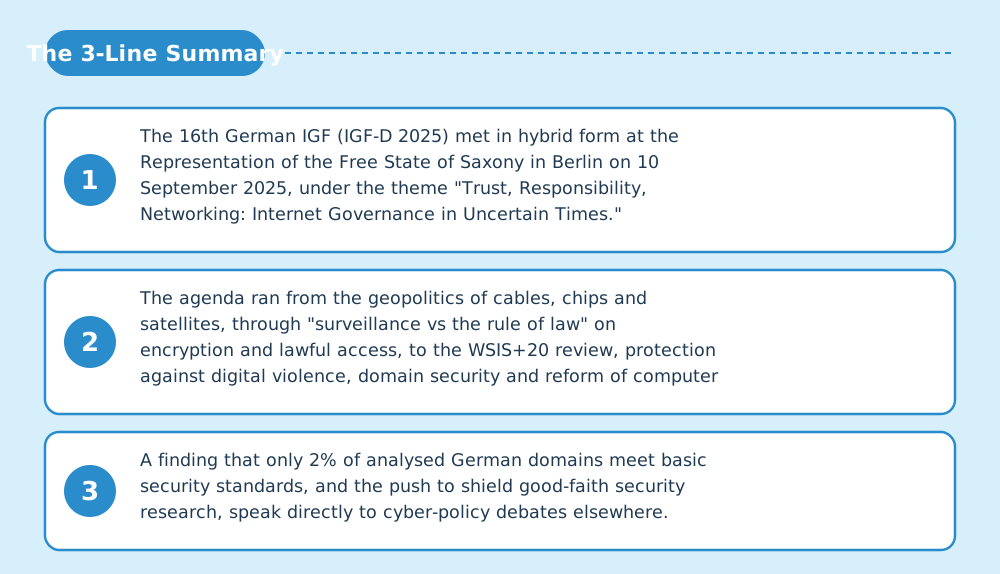
- The 16th German IGF (IGF-D 2025) met in hybrid form at the Representation of the Free State of Saxony in Berlin on 10 September 2025, under the theme "Trust, Responsibility, Networking: Internet Governance in Uncertain Times."
- The agenda ran from the geopolitics of cables, chips and satellites, through "surveillance vs the rule of law" on encryption and lawful access, to the WSIS+20 review, protection against digital violence, domain security and reform of computer criminal law.
- A finding that only 2% of analysed German domains meet basic security standards, and the push to shield good-faith security research, speak directly to cyber-policy debates elsewhere.
Welcome — this is the Japan IGF Support Organization. This in-depth report on IGF-D 2025 (16th German Internet Governance Forum / XVI. Internet Governance Forum Deutschland) draws on official outputs, session records and on-site reporting. In a hurry? The three lines above and the diagrams carry the gist.
Conference at a Glance (from official records)
| Item | Detail |
|---|---|
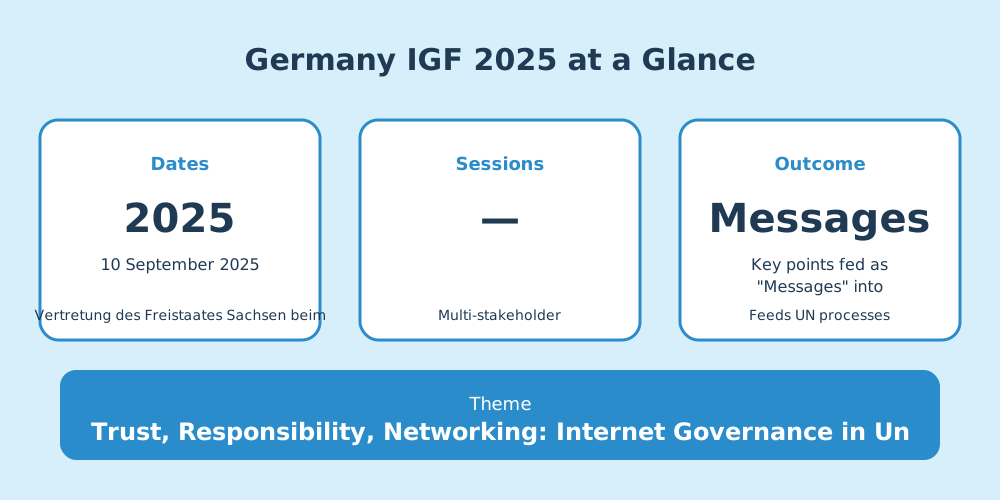
| Official name | IGF-D 2025 (16th German Internet Governance Forum / XVI. Internet Governance Forum Deutschland) |
| Dates | 10 September 2025 |
| Venue | Vertretung des Freistaates Sachsen beim Bund (Representation of the Free State of Saxony), Brüderstraße 11/12, Berlin, with online participation (hybrid) |
| Theme | Trust, Responsibility, Networking: Internet Governance in Uncertain Times (Vertrauen, Verantwortung, Vernetzung) |
| Host | IGF-D e.V.; secretariat run by DENIC eG since late 2022 |
| Outcome | Key points fed as "Messages" into the UN IGF process during the WSIS+20 review period |
(See the source list at the end of this article.)
Discussion Digest — from the Session Records
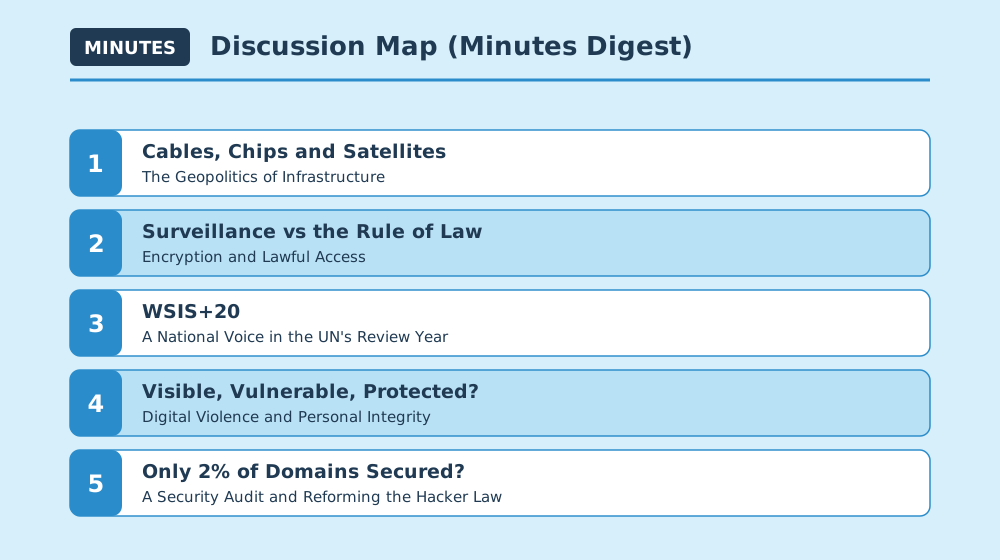
Key exchanges extracted from session records and transcripts.
1. Cables, Chips and Satellites — The Geopolitics of Infrastructure
Sessions: Session "Kabel, Chips und Satelliten: Welche Infrastruktur brauchen wir?" (09:45–10:45) with Klaus Landefeld (eco), Aline Blankertz (Rebalance Now e.V.) and Dr. Katja Muñoz (DGAP)
- From fibre and submarine cables to chips and satellite constellations, the panel examined what digital infrastructure Germany and Europe need — and its geopolitical dimension [1][3]
- Industry (eco), civil society (Rebalance Now) and the foreign-policy community (DGAP) converged on European strategic sovereignty as the underlying theme [1][3]
2. Surveillance vs the Rule of Law — Encryption and Lawful Access
Sessions: Session "Überwachung vs. Rechtsstaat?" (11:00–12:15) with Dr. Alexander Klimburg (The Hague Centre for Strategic Studies) and panellists including Dirk Kunze (LKA NRW cybercrime)
- The panel weighed renewed EU proposals for law-enforcement access to encrypted communications against the principles of the rule of law [1]
- An international-security scholar and a state criminal police cybercrime practitioner shared the stage, exposing the tension between principle and investigative practice [1]
3. WSIS+20 — A National Voice in the UN's Review Year
Sessions: Government segments: remarks by Parliamentary State Secretary Thomas Jarzombek (BMDS, 12:15–12:30) and a WSIS+20 update by Swantje Jäger-Lindemann (BMDS, 13:15–13:45)
- State Secretary Jarzombek presented the legislative priorities of the new Federal Ministry for Digital Affairs and State Modernisation (BMDS), and ministry officials briefed the forum on the WSIS+20 review — including the renewal of the IGF's mandate — heading to its endgame at the UN in late 2025 [1]
- Feeding the German multistakeholder community's input into that UN process was framed as the year's central purpose under the "uncertain times" theme [1]
4. Visible, Vulnerable, Protected? — Digital Violence and Personal Integrity
Sessions: Session "Sichtbar. Verwundbar. Geschützt?" (13:45–15:00) with Kathrin Morasch (Baden-Württemberg media authority) and Michael Terhörst (KidD)
- The session asked how to protect personal dignity and integrity against digital violence — hate, stalking, image abuse [1]
- A state media regulator and a child-protection body outlined a layered approach combining regulation, enforcement, education and support [1]
5. Only 2% of Domains Secured? — A Security Audit and Reforming the Hacker Law
Sessions: Presentation on domain security (15:15–15:35, Daniel Strauß) and panel on computer criminal law (15:35–16:30) with MdB Jeanne Dillschneider and Florian Hantke (CISPA)
- Daniel Strauß presented audit findings that only 2% of the analysed German domains fulfil basic security standards [1]
- The closing panel debated reforming computer criminal law to shield good-faith security research (ethical hacking) from prosecution risk, with MP Jeanne Dillschneider and CISPA researcher Florian Hantke [1]
Three-Minute Short Talk — Your Questions Answered
Q. What was discussed?
A. Under "Trust, Responsibility, Networking": the geopolitics of cables and chips, encryption vs lawful access, the UN's WSIS+20 review, protection from digital violence — and an audit showing only 2% of German domains meet basic security standards.
Q. The most striking number?
A. That 2% figure. It laid bare how rarely basics like DNSSEC and mail authentication are actually deployed.
Q. Why should I care?
A. Low adoption of domain-security basics is a universal problem, and Germany's push to protect ethical hackers from prosecution is a live question in most legal systems.
What Is Germany IGF? (for first-time readers)
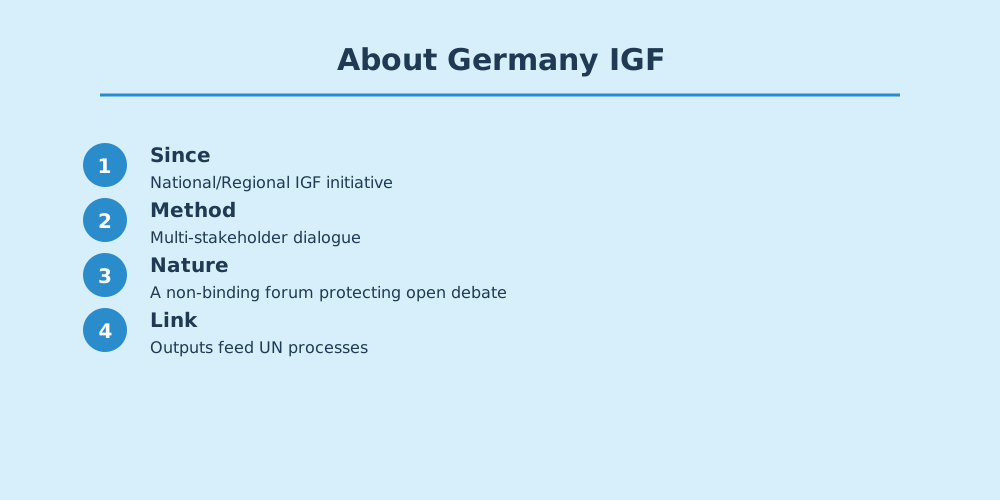
Germany IGF is a National or Regional IGF Initiative (NRI), aligning local internet governance discussion with global IGF principles.
Why It Matters to You
What was discussed here becomes the baseline for national digital policy, platform rules and AI regulation worldwide within a few years. The principles confirmed at the 2025 meeting are the foundation of the "next rules" for the phones, social platforms and AI services you use every day.
Sources & References
- IGF-D 2025 – XVI. Internet Governance Forum Deutschland(公式プログラム) — IGF-D (accessed 2026-07-11)
- Berlin – Das 16. Internet Governance Forum Deutschland 2025 findet am 10. September 2025 statt — domain-recht.de (accessed 2026-07-11)
- IGF-D 2025 kicks off — DENIC eG(公式ブログ) (accessed 2026-07-11)
- IGF-D(公式サイト・イベント一覧と報告書) — IGF-D (accessed 2026-07-11)
Quotes are translated or condensed from the records listed above. Bracketed numbers [n] refer to the source list.
Related links
- IGF official (NRI list): https://www.intgovforum.org/en/content/national-and-regional-igf-initiatives
- Japan IGF: https://japanigf.jp/
- Yuki Nakazawa's blog: https://nkzw.jp/category/igf/
Revision History
Rev. 1 — published 11 June 2025, 10:00 (Article published)
Rev. 2 — updated 16 July 2026, 20:09 (Fully revised into the in-depth edition: added the 3-line summary, minutes digest, short talk, source list and diagrams (all quotes verified against the listed sources))
— 中澤祐樹