


The 3-Line Summary
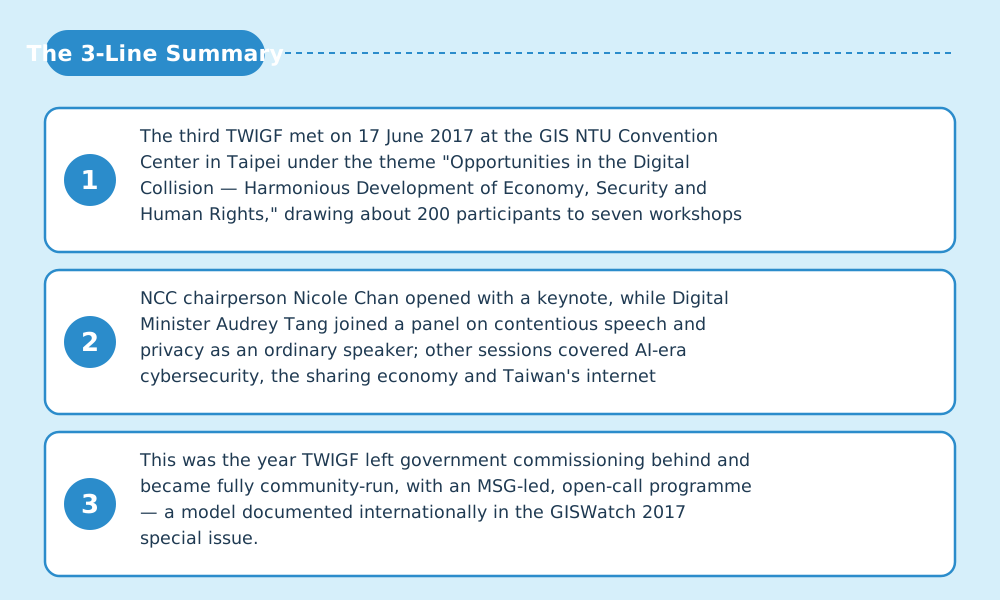
- The third TWIGF met on 17 June 2017 at the GIS NTU Convention Center in Taipei under the theme "Opportunities in the Digital Collision — Harmonious Development of Economy, Security and Human Rights," drawing about 200 participants to seven workshops chosen from 11 open-call proposals.
- NCC chairperson Nicole Chan opened with a keynote, while Digital Minister Audrey Tang joined a panel on contentious speech and privacy as an ordinary speaker; other sessions covered AI-era cybersecurity, the sharing economy and Taiwan's internet exchange environment.
- This was the year TWIGF left government commissioning behind and became fully community-run, with an MSG-led, open-call programme — a model documented internationally in the GISWatch 2017 special issue.
Welcome — this is the Japan IGF Support Organization. This in-depth report on Taiwan Internet Governance Forum 2017 (TWIGF 2017) draws on official outputs, session records and on-site reporting. In a hurry? The three lines above and the diagrams carry the gist.
Conference at a Glance (from official records)
| Item | Detail |
|---|---|
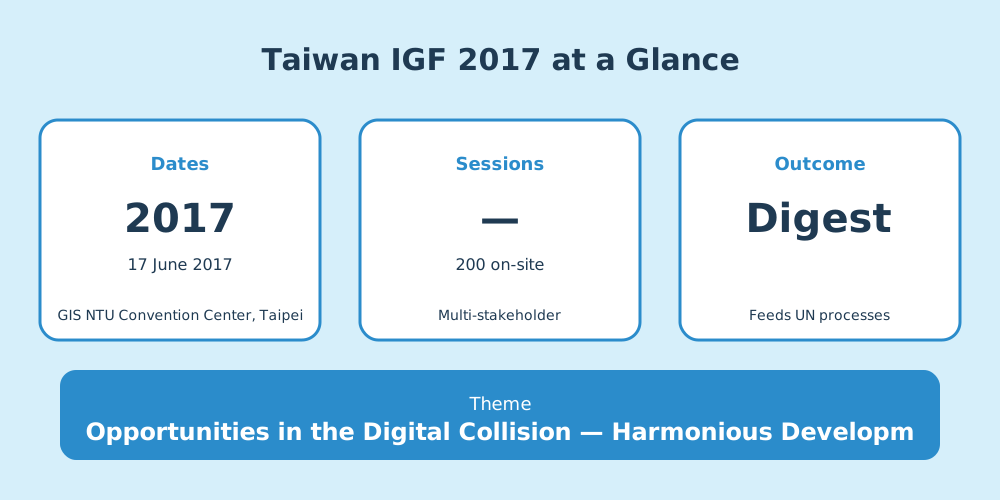
| Official name | Taiwan Internet Governance Forum 2017 (TWIGF 2017) |
| Edition | 3rd edition |
| Dates | 17 June 2017 |
| Venue | GIS NTU Convention Center, Taipei |
| Theme | Opportunities in the Digital Collision — Harmonious Development of Economy, Security and Human Rights |
| Participants | 200 |
| Workshops | 7 |
| Host | NII Enterprise Promotion Association (NIIEPA) with the multistakeholder steering group (MSG) — fully community-run from this year |
(See the source list at the end of this article.)
Discussion Digest — from the Session Records
Key exchanges extracted from session records and transcripts.
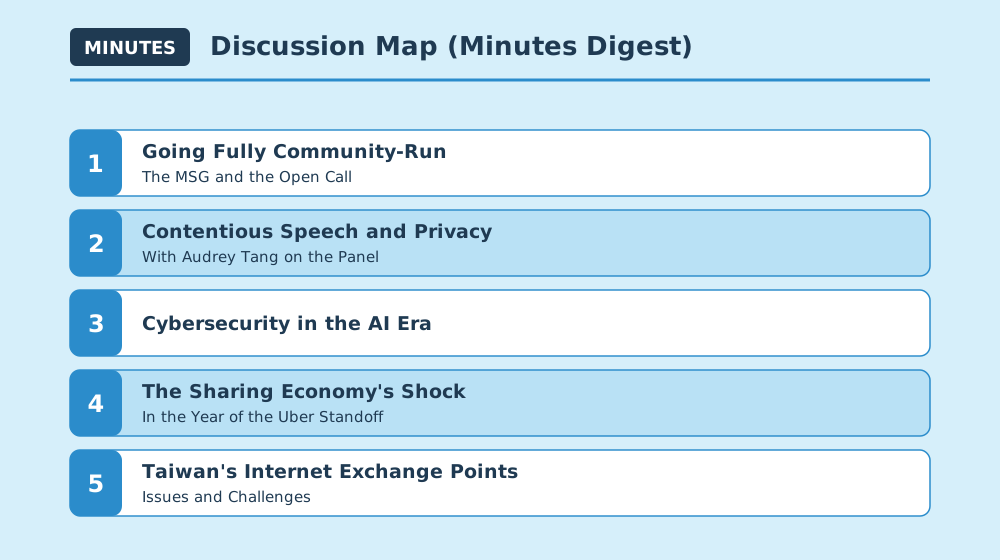
1. Going Fully Community-Run — The MSG and the Open Call
Sessions: Overall forum (organisation)
- TWIGF's official history records that from 2017 the forum became an entirely private, voluntary organisation — the year's biggest structural change [2][5]
- The MSG formed in December 2016 after APrIGF Taipei — 15 members spanning the technical community, business, civil society, government and academia — selected seven workshops from 11 open-call proposals [2][5]
- Per the GISWatch report, funding came from corporate donors including LINE, Chunghwa Telecom and Chief Telecom; of roughly 200 participants, 61% came from business, 15% from government and 14% from academia [2][5]
2. Contentious Speech and Privacy — With Audrey Tang on the Panel
Sessions: Socrates Hall: Controversial speech mitigation; privacy and personal data protection (11:00–12:30)
- Moderated by Kuo-Wei Wu, the panel included Digital Minister Audrey Tang and Lee and Li attorney Ken-Ying Tseng [1]
- The session weighed responses to harmful speech against privacy and data protection — with a cabinet-level minister debating as just another panellist, embodying the multistakeholder format [1]
3. Cybersecurity in the AI Era
Sessions: Socrates Hall: Cybersecurity challenges and prospects in the era of artificial intelligence (13:30–15:00)
- Moderated by NTU professor Tsung-Nan Lin, with experts from Trend Micro and the Institute for Information Industry [1]
- Panellists examined how AI would transform both cyber attack and defence, from industry and research perspectives [1]
4. The Sharing Economy's Shock — In the Year of the Uber Standoff
Sessions: Alexander Hall: The impact and evolution of the sharing economy (13:30–14:30)
- Kenny Huang (APNIC Executive Council) spoke on the collision between regulation and innovation through the lens of the sharing economy [1]
- Uber had suspended its Taiwan service that February under regulatory pressure (resuming in April), making this the year's most literal case of the forum's "digital collision" theme [1]
5. Taiwan's Internet Exchange Points — Issues and Challenges
Sessions: Alexander Hall: Taiwan Internet Exchange Point — issues and challenges (15:00–16:00)
- Moderated by Wen-Sheng Chen (NIIEPA executive director), with interconnection players such as Chief Telecom [1]
- The panel aired rarely-public infrastructure questions — Taiwan's domestic traffic exchange environment and its cost structure [1]
Three-Minute Short Talk — Your Questions Answered
Q. What changed most this year?
A. The governance of the forum itself: TWIGF went from a government-commissioned event to a fully community-run one, funded by corporate donations, with an open call for workshop proposals.
Q. Any big names?
A. Yes — Digital Minister Audrey Tang joined a panel on speech and privacy, and NCC chairperson Nicole Chan gave the opening keynote. Ministers debating as ordinary panellists is the forum's signature.
Q. Why does it matter elsewhere?
A. Fake news, AI security and sharing-economy regulation were global battles in 2017, and TWIGF's shift to community-run operation became a reference model for national IGFs — documented in the GISWatch 2017 special issue.
What Is Taiwan IGF? (for first-time readers)
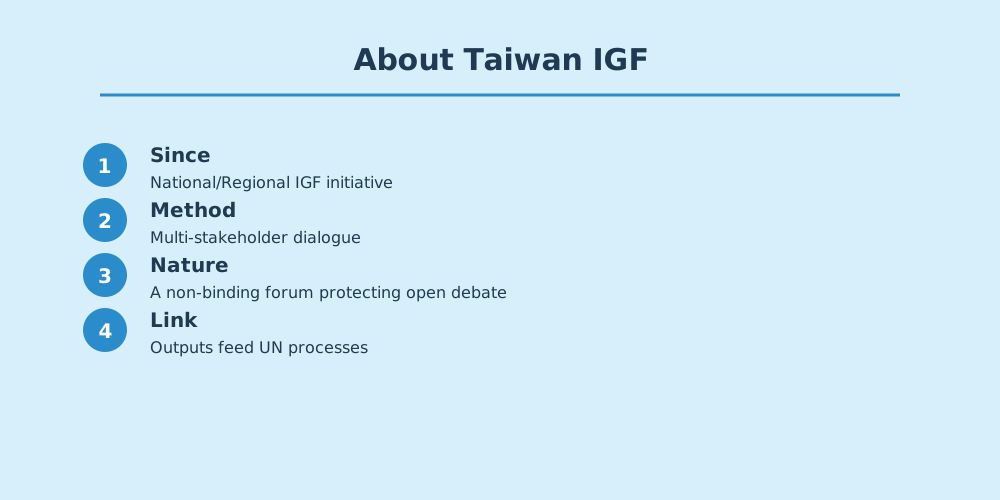
Taiwan IGF is a National or Regional IGF Initiative (NRI), aligning local internet governance discussion with global IGF principles.
Why It Matters to You
What was discussed here becomes the baseline for national digital policy, platform rules and AI regulation worldwide within a few years. The principles confirmed at the 2017 meeting are the foundation of the "next rules" for the phones, social platforms and AI services you use every day.
Sources & References
- 2017 臺灣網路治理論壇(大会公式サイト・議程/講者) — NII產業發展協進會(NIIEPA) (accessed 2026-07-11)
- Taiwan IGF (country report, GISWatch 2017 Special Issue) — APC (accessed 2026-07-11)
- 關於2018年的台灣網路治理論壇(2017年大会の振り返りを含む) — YingChu Chen(TWIGF MSG), Medium (accessed 2026-07-11)
- 歷屆年會(TWIGF公式アーカイブ一覧) — 臺灣網路治理論壇(TWIGF) (accessed 2026-07-11)
- 關於TWIGF(組織沿革) — 臺灣網路治理論壇(TWIGF) (accessed 2026-07-11)
Quotes are translated or condensed from the records listed above. Bracketed numbers [n] refer to the source list.
Related links
- IGF official (NRI list): https://www.intgovforum.org/en/content/national-and-regional-igf-initiatives
- Japan IGF: https://japanigf.jp/
- Yuki Nakazawa's blog: https://nkzw.jp/category/igf/
Revision History
Rev. 1 — published 3 July 2017, 14:00 (Article published)
Rev. 2 — updated 16 July 2026, 20:09 (Fully revised into the in-depth edition: added the 3-line summary, minutes digest, short talk, source list and diagrams (all quotes verified against the listed sources))
— 中澤祐樹

