


The 3-Line Summary
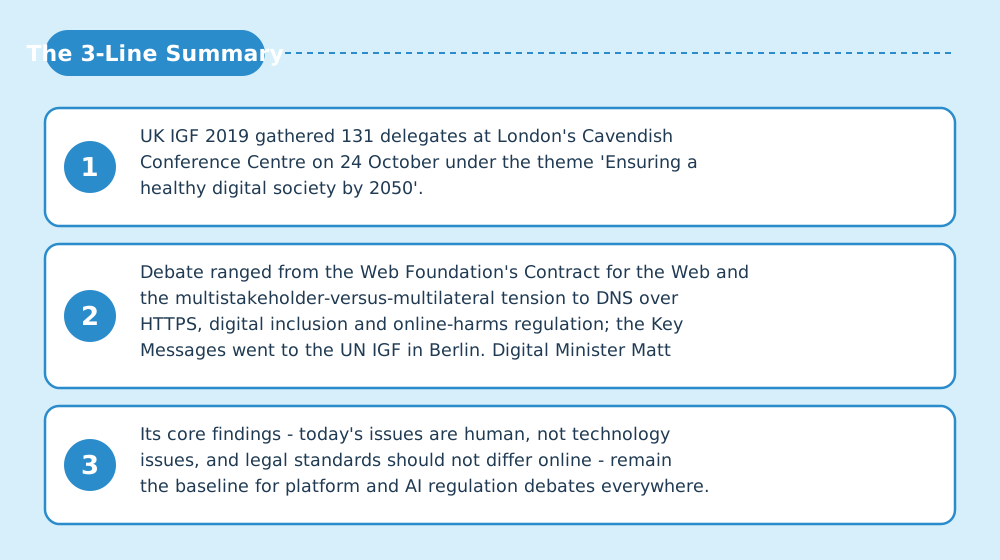
- UK IGF 2019 gathered 131 delegates at London's Cavendish Conference Centre on 24 October under the theme 'Ensuring a healthy digital society by 2050'.
- Debate ranged from the Web Foundation's Contract for the Web and the multistakeholder-versus-multilateral tension to DNS over HTTPS, digital inclusion and online-harms regulation; the Key Messages went to the UN IGF in Berlin. Digital Minister Matt Warman declared the multistakeholder model 'the best way to ensure a free, open and secure Internet'.
- Its core findings – today's issues are human, not technology issues, and legal standards should not differ online – remain the baseline for platform and AI regulation debates everywhere.
Welcome — this is the Japan IGF Support Organization. This in-depth report on UK Internet Governance Forum 2019 draws on official outputs, session records and on-site reporting. In a hurry? The three lines above and the diagrams carry the gist.
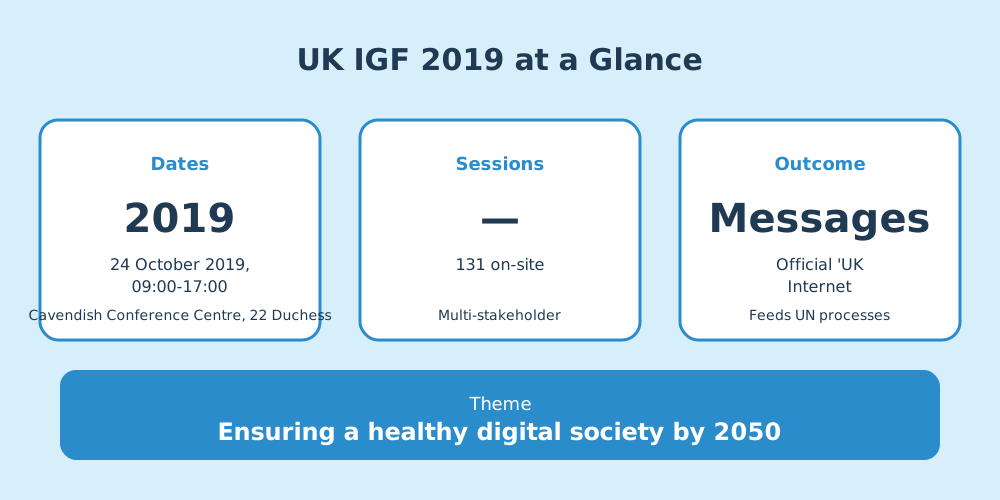
Conference at a Glance (from official records)
| Item | Detail |
|---|---|
| Official name | UK Internet Governance Forum 2019 |
| Dates | 24 October 2019, 09:00-17:00 |
| Venue | Cavendish Conference Centre, 22 Duchess Mews, Marylebone, London W1G 9DT |
| Theme | Ensuring a healthy digital society by 2050 |
| Participants | 131 |
| Outcome | Official 'UK Internet Governance Forum Report 2019' with Key Messages submitted to the UN IGF in Berlin that November |
(See the source list at the end of this article.)
Discussion Digest — from the Session Records
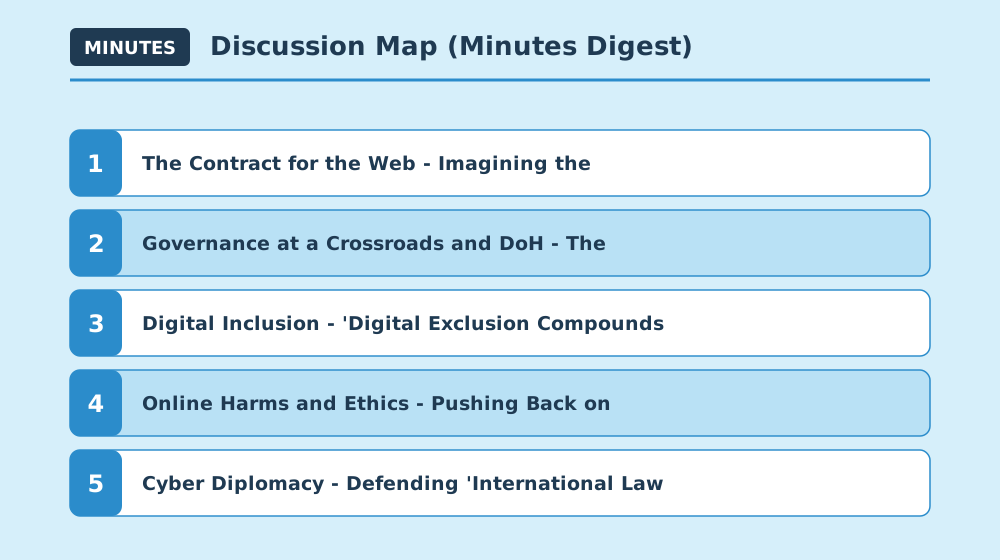
Key exchanges extracted from session records and transcripts.
1. The Contract for the Web – Imagining the Internet 30 Years Out
Sessions: Welcome by Eleanor Bradley (Nominet) and 'Vision for the future of the internet over the next 30 years' by Adrian Lovett (CEO, World Wide Web Foundation)
"I had a naïve assumption with the internet that if you build it, they will come. In reality the barriers to getting online are much more complex than that."
— Adrian Lovett (President & CEO, World Wide Web Foundation) [1][2]
- The Contract for the Web – principles for governments, companies and citizens – tackles a twin challenge: half the world cannot get online, while the other half faces outsized risks to privacy and democracy. Nearly 300 companies, 100+ civil society organisations, 10 governments and 8,000+ citizens helped draft it, with the action plan launching at the UN IGF in Berlin [1][2]
- A hall poll split on who matters most for a healthy 2050 digital society: governments 46%, citizens 30%, companies 24% [1][2]
- Nominet's Eleanor Bradley likened internet safety to road safety – 'there are dangers, but they are manageable' – and urged aiming higher: the digital society of 2050 could be part of the solution to problems like climate change [1][2]
2. Governance at a Crossroads and DoH – The Geopolitics of Technical Decisions
Sessions: Panel 'Taking Stock: Current Developments and Future Proposals for Internet Governance', chaired by Oxford Information Labs
"It's not privacy vs security. It's understanding the limits of technology – who is benefiting and for what purpose?"
— Stacie Hoffman (Digital Policy & Cyber Security Consultant, Oxford Information Labs) [1]
- Dominique Lazanski described the mounting multistakeholder-versus-multilateral tension as a 'crisis of internet governance' that will keep shaping the debate [1]
- Stacie Hoffman showed how DNS over HTTPS, while protecting citizens whose rights are threatened, centralises the system and shifts elements of national jurisdiction to private US companies – feeding the Key Message that technical decisions need inclusive discussion in advance [1]
- A hall poll on post-Brexit alignment was emphatic: EU 66%, other 26%, USA 8% [1]
3. Digital Inclusion – 'Digital Exclusion Compounds Inequality'
Sessions: 'Digital Inclusion and Education' session with the Good Things Foundation and the Scouts
"Digital exclusion compounds inequality. In turn, inequality reinforces and entrenches digital exclusion"
— Adam Micklethwaite (Director of Digital Social Inclusion, Good Things Foundation) [1]
"Scout values – integrity, respect and cooperation – are as essential online as they are offline"
— Gareth Jones (Member of Scouts Board of Trustees) [1]
- In the UK, 6 million adults cannot turn on a device and 11.9 million lack essential digital skills – a divide that runs along the lines of other inequalities [1]
- Non-formal education like Scouting has a major role: motivation and lack of trust keep people offline, and addressing them takes time and personal context [1]
4. Online Harms and Ethics – Pushing Back on Notice-and-Takedown Tunnel Vision
Sessions: Panels 'Risk, Harms and Ethics in Digital Society' and 'Empowering Users', plus the ministerial video address
"I firmly believe that the multi-stakeholder model of Internet governance is the best way to ensure a free, open and secure Internet… Regulation needs to be innovative, agile and forward-thinking to match the pace of technology."
— Matt Warman MP (Minister for Digital and Broadband) [1]
"Cross-party consensus in the UK on online harm should not be lost in a moment of political uncertainty."
— Maeve Walsh (Associate, Carnegie) [1]
- Panellists criticised the Online Harms White Paper for leaning too hard on notice-and-takedown, calling for a holistic, systemic approach covering malign uses of new technology such as disinformation-spreading algorithms [1]
- Oxford Internet Institute's Victoria Nash cited research that 79% of internet users say technology makes life better (29% among non-users), defining a healthy digital society as one where people can flourish through technology [1]
- Ofcom's Online Nation report added that 79% of children aged 12-15 had a potentially harmful online experience in the past year; the challenge is a culture where safety by design is not seen as opposed to commercial goals [1]
5. Cyber Diplomacy – Defending 'International Law Applies in Cyberspace'
Sessions: 'Cybersecurity: Challenges and Opportunities' conversation with the FCO, and the summary session
"The UK invites stakeholders to join their delegation to the ITU – that's not something that many other countries do"
— Kat Jones (Head of Cyber Policy, UK Foreign and Commonwealth Office) [1]
- The FCO set out its drive to build agreement around a free, open, peaceful and secure cyberspace; the UK position that international law applies in cyberspace is contested by other states and must be defended [1]
- The summary session confirmed strong support for the 'IGF+' model proposed by the UN Secretary-General's High-level Panel, and the Key Messages went to the UN IGF in Berlin the following month [1]
- Two pillars of those messages: legal standards should not differ online, and today's issues are human, not technology issues [1]
Three-Minute Short Talk — Your Questions Answered
Q. So what did the meeting decide?
A. Nothing binding, but the 131 delegates' debate was distilled into nine Key Messages delivered to the UN IGF in Berlin the following month – headlined by the principle that legal standards should not differ between online and offline.
Q. What was the standout topic?
A. A technical one: DNS over HTTPS. Encrypting DNS protects privacy but centralises the system and hands parts of national enforcement to private US companies – hence the lesson that technical decisions need inclusive discussion in advance.
Q. Why should I care?
A. The 2019 findings – issues are human, not technological; regulation should be outcome-based but legally clear – remain the baseline of platform and AI regulation debates, and the DoH question is still live for ISPs and security teams everywhere.
What Is UK IGF? (for first-time readers)
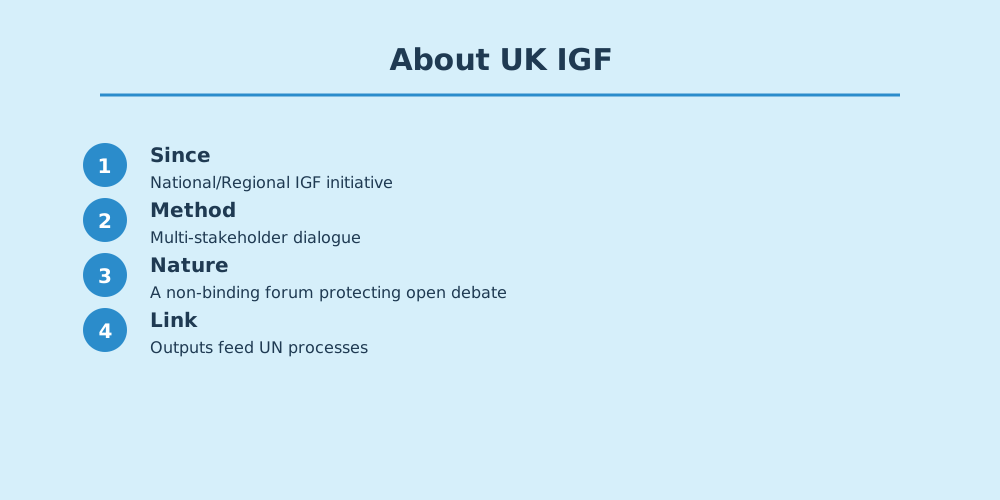
UK IGF is a National or Regional IGF Initiative (NRI), aligning local internet governance discussion with global IGF principles.
Why It Matters to You
What was discussed here becomes the baseline for national digital policy, platform rules and AI regulation worldwide within a few years. The principles confirmed at the 2019 meeting are the foundation of the "next rules" for the phones, social platforms and AI services you use every day.
Sources & References
- UK Internet Governance Forum Report 2019(公式報告書PDF、Key Messages収録) — UK IGF (accessed 2026-07-11)
- 2019 UK IGF(公式イベントページ) — UK IGF(公式サイト) (accessed 2026-07-11)
- UK IGF(2019年大会の記録) — DiploFoundation (accessed 2026-07-11)
- UK IGF 2019 meeting date announced(開催告知、日時・会場・遠隔参加の根拠) — ISOC UK England(インターネットソサエティ英国支部) (accessed 2026-07-11)
- UK IGF 2019(全セッションのライブ配信アーカイブ) — Livestream(Internet Society) (accessed 2026-07-11)
Quotes are translated or condensed from the records listed above. Bracketed numbers [n] refer to the source list.
Related links
- IGF official (NRI list): https://www.intgovforum.org/en/content/national-and-regional-igf-initiatives
- Japan IGF: https://japanigf.jp/
- Yuki Nakazawa's blog: https://nkzw.jp/category/igf/
Revision History
Rev. 1 — published 27 October 2019, 15:00 (Article published)
Rev. 2 — updated 16 July 2026, 20:09 (Fully revised into the in-depth edition: added the 3-line summary, minutes digest, short talk, source list and diagrams (all quotes verified against the listed sources))
— 中澤祐樹

