


The 3-Line Summary
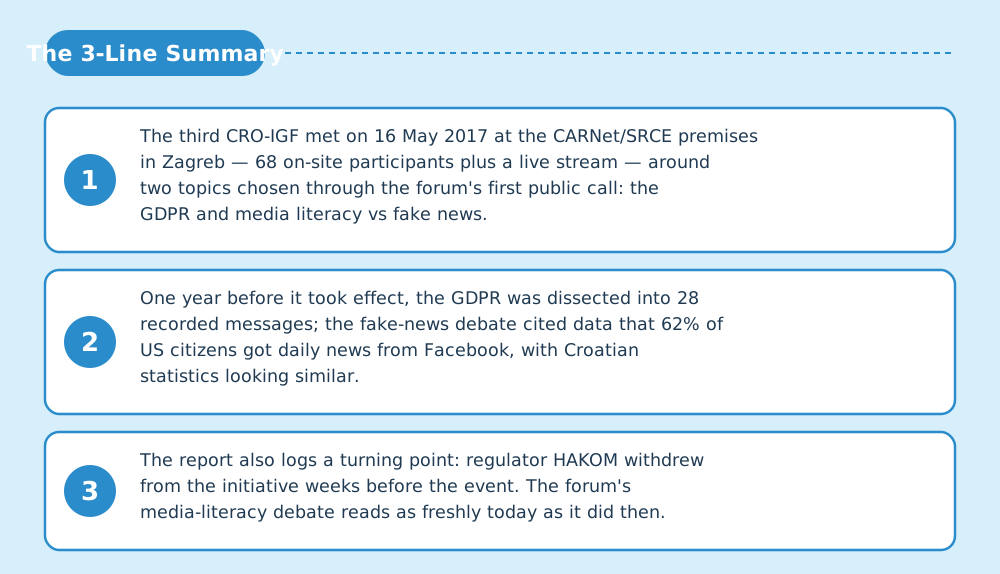
- The third CRO-IGF met on 16 May 2017 at the CARNet/SRCE premises in Zagreb — 68 on-site participants plus a live stream — around two topics chosen through the forum's first public call: the GDPR and media literacy vs fake news.
- One year before it took effect, the GDPR was dissected into 28 recorded messages; the fake-news debate cited data that 62% of US citizens got daily news from Facebook, with Croatian statistics looking similar.
- The report also logs a turning point: regulator HAKOM withdrew from the initiative weeks before the event. The forum's media-literacy debate reads as freshly today as it did then.
Welcome — this is the Japan IGF Support Organization. This in-depth report on CRO-IGF 2017 (Croatian Internet Governance Forum) draws on official outputs, session records and on-site reporting. In a hurry? The three lines above and the diagrams carry the gist.
Conference at a Glance (from official records)
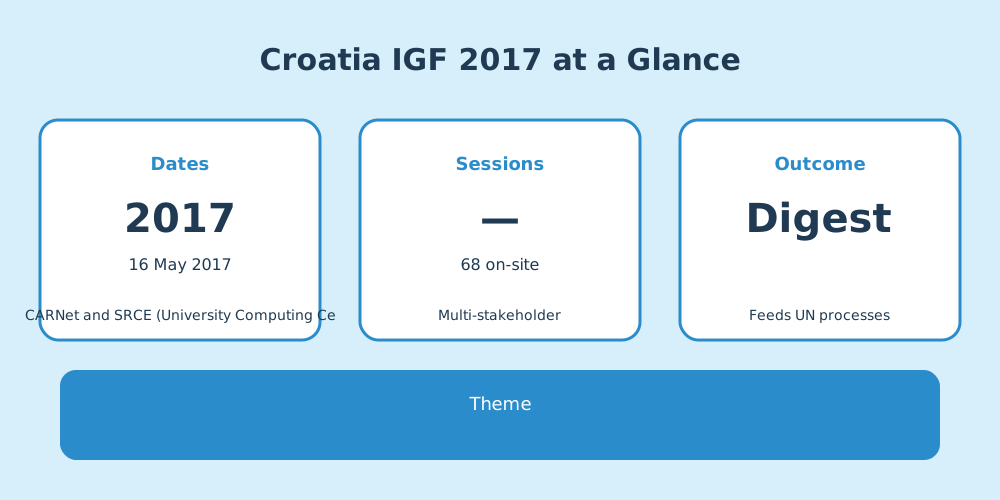
| Item | Detail |
|---|---|
| Official name | CRO-IGF 2017 (Croatian Internet Governance Forum) |
| Edition | 3rd edition |
| Dates | 16 May 2017 |
| Venue | CARNet and SRCE (University Computing Centre) premises, Zagreb |
| Theme | Regional governance themes |
| Participants | 68 |
| Host | The CRO-IGF Organising Committee, hosted this year by CARNet (coordinator: Nataša Glavor) |
(See the source list at the end of this article.)
Discussion Digest — from the Session Records
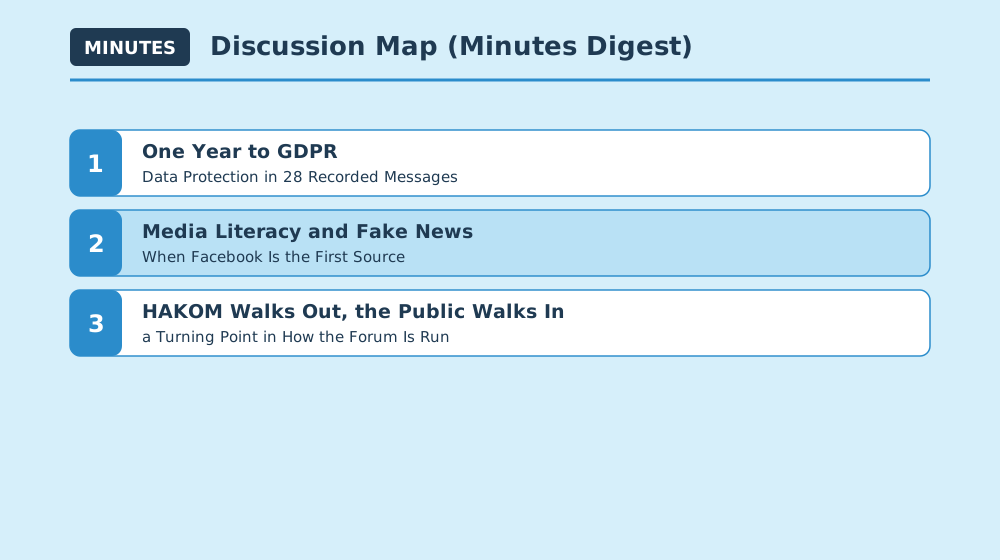
Key exchanges extracted from session records and transcripts.
1. One Year to GDPR — Data Protection in 28 Recorded Messages
Sessions: Panel 'Personal Data Protection, GDPR, Micro-targeting of Internet Users' (introduced and moderated by Vedran Podobnik, FER)
- The official report distils the debate into 28 messages — 'GDPR is neither the beginning nor the end of the data-protection story', 'high penalties will be the incentive to comply', 'compliance is far wider than the IT department' [1][2]
- Panellists traced how the demise of the Safe Harbour arrangement raised the stakes for EU citizens' data handled by US companies, and unpacked GDPR's privacy-by-design principle and the strengthened national authority AZOP [1][2]
- Large telecoms and pharma firms were judged ready or able to comply, but adapting existing large, complex systems was named the real challenge — and some companies, the panel predicted, would not be ready by 25 May 2018 [1][2]
2. Media Literacy and Fake News — When Facebook Is the First Source
Sessions: Panel 'Media Literacy and Fake News' (introduction by Hrvoje Lisičar, Faculty of Law; moderated by Nataša Glavor)
"Public domain cannot be left to self-regulation. The state must intervene and take part in regulation having in mind primarily public interest (written feedback in the official final report)"
— Anamarija Musa (Information Commissioner) [1]
"Fake news is also a responsibility of the reader. Technology by itself is not a threat. We need to adapt our approach when reading an article in The Economist differently than when reading the news on Facebook (written feedback in the official final report)"
— Vedran Podobnik (FER, University of Zagreb) [1]
- Panellists cited data that 62% of US citizens use Facebook as a daily news source, with similar statistics in Croatia where television ranks only fourth — and warned that news dominant on social networks becomes 'the truth' and gets rebroadcast unverified by traditional media [1]
- Croatian adults reportedly read newspapers about six minutes a day (against 63 in the US and 104 in Israel in the research cited), a symptom of underinvestment in reading culture and journalism that leaves the public exposed [1]
- Existing law — defamation, media and civil codes — already covers much fake-news conduct but is under-enforced; with about 40% of national cybersecurity measures tied to education, panellists urged media literacy be built into the school system [1]
3. HAKOM Walks Out, the Public Walks In — a Turning Point in How the Forum Is Run
Sessions: Preparatory process and governance (as recorded in the official final report)
- In late April 2017, less than a month before the event, HAKOM — the regulator that had launched the initiative — withdrew and pulled its representative from the Organising Committee, a fact the report records matter-of-factly (Zdravko Jukić stayed on as Croatia's GAC representative) [1][3]
- The same year the forum switched to a bottom-up public call for topics and created an Executive Committee of the previous, current and next year's leaders — a step towards institutionalisation [1][3]
- The conclusions call the forum 'a valuable multistakeholder effort to illuminate particular cyber-space issues', noting that as an informal event, the report and the audio-video recording are its only outputs [1][3]
Three-Minute Short Talk — Your Questions Answered
Q. What did this meeting decide?
A. Nothing formally — but it served as a public dress rehearsal for the GDPR, one year before it took effect, with the supervisory side, companies and academia checking each other's readiness. The debate survives as 28 recorded messages.
Q. What was the most contentious topic?
A. Who should deal with fake news. The Information Commissioner insisted the state must intervene because the public domain cannot be left to self-regulation, while others argued readers bear responsibility too — regulation versus literacy, argued head-on.
Q. Why should I care?
A. Social media as the first news source is a global condition, GDPR applies to any company serving EU users, and the warning that a country reading newspapers six minutes a day is soft ground for disinformation crosses every border.
What Is Croatia IGF? (for first-time readers)
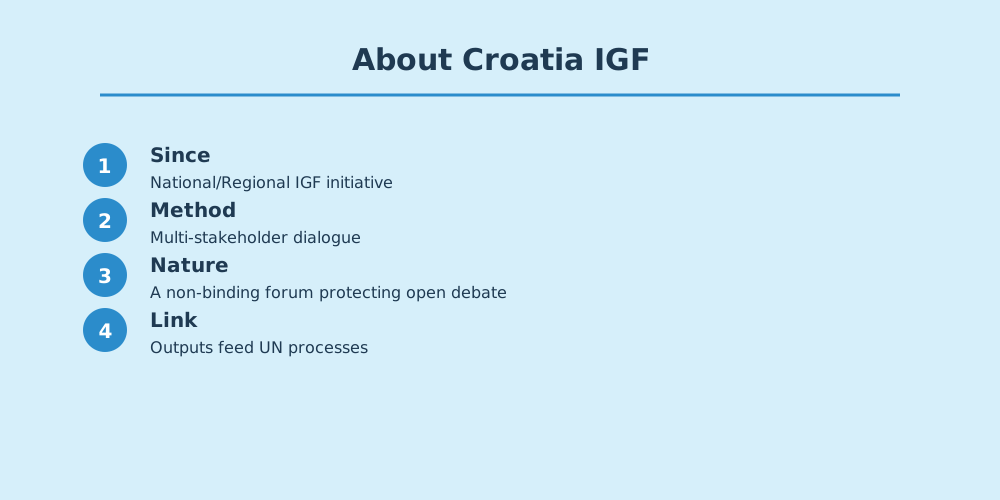
Croatia IGF is a National or Regional IGF Initiative (NRI), aligning local internet governance discussion with global IGF principles.
Why It Matters to You
What was discussed here becomes the baseline for national digital policy, platform rules and AI regulation worldwide within a few years. The principles confirmed at the 2017 meeting are the foundation of the "next rules" for the phones, social platforms and AI services you use every day.
Sources & References
- Croatian IGF 2017 – Final report (PDF) — CRO-IGF組織委員会(CARNET公式サイト掲載) (accessed 2026-07-11)
- Croatian Internet Governance Forum 2017 — DiploFoundation (accessed 2026-07-11)
- Forum o upravljanju internetom (CRO-IGF)(公式プロジェクトページ・歴代最終報告書一覧) — CARNET (accessed 2026-07-11)
Quotes are translated or condensed from the records listed above. Bracketed numbers [n] refer to the source list.
Related links
- IGF official (NRI list): https://www.intgovforum.org/en/content/national-and-regional-igf-initiatives
- Japan IGF: https://japanigf.jp/
- Yuki Nakazawa's blog: https://nkzw.jp/category/igf/
Revision History
Rev. 1 — published 23 June 2017, 11:00 (Article published)
Rev. 2 — updated 17 July 2026, 12:32 (Fully revised into the in-depth edition: added the 3-line summary, minutes digest, short talk, source list and diagrams (all quotes verified against the listed sources))
— 中澤祐樹

