

The 3-Line Summary
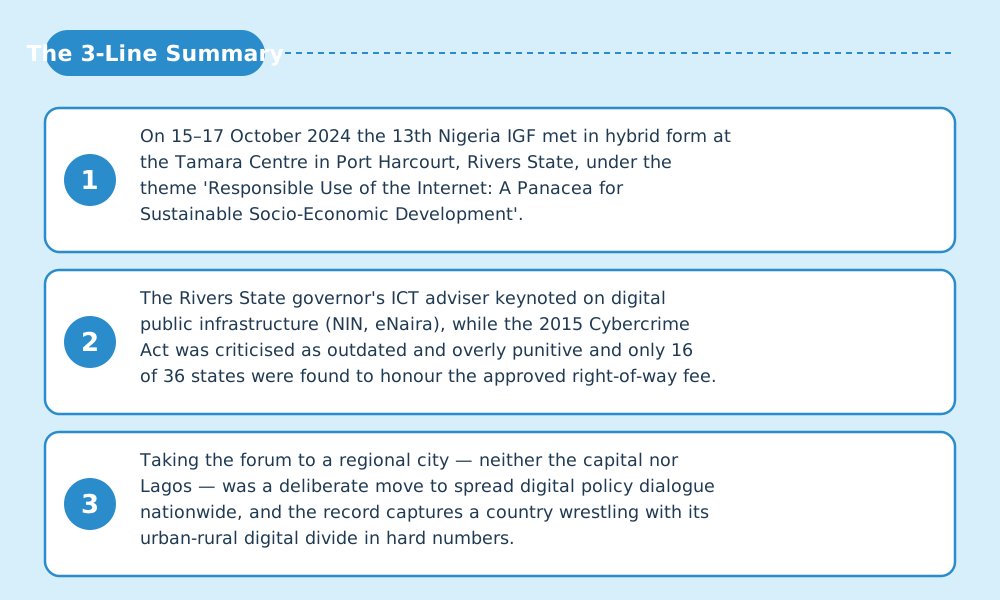
- On 15–17 October 2024 the 13th Nigeria IGF met in hybrid form at the Tamara Centre in Port Harcourt, Rivers State, under the theme 'Responsible Use of the Internet: A Panacea for Sustainable Socio-Economic Development'.
- The Rivers State governor's ICT adviser keynoted on digital public infrastructure (NIN, eNaira), while the 2015 Cybercrime Act was criticised as outdated and overly punitive and only 16 of 36 states were found to honour the approved right-of-way fee.
- Taking the forum to a regional city — neither the capital nor Lagos — was a deliberate move to spread digital policy dialogue nationwide, and the record captures a country wrestling with its urban-rural digital divide in hard numbers.
Welcome — this is the Japan IGF Support Organization. This in-depth report on Nigeria Internet Governance Forum 2024 (13th edition) draws on official outputs, session records and on-site reporting. In a hurry? The three lines above and the diagrams carry the gist.
📍 Held in Port Harcourt in the oil-producing South-South; in closing remarks the MAG chair announced plans to extend future editions to geopolitical zones that have not yet hosted the forum
Conference at a Glance (from official records)
| Item | Detail |
|---|---|
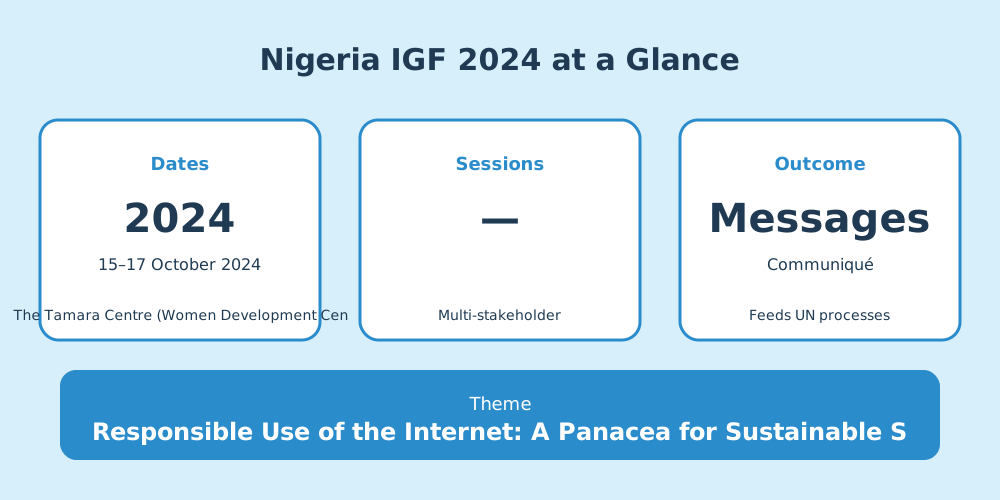
| Official name | Nigeria Internet Governance Forum 2024 (13th edition) |
| Dates | 15–17 October 2024 |
| Venue | The Tamara Centre (Women Development Centre), Ministry of Women Affairs Complex, Port Harcourt, Rivers State, with online participation (hybrid) |
| Theme | Responsible Use of the Internet: A Panacea for Sustainable Socio-Economic Development |
| Keynote | Lead paper by Engr. Fenibo Fubara (Special Assistant on ICT to the Governor of Rivers State); moderated by Hajia Sani (Director, Digital Media, Voice of Nigeria) |
| Host | NIGF Multistakeholder Advisory Group (Federal Ministry of Communications, Innovation and Digital Economy, NCC, NITDA, NiRA, ISOC Nigeria, CITAD and other stakeholders) |
| Outcome | Communiqué (published January 2025) |
(See the source list at the end of this article.)
Discussion Digest — from the Session Records
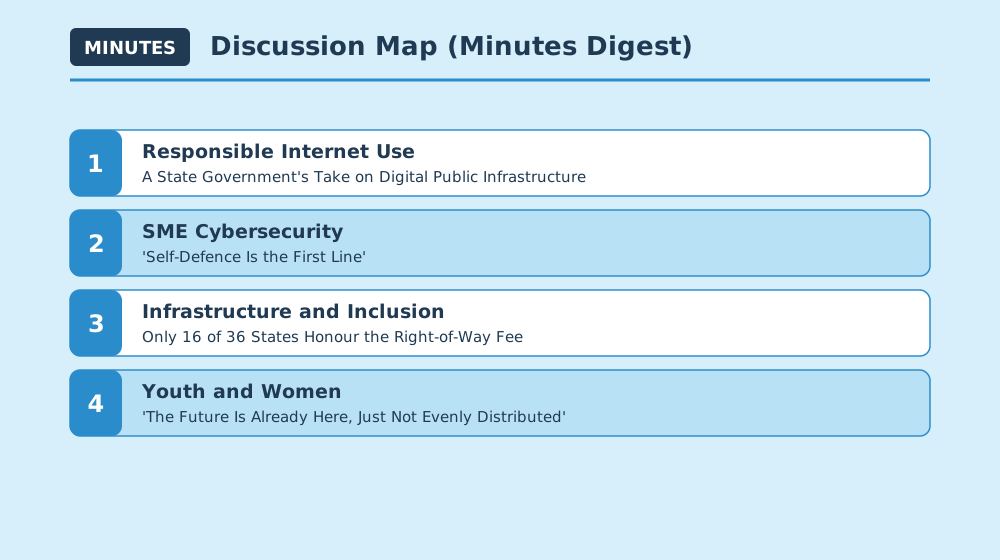
Key exchanges extracted from session records and transcripts.
1. Responsible Internet Use — A State Government's Take on Digital Public Infrastructure
Sessions: High-level panel (17 October; lead paper by Engr. Fenibo Fubara, Special Assistant on ICT to the Governor of Rivers State)
- Fubara framed the internet — connecting over 190 countries and 68% of the world's population — as the backbone of national development, with digital public infrastructure such as the National Identity Number (NIN), the eNaira and the IPPIS payroll system as keystones for the SDGs [1]
- He critiqued the Cybercrime Act of 2015 and related frameworks as outdated and overly punitive barriers to innovation, citing unclear data-privacy guidelines, restrictions on mobile-money operators, multiple taxation and the absence of provisions for gig workers, and recommended regulatory reform matched to the modern digital economy [1]
- Rivers State's 'Skillwave' digital-literacy programme was showcased as a model for fostering responsible online behaviour, with scaling to rural and vulnerable populations flagged as unfinished business [1]
2. SME Cybersecurity — 'Self-Defence Is the First Line'
Sessions: High-level panel and Breakout Session 1 'Cybersecurity, Data Protection, and Child Online Safety'
- NITDA's Emmanuel Edet warned that SMEs marketing on Instagram and TikTok hand critical business information to profit-driven platforms without grasping the risk; invoking the analogy of locking your house despite laws against theft, he argued self-defence is the first line against cyber threats, with awareness as basic as looking left and right before crossing the road [1]
- Tonye Apiafi of Intels recommended that government and the private sector first map threat actors and vectors in the Nigerian environment, then run continuous education — notably on spotting phishing — for MSMEs and their employees [1]
- A robust identity system, letting users verify who they are transacting with, was repeatedly stressed as the foundation of trust in online commerce [1]
3. Infrastructure and Inclusion — Only 16 of 36 States Honour the Right-of-Way Fee
Sessions: Breakout Session 3 'Enhancing Multistakeholder Digital Cooperation: Internet Governance, Regulations and Infrastructure' and related sessions
- Permanent Secretary Faruk Yusuf Yabo reported broadband penetration up from 6% in 2015 to nearly 50% in 2023 under the National Broadband Plan, targeting 70% by 2025, and — alongside the Startup Act — invited collaboration on frameworks for ethical online behaviour, data protection and digital citizenship [1][2]
- The NCC's Dr Ibiso Kingsley-George noted that only 16 of 36 states comply with the approved right-of-way charge of 145 naira, arguing the benefits states reap from digital infrastructure far outweigh revenue from excessive fees [1][2]
- With about 109 million internet subscriptions (NCC, 2023) and an NBS study finding 77% of young people had gained skills via the internet, the session recommended rural deployment and state-level adoption of national digital-inclusion policies [1][2]
4. Youth and Women — 'The Future Is Already Here, Just Not Evenly Distributed'
Sessions: Youth IGF (16 October) and Women's IGF (15 October; 6th WIGF, organised by CITAD)
"The future is already here, it's just not evenly distributed"
— Taiwo Sobowale (Digital Grassroots), quoting William Gibson in the NYIGF keynote [1][2]
- The Youth IGF, themed 'Navigating the Digital Sphere: Rights, Risks, and Resilience', cast young people — over 60% of Nigeria's population is under 30 — as both consumers and creators, adding a dedicated 'Empowering Teens' session for secondary-school students; keynoter Taiwo Sobowale invoked Gibson's line on uneven digital opportunity and called digital literacy a lifelong necessity, not a luxury [1][2]
- The 6th Women's IGF, on promoting a gender-sensitive internet, documented how cultural norms (particularly in Northern Nigeria) deter women from STEM, alongside online harassment and the lack of local-language platforms, and recommended funding and mentorship for women entrepreneurs and safer digital spaces [1][2]
- In closing, MAG chair Dr Wariowei (NITDA) acknowledged past communiqués had lacked follow-through, promising rigorous follow-up and rotation of future editions to zones yet to host the forum [1][2]
Three-Minute Short Talk — Your Questions Answered
Q. What did the conference actually decide?
A. Nothing binding — it's a national dialogue forum in the UN IGF family. But its communiqué handed government, states and business concrete homework: modernise the Cybercrime Act, fix right-of-way fees, legislate child online safety.
Q. Why Port Harcourt?
A. To take digital policy dialogue beyond Abuja and Lagos. The MAG chair pledged to rotate the forum through geopolitical zones that haven't yet hosted it; the venue was the Women Development Centre in oil-rich Rivers State.
Q. Why should I care?
A. 'Fibre is laid but unused' and 'inconsistent local fees stall deployment' are the same last-mile dilemmas rich and poor countries alike are wrestling with — Nigeria's numbers just make them unusually visible.
What Is Nigeria IGF? (for first-time readers)
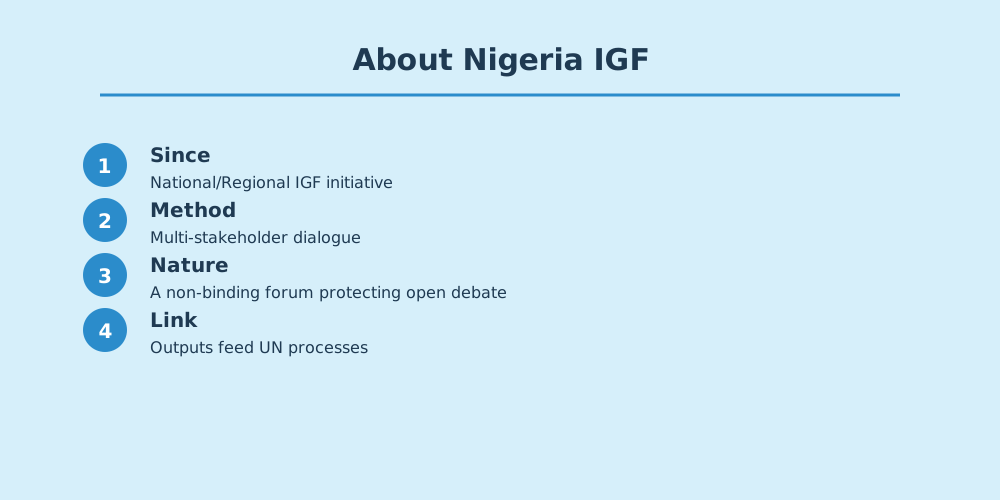
Nigeria IGF is a National or Regional IGF Initiative (NRI), aligning local internet governance discussion with global IGF principles.
Why It Matters to You
What was discussed here becomes the baseline for national digital policy, platform rules and AI regulation worldwide within a few years. The principles confirmed at the 2024 meeting are the foundation of the "next rules" for the phones, social platforms and AI services you use every day.
Sources & References
- Report of the Nigeria Internet Governance Forum (NIGF 2024) Events (PDF) — igf.ng (accessed 2026-07-16)
- Communique issued at the end of the Nigeria Internet Governance Forum (NIGF 2024) Event (PDF) — igf.ng (accessed 2026-07-16)
- NIGF 2024(公式イベントページ) — igf.ng (accessed 2026-07-16)
- Nigeria Internet Governance Forum (NIGF) 2024(公告) — NCC (accessed 2026-07-16)
Quotes are translated or condensed from the records listed above. Bracketed numbers [n] refer to the source list.
Related links
- IGF official (NRI list): https://www.intgovforum.org/en/content/national-and-regional-igf-initiatives
- Japan IGF: https://japanigf.jp/
- Yuki Nakazawa's blog: https://nkzw.jp/category/igf/
Revision History
Rev. 1 — published 2 September 2024, 15:00 (Article published)
Rev. 2 — updated 17 July 2026, 12:32 (Fully revised into the in-depth edition: added the 3-line summary, minutes digest, short talk, source list and diagrams (all quotes verified against the listed sources))
— 中澤祐樹

