


The 3-Line Summary
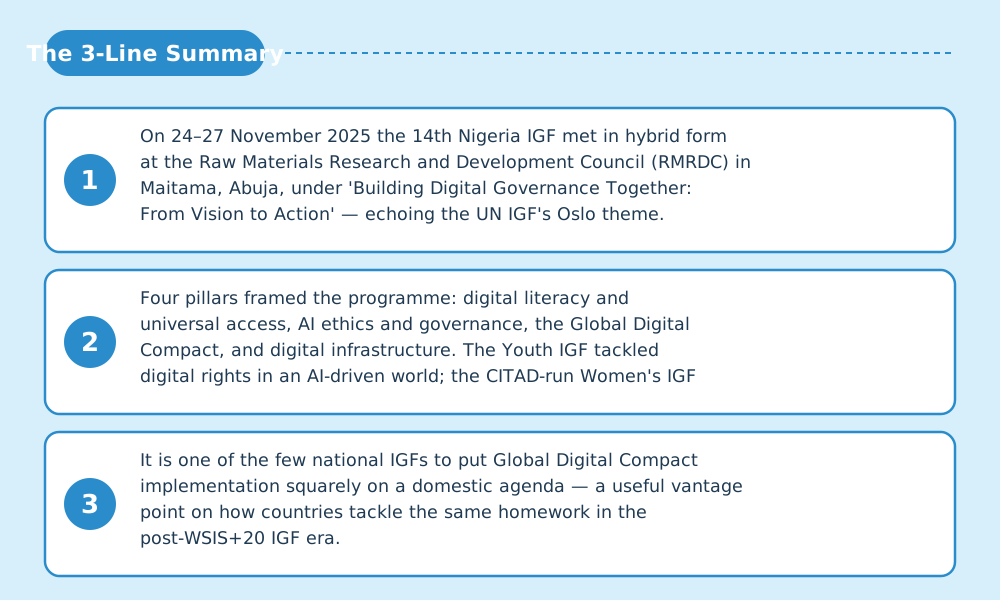
- On 24–27 November 2025 the 14th Nigeria IGF met in hybrid form at the Raw Materials Research and Development Council (RMRDC) in Maitama, Abuja, under 'Building Digital Governance Together: From Vision to Action' — echoing the UN IGF's Oslo theme.
- Four pillars framed the programme: digital literacy and universal access, AI ethics and governance, the Global Digital Compact, and digital infrastructure. The Youth IGF tackled digital rights in an AI-driven world; the CITAD-run Women's IGF confronted women's roughly 15% share of leadership in major ICT institutions.
- It is one of the few national IGFs to put Global Digital Compact implementation squarely on a domestic agenda — a useful vantage point on how countries tackle the same homework in the post-WSIS+20 IGF era.
Welcome — this is the Japan IGF Support Organization. This in-depth report on Nigeria Internet Governance Forum 2025 (14th edition) draws on official outputs, session records and on-site reporting. In a hurry? The three lines above and the diagrams carry the gist.
Conference at a Glance (from official records)
| Item | Detail |
|---|---|
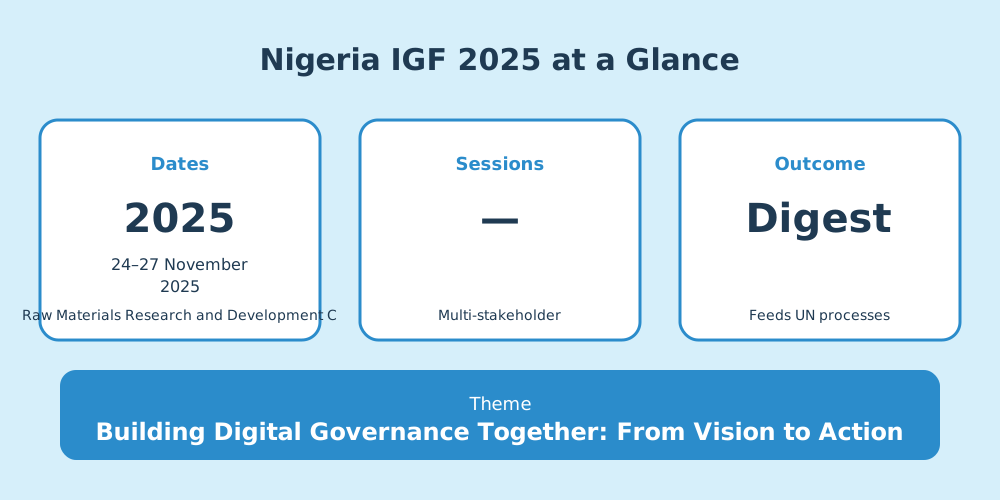
| Official name | Nigeria Internet Governance Forum 2025 (14th edition) |
| Dates | 24–27 November 2025 |
| Venue | Raw Materials Research and Development Council (RMRDC), Plot 17 Aguiyi Ironsi, Maitama, Abuja, with full online participation (hybrid) |
| Theme | Building Digital Governance Together: From Vision to Action (Echoes the overall theme of the UN IGF 2025 in Oslo ('Building Digital Governance Together'), adding 'From Vision to Action') |
| Pre-events | 6th Nigerian School on Internet Governance (23–26 November, NITDA e-Government Centre, Public Service Institute of Nigeria, Kubwa); Youth IGF (NYIGF 2025, at RMRDC, hybrid); Women's IGF (WIGF 2025, 25 November, online, organised by CITAD) |
| Host | NIGF Secretariat and NIGF-MAG, self-described as 'a renewed collaborative effort' of internet stakeholders |
(See the source list at the end of this article.)
Discussion Digest — from the Session Records
Key exchanges extracted from session records and transcripts.
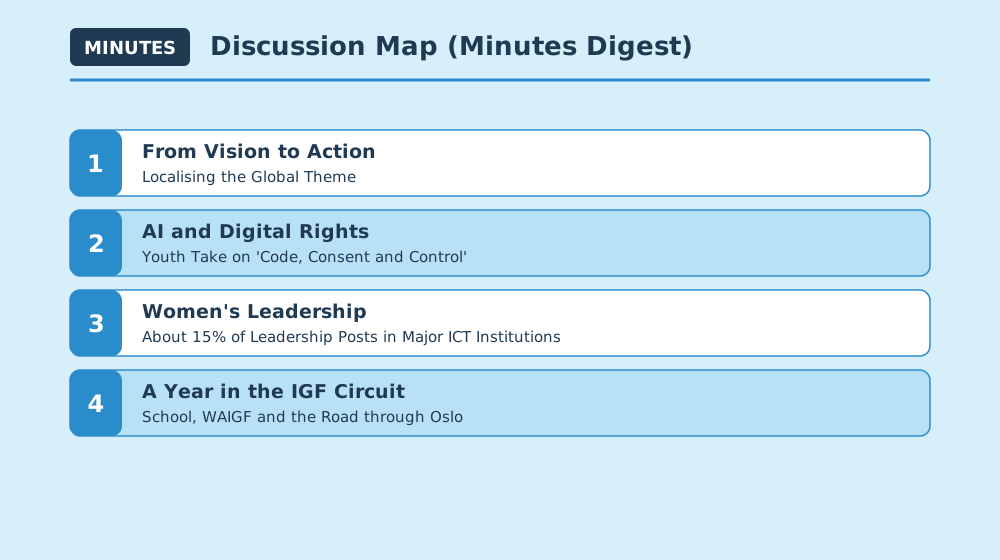
1. From Vision to Action — Localising the Global Theme
Sessions: Main sessions (24–27 November, RMRDC)
- NIGF 2025 was built on four pillars — digital literacy and universal access, AI ethics and governance, the Global Digital Compact, and digital infrastructure and national development — combining multistakeholder discussions, high-level roundtables and practical breakout sessions [1]
- The theme adopted the UN IGF 2025 Oslo banner 'Building Digital Governance Together' and appended 'From Vision to Action', framing the forum as a place where government, civil society, the private sector and citizens co-create inclusive and effective digital governance [1]
- Giving the UN's Global Digital Compact its own session pillar made domestic GDC implementation a headline agenda item — still rare among national IGFs [1]
2. AI and Digital Rights — Youth Take on 'Code, Consent and Control'
Sessions: Youth IGF (NYIGF 2025, at RMRDC, hybrid)
- The Youth IGF's theme, 'Code, Consent and Control — Reimaging Nigeria's Digital Rights in an AI-Driven World', confronted how AI and rising internet access are reshaping the job market, automation and the future of work for young Nigerians, centring AI governance, data privacy and youth digital rights [2]
- Run as a youth-led multistakeholder forum with nine featured speakers, its outcomes were published as a downloadable communiqué [2]
3. Women's Leadership — About 15% of Leadership Posts in Major ICT Institutions
Sessions: Women's IGF (WIGF 2025, 25 November, online; organised by CITAD under 'From Vision to Visibility — Advancing Women's Leadership in Digital Governance')
- CITAD executive director Y.Z. Ya'u reported that women hold only about 15% of leadership positions across major Nigerian ICT institutions such as the NCC, NITDA and NigComSat — far below the 35% National Gender Policy benchmark [3]
- West Africa IGF chair Mary Uduma stressed that improving women's visibility in digital governance requires a comprehensive approach to systemic inequalities, while keynote speaker Prof. Nafisat Afolake Adedokun-Shittu argued visibility demands intentional leadership, continuous learning and community support [3]
- Recommendations included gender-responsive ICT policies, more women in regulatory bodies, leadership academies and fellowships, digital innovation labs, enforced penalties for online harassment, and stronger mentorship networks [3]
4. A Year in the IGF Circuit — School, WAIGF and the Road through Oslo
Sessions: Pre-events and related 2025 activities
- The 6th Nigerian School on Internet Governance (23–26 November, NITDA e-Government Centre at the Public Service Institute) fed trained participants into the forum after four days covering IG fundamentals, WSIS Action Lines, ICANN's structure and policy-brief writing [4][5][1]
- Nigeria also co-hosted the West Africa IGF 2025 in Abuja with ECOWAS and development partners, and ran a dedicated national Open Forum on digital literacy at the UN IGF 2025 in Oslo — keeping its agenda moving along the national-regional-global circuit all year [4][5][1]
- The 14th consecutive edition since 2012 returned to Abuja for the first time in three years, at a government research council (RMRDC) — a capital homecoming after recent editions in private venues and state capitals [4][5][1]
Three-Minute Short Talk — Your Questions Answered
Q. What did the conference actually decide?
A. It's the national chapter of the UN's IGF — a dialogue forum. This edition ran on four pillars: digital literacy, AI ethics, the UN's Global Digital Compact and infrastructure. Its report and communiqué were not yet published at research time.
Q. What made this edition distinctive?
A. It gave the Global Digital Compact its own session pillar — asking squarely how a UN framework gets implemented at national level — and borrowed its very theme from the Oslo UN IGF, keeping the national debate continuous with the global one.
Q. Why should I care?
A. Every country now has the same homework: implement the GDC and govern AI. Watching how a national IGF translates the global theme into local action makes Nigeria a useful comparison point for any country's digital-policy community.
What Is Nigeria IGF? (for first-time readers)
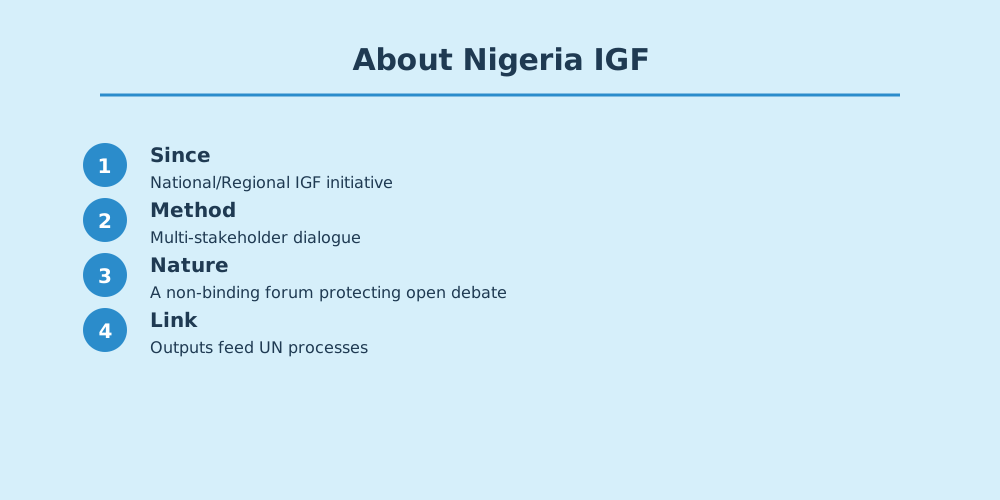
Nigeria IGF is a National or Regional IGF Initiative (NRI), aligning local internet governance discussion with global IGF principles.
Why It Matters to You
What was discussed here becomes the baseline for national digital policy, platform rules and AI regulation worldwide within a few years. The principles confirmed at the 2025 meeting are the foundation of the "next rules" for the phones, social platforms and AI services you use every day.
Sources & References
- NIGF 2025(公式イベントページ) — igf.ng (accessed 2026-07-16)
- NYIGF-2025(ナイジェリア・ユースIGF 2025) — Nigeria Youth Internet Governance Forum (accessed 2026-07-16)
- Report of the Women Internet Governance Forum (WIGF) 2025 — CITAD (accessed 2026-07-16)
- Agenda — Nigeria School of Internet Governance 2025 — 2025.sig.ng (accessed 2026-07-16)
- News 2025(年別アーカイブ: WAIGF 2025アブジャ開催・IGF 2025オスロでの国別オープンフォーラム告知) — igf.ng (accessed 2026-07-16)
Quotes are translated or condensed from the records listed above. Bracketed numbers [n] refer to the source list.
Related links
- IGF official (NRI list): https://www.intgovforum.org/en/content/national-and-regional-igf-initiatives
- Japan IGF: https://japanigf.jp/
- Yuki Nakazawa's blog: https://nkzw.jp/category/igf/
Revision History
Rev. 1 — published 10 September 2025, 11:00 (Article published)
Rev. 2 — updated 17 July 2026, 12:32 (Fully revised into the in-depth edition: added the 3-line summary, minutes digest, short talk, source list and diagrams (all quotes verified against the listed sources))
— 中澤祐樹

