


The 3-Line Summary
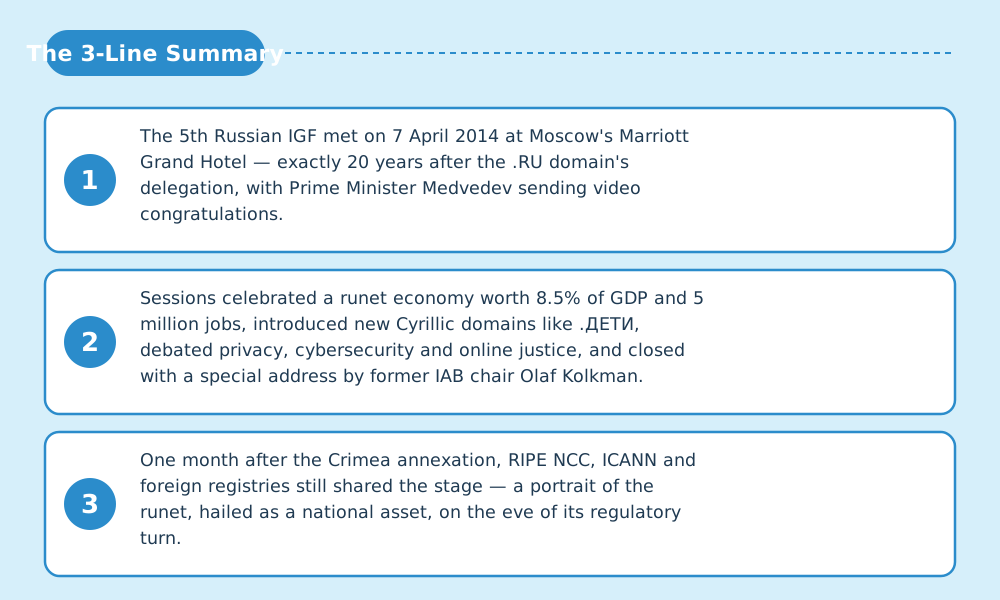
- The 5th Russian IGF met on 7 April 2014 at Moscow's Marriott Grand Hotel — exactly 20 years after the .RU domain's delegation, with Prime Minister Medvedev sending video congratulations.
- Sessions celebrated a runet economy worth 8.5% of GDP and 5 million jobs, introduced new Cyrillic domains like .ДЕТИ, debated privacy, cybersecurity and online justice, and closed with a special address by former IAB chair Olaf Kolkman.
- One month after the Crimea annexation, RIPE NCC, ICANN and foreign registries still shared the stage — a portrait of the runet, hailed as a national asset, on the eve of its regulatory turn.
Welcome — this is the Japan IGF Support Organization. This in-depth report on 5th Russian Internet Governance Forum (RIGF 2014) draws on official outputs, session records and on-site reporting. In a hurry? The three lines above and the diagrams carry the gist.
Conference at a Glance (from official records)
| Item | Detail |
|---|---|
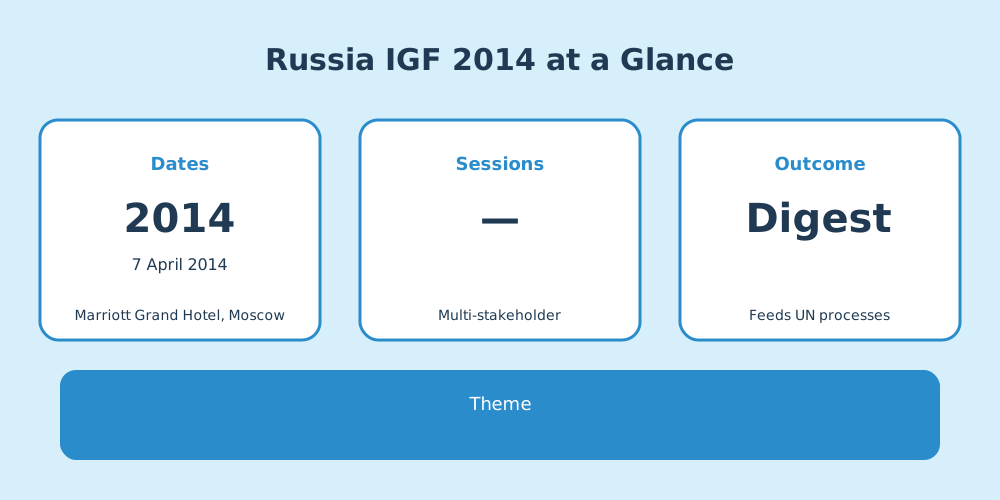
| Official name | 5th Russian Internet Governance Forum (RIGF 2014) |
| Dates | 7 April 2014 |
| Venue | Marriott Grand Hotel, Moscow |
| Theme | Regional governance themes |
| Award | Olaf Kolkman (Director of NLnet Labs, former IAB chair) received the forum's Order for Services to the Internet |
| Host | Coordination Center for TLD RU/РФ and the Technical Center of Internet (TCI), supported by ICANN and RAEC |
| Milestone | 20th anniversary of the .RU domain (delegated 7 April 1994), with a video address from Prime Minister Dmitry Medvedev |
(See the source list at the end of this article.)
Discussion Digest — from the Session Records
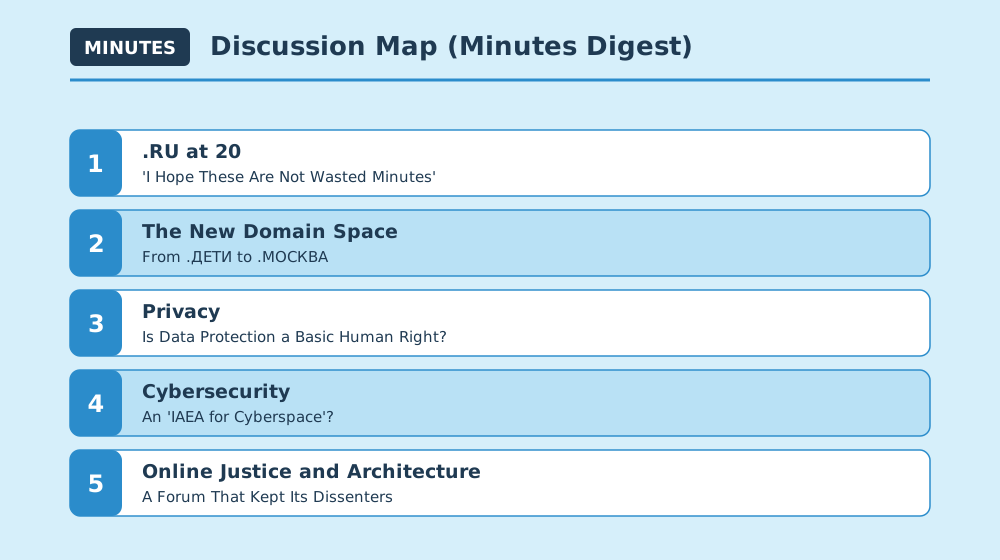
Key exchanges extracted from session records and transcripts.
1. .RU at 20 — 'I Hope These Are Not Wasted Minutes'
Sessions: Press conference on the .RU 20th anniversary (11:45–12:30) and session 'The Tips and Tricks of the Internet Economy' (10:45–11:45)
"An average web user spends over 100 minutes per day in the .RU zone — I hope these are not wasted minutes"
— Dmitry Medvedev (Prime Minister of Russia, video address) [4][3][2]
"We have nurtured .RU to maturity and are now giving the same treatment to .РФ"
— Marina Nikerova (Deputy General Director, Technical Center of Internet) [4][3][2]
- RAEC's Sergei Plugotarenko reported the internet economy at 8.5% of Russian GDP, 5 million jobs, and over 80% of 2013 investment deals landing in IT [4][3][2]
- Medvedev noted Russia led Europe in internet users; the day closed with an anniversary concert at Arena Moscow [4][3][2]
2. The New Domain Space — From .ДЕТИ to .МОСКВА
Sessions: Session 2 'Face the Domain Space' (13:30–15:00) and the 'Meet New Domains' panel
- Limited registration opened for .ДЕТИ, the Cyrillic children's domain, while .МОСКВА/.MOSCOW, .TATAR, .РУС and Ukraine's .УКР presented their launch strategies [2][5][3]
- With ICANN's new gTLD programme exploding the namespace, city, ethnic and language domains were pitched as vessels of local identity [2][5][3]
- Notably, Ukraine's .УКР took the stage — technical-community dialogue holding even amid political crisis [2][5][3]
3. Privacy — Is Data Protection a Basic Human Right?
Sessions: Session 1 'Fear/no/Action. Privacy on the Net' (13:30–15:00)
- Panellists framed online personal-data protection as a basic human right, centring on how far government and business access to user data should go [5][2]
- Chatham House's Caroline Baylon, Microsoft, the communications ministry, RAEC and MSU's Ivan Zasurskiy debated — one year after Snowden, the surveillance-versus-service line was a global question [5][2]
4. Cybersecurity — An 'IAEA for Cyberspace'?
Sessions: Session 3 'Cybersecurity – Liquidity vs. Solidity' (15:30–17:00) and the danger-free internet panel
- Participants floated an IAEA-style international institution to combat transnational cybercrime [5][2]
- RIPE NCC, Czech registry NIC.CZ, cybercrime investigators Group-IB, Kaspersky Lab and Federation Council members weighed how international best practice translates into Russian domestic contexts [5][2]
- The gap between national approaches and international coordination — soon to widen in cyber-norms negotiations — was already on the table [5][2]
5. Online Justice and Architecture — A Forum That Kept Its Dissenters
Sessions: Session 4 '…and Justice for All' (15:30–17:00) and the special address (17:00–18:00)
- The '…and Justice for All' session seated critics of the state — Agora human-rights lawyer Damir Gainutdinov and Pirate Party leader Pavel Rassudov — to debate anonymity, access to information and copyright enforcement [2][5][3]
- Former IAB chair Olaf Kolkman closed with 'Internet Architecture as the Basis of Future Innovation' and received the forum's internet merit award [2][5][3]
- With the blogger-registration law and other restrictions arriving within months, this was among the last editions to feature critical civil society on the official programme [2][5][3]
Three-Minute Short Talk — Your Questions Answered
Q. So what did the conference actually decide?
A. Nothing binding — it was a birthday and a policy forum in one: 20 years of .RU, a prime-ministerial video, and debates stretching from cybersecurity to a human-rights lawyer's critique.
Q. What was the most contentious topic?
A. How far government and business may reach into user data. A year after Snowden, panellists asserted that online data protection is a basic human right.
Q. Why should I care?
A. The .RU story — a country-code domain growing into an economic backbone — mirrors every national domain, and the months after this forum showed how quickly an open national internet can be reined in.
What Is Russia IGF? (for first-time readers)
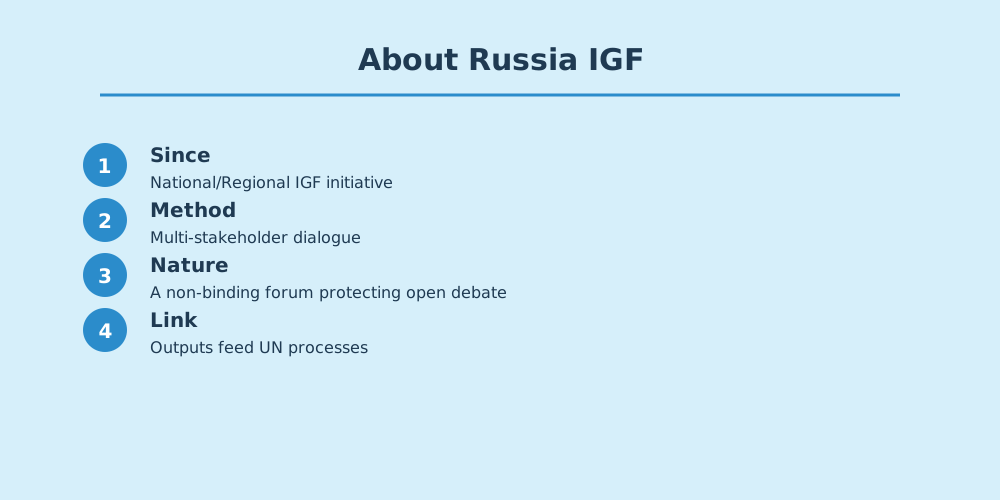
Russia IGF is a National or Regional IGF Initiative (NRI), aligning local internet governance discussion with global IGF principles.
Why It Matters to You
What was discussed here becomes the baseline for national digital policy, platform rules and AI regulation worldwide within a few years. The principles confirmed at the 2014 meeting are the foundation of the "next rules" for the phones, social platforms and AI services you use every day.
Sources & References
- Russian Internet Governance Forum – 2014(公式サイト) — ロシア国別ドメイン調整センター(Coordination Center for TLD RU/РФ) (accessed 2026-07-11)
- Program of Russian Internet Governance Forum 2014(公式プログラム) — ロシア国別ドメイン調整センター(Coordination Center for TLD RU/РФ) (accessed 2026-07-11)
- Marina Nikerova: We have nurtured .RU to maturity(公式プレスリリース・開会報告) — ロシア国別ドメイン調整センター(Coordination Center for TLD RU/РФ) (accessed 2026-07-11)
- Dmitry Medvedev congratulates Russian web users on 20 years of .RU domain zone(公式プレスリリース) — ロシア国別ドメイン調整センター(Coordination Center for TLD RU/РФ) (accessed 2026-07-11)
- RIGF participants discuss human rights and cyber security(公式プレスリリース・閉会報告) — ロシア国別ドメイン調整センター(Coordination Center for TLD RU/РФ) (accessed 2026-07-11)
Quotes are translated or condensed from the records listed above. Bracketed numbers [n] refer to the source list.
Related links
- IGF official (NRI list): https://www.intgovforum.org/en/content/national-and-regional-igf-initiatives
- Japan IGF: https://japanigf.jp/
- Yuki Nakazawa's blog: https://nkzw.jp/category/igf/
Revision History
Rev. 1 — published 27 June 2014, 11:00 (Article published)
Rev. 2 — updated 17 July 2026, 12:32 (Fully revised into the in-depth edition: added the 3-line summary, minutes digest, short talk, source list and diagrams (all quotes verified against the listed sources))
— 中澤祐樹

