


The 3-Line Summary
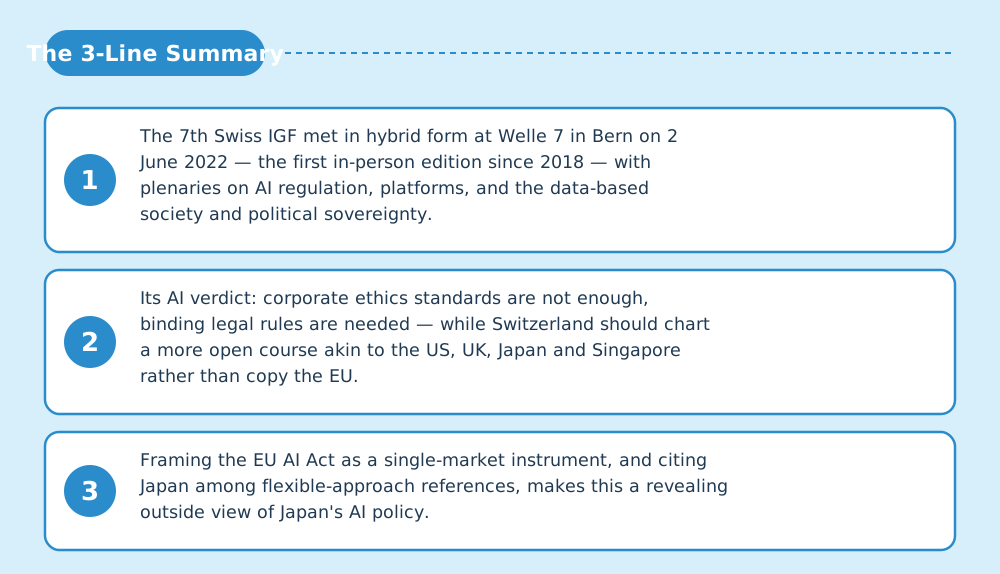
- The 7th Swiss IGF met in hybrid form at Welle 7 in Bern on 2 June 2022 — the first in-person edition since 2018 — with plenaries on AI regulation, platforms, and the data-based society and political sovereignty.
- Its AI verdict: corporate ethics standards are not enough, binding legal rules are needed — while Switzerland should chart a more open course akin to the US, UK, Japan and Singapore rather than copy the EU.
- Framing the EU AI Act as a single-market instrument, and citing Japan among flexible-approach references, makes this a revealing outside view of Japan's AI policy.
Welcome — this is the Japan IGF Support Organization. This in-depth report on Swiss IGF 2022 (7th Swiss Internet Governance Forum) draws on official outputs, session records and on-site reporting. In a hurry? The three lines above and the diagrams carry the gist.
Conference at a Glance (from official records)
| Item | Detail |
|---|---|
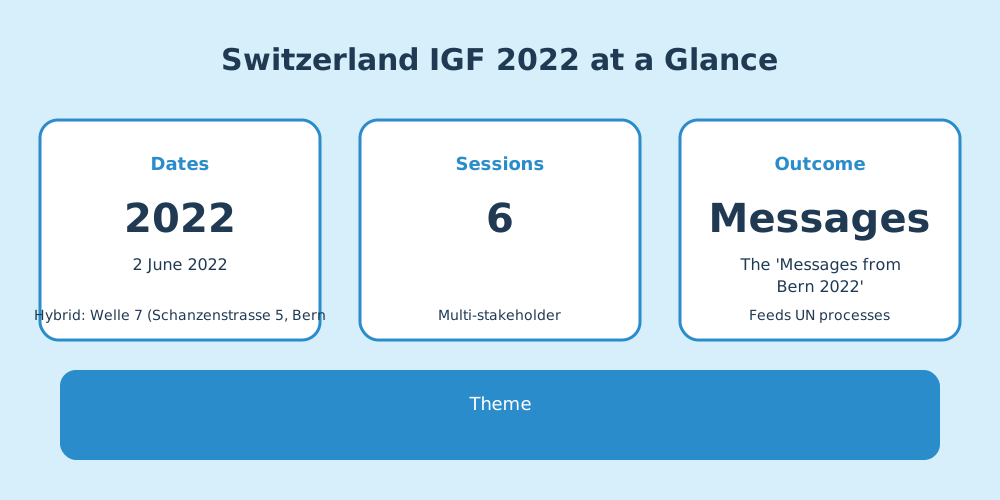
| Official name | Swiss IGF 2022 (7th Swiss Internet Governance Forum) |
| Dates | 2 June 2022 |
| Venue | Hybrid: Welle 7 (Schanzenstrasse 5, Bern) and Zoom |
| Theme | Regional governance themes |
| Sessions | 6 (Three plenaries (AI regulation; platforms; data-based society and sovereignty) plus three workshops (sustainability; cybersecurity; digital participation)) |
| Host | Multistakeholder steering group under OFCOM patronage |
| Outcome | The 'Messages from Bern 2022', submitted to the UN IGF and EuroDIG |
(See the source list at the end of this article.)
Discussion Digest — from the Session Records
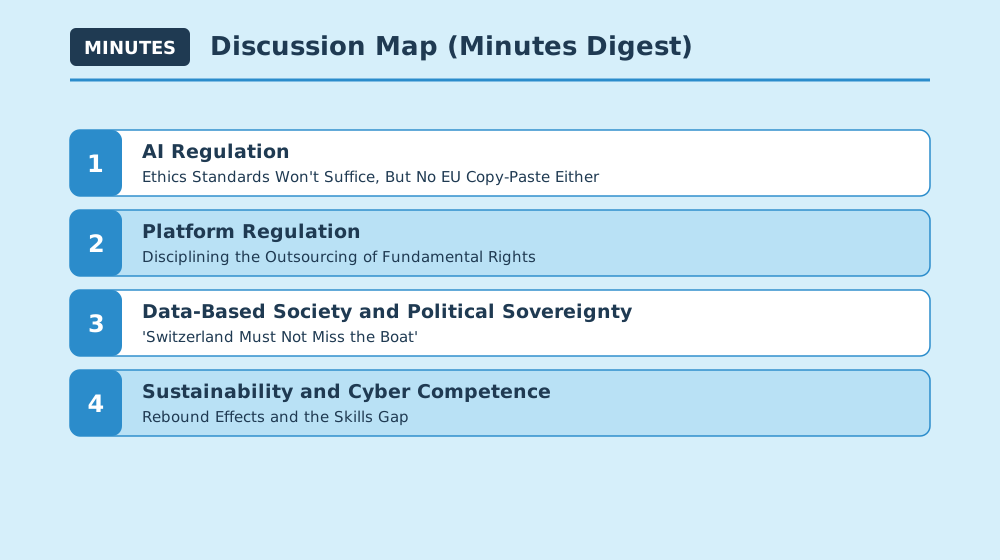
Key exchanges extracted from session records and transcripts.
1. AI Regulation — Ethics Standards Won't Suffice, But No EU Copy-Paste Either
Sessions: Plenary 1 "'Regulation' of artificial intelligence – What is Switzerland doing?"
- Regulation is needed — and waiting for EU standards puts Switzerland at a disadvantage; the right course is active involvement in international fora (especially the Council of Europe) while developing national solutions [1]
- Corporate self-set ethical standards are not sufficient: binding legal rules are needed, combining international technical standards with technology-neutral national law on liability and non-discrimination [1]
- The EU's draft AI regulation should be understood as safeguarding the single market; Switzerland should adopt a more open approach (like the USA, UK, Japan, Singapore), with publicly funded independent supervisory bodies, an observatory or AI auditing entities conceivable [1]
2. Platform Regulation — Disciplining the Outsourcing of Fundamental Rights
Sessions: Plenary 2 'Platforms: Political-economic challenges and their regulation'
- Social media increasingly shapes opinion formation, especially among the young; platforms' own measures fall short — more needs to be done [1]
- Where fundamental rights are concerned — e.g. restrictions on freedom of expression — the outsourcing of state tasks must be regulated in a nuanced way, weighing proportionality and context such as voting campaigns [1]
- Access to platform data and understanding of how platforms work are insufficient; better access is needed, especially for researchers, as is happening at European level [1]
3. Data-Based Society and Political Sovereignty — 'Switzerland Must Not Miss the Boat'
Sessions: Plenary 3 'Data-based society and political sovereignty'
- In a deeply interconnected digital world, classical sovereignty is hard to insist on; trade-offs — efficiency through centralisation versus security through decentralisation — must be weighed [1]
- Economies of scale make platform monopolies likely; once systemically relevant, they displace traditional players — raising the question of democratic control [1]
- With the EU's Data Governance Act in place, 'Switzerland must not miss the boat': an OFCOM/FDFA report envisages, among other things, a code of conduct for dataspace operators [1]
4. Sustainability and Cyber Competence — Rebound Effects and the Skills Gap
Sessions: Workshop 1 'Digitalisation and sustainability' / Workshop 2 'Cybersecurity and cyber competence'
- Digitalisation offers big efficiency potential, but rebound effects risk wiping out the gains; with most Swiss-caused emissions generated abroad, life-cycle-wide data and transparency are needed [1]
- Cybersecurity is a process, not a state — and the basis of successful digital transformation; investment in skilled staff from interns to CEOs is needed to close the skills gap [1]
- The paradox of building secure systems from insecure components was flagged; approaches from voluntary labels to binding standards were recommended beyond critical infrastructure, and the risk of machine-learning systems misdirected by distorted input data was debated [1]
Three-Minute Short Talk — Your Questions Answered
Q. What did it decide?
A. Nothing binding — the 'Messages from Bern 2022' went to the UN IGF and EuroDIG, built on AI, platforms and data sovereignty.
Q. Most contentious point?
A. Switzerland's AI stance: binding legal rules yes, automatic EU alignment no — with the USA, UK, Japan and Singapore cited as the open-approach references.
Q. Why care?
A. It is a rare documented moment of a European forum citing Japan's flexible AI-governance approach as a model worth considering.
What Is Switzerland IGF? (for first-time readers)
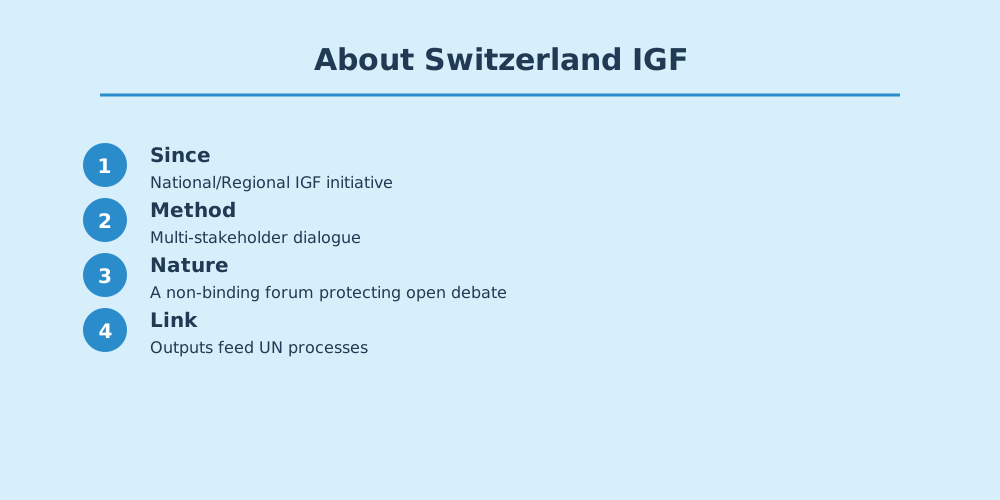
Switzerland IGF is a National or Regional IGF Initiative (NRI), aligning local internet governance discussion with global IGF principles.
Why It Matters to You
What was discussed here becomes the baseline for national digital policy, platform rules and AI regulation worldwide within a few years. The principles confirmed at the 2022 meeting are the foundation of the "next rules" for the phones, social platforms and AI services you use every day.
Sources & References
- Messages from Bern (Swiss IGF 2022, final version) — Swiss IGF (accessed 2026-07-23)
- Swiss IGF 2022(大会ページ) — igf.swiss (accessed 2026-07-23)
- About the Swiss IGF — igf.swiss (accessed 2026-07-23)
- National IGFs — Western European and Others Regional Group (WEOG) — 国連IGF事務局(Waybackアーカイブ) (accessed 2026-07-23)
Quotes are translated or condensed from the records listed above. Bracketed numbers [n] refer to the source list.
Related links
- IGF official (NRI list): https://www.intgovforum.org/en/content/national-and-regional-igf-initiatives
- Japan IGF: https://japanigf.jp/
- Yuki Nakazawa's blog: https://nkzw.jp/category/igf/
更新履歴
第1稿投稿 2026年8月1日 20時02分(記事コンテンツアップ)
— 中澤祐樹

