

The 3-Line Summary
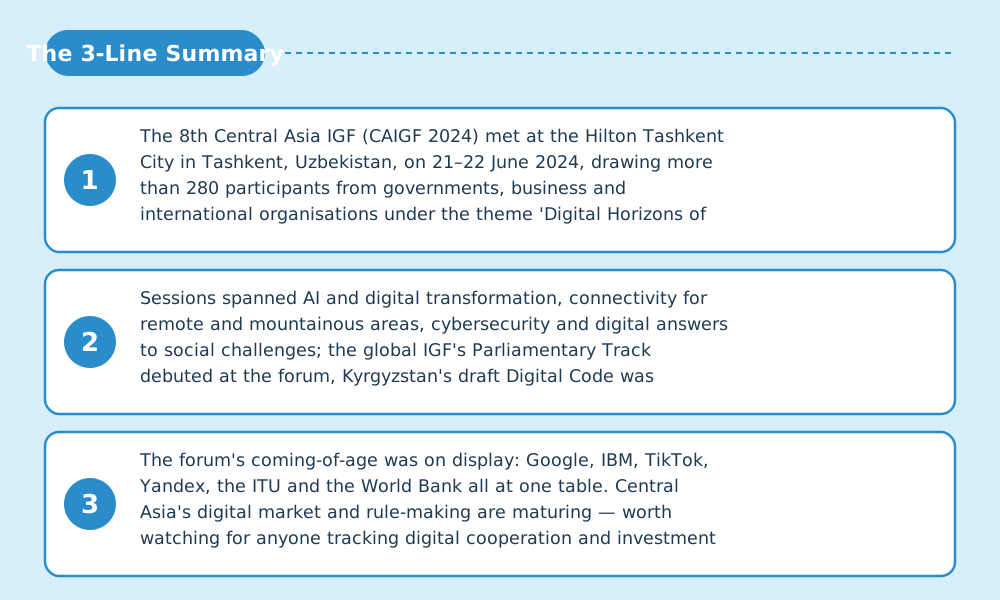
- The 8th Central Asia IGF (CAIGF 2024) met at the Hilton Tashkent City in Tashkent, Uzbekistan, on 21–22 June 2024, drawing more than 280 participants from governments, business and international organisations under the theme 'Digital Horizons of Central Asia: Innovation, Security and Development'.
- Sessions spanned AI and digital transformation, connectivity for remote and mountainous areas, cybersecurity and digital answers to social challenges; the global IGF's Parliamentary Track debuted at the forum, Kyrgyzstan's draft Digital Code was presented, and a new regional Digital Resilience Association was announced.
- The forum's coming-of-age was on display: Google, IBM, TikTok, Yandex, the ITU and the World Bank all at one table. Central Asia's digital market and rule-making are maturing — worth watching for anyone tracking digital cooperation and investment in the region.
Welcome — this is the Japan IGF Support Organization. This in-depth report on CAIGF 2024 in Tashkent draws on official outputs, session records and on-site reporting. In a hurry? The three lines above and the diagrams carry the gist.
📍 [Catalogue discrepancy] The catalogue lists Almaty for 2024, which is incorrect: the 8th CAIGF (2024) was held at the Hilton Tashkent City in Tashkent, Uzbekistan. Almaty, Kazakhstan, hosted the 7th edition on 10 November 2023; the catalogue entry likely conflates the two
Conference at a Glance (from official records)
| Item | Detail |
|---|---|
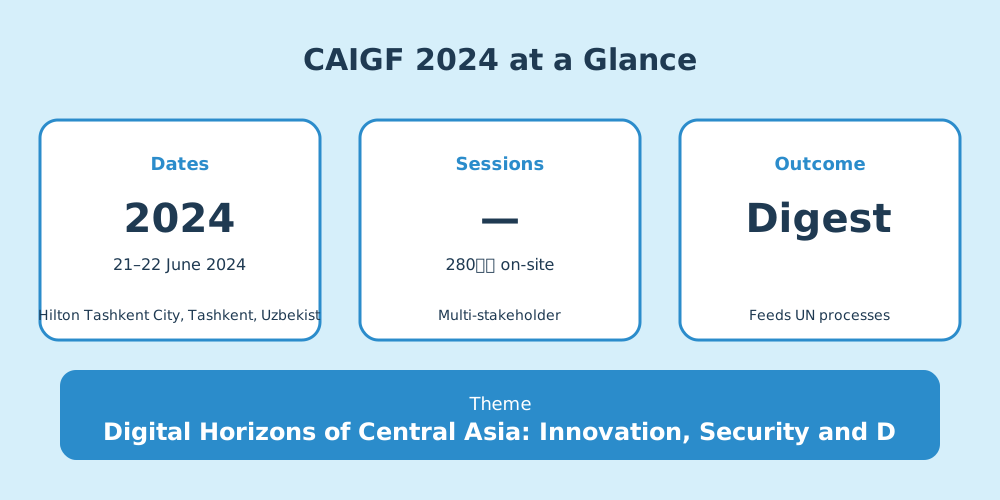
| Edition | 8th Central Asia IGF |
| Dates | 21–22 June 2024 |
| Venue | Hilton Tashkent City, Tashkent, Uzbekistan |
| Theme | Digital Horizons of Central Asia: Innovation, Security and Development |
| Participants | More than 280 participants: government agencies of Uzbekistan, Kazakhstan, Tajikistan, Kyrgyzstan and Armenia, experts from the USA, Canada, China, Switzerland, France and Estonia among others, and global technology companies including Google and IBM (per the official report) |
| Host | Organised by the National Legal Corporation (NLC), together with the Civil Initiative on Internet Policy (CIIP), Uzbekistan's Ministry of Digital Technologies and UNIVERSOFT IT |
(See the source list at the end of this article.)
Discussion Digest — from the Session Records
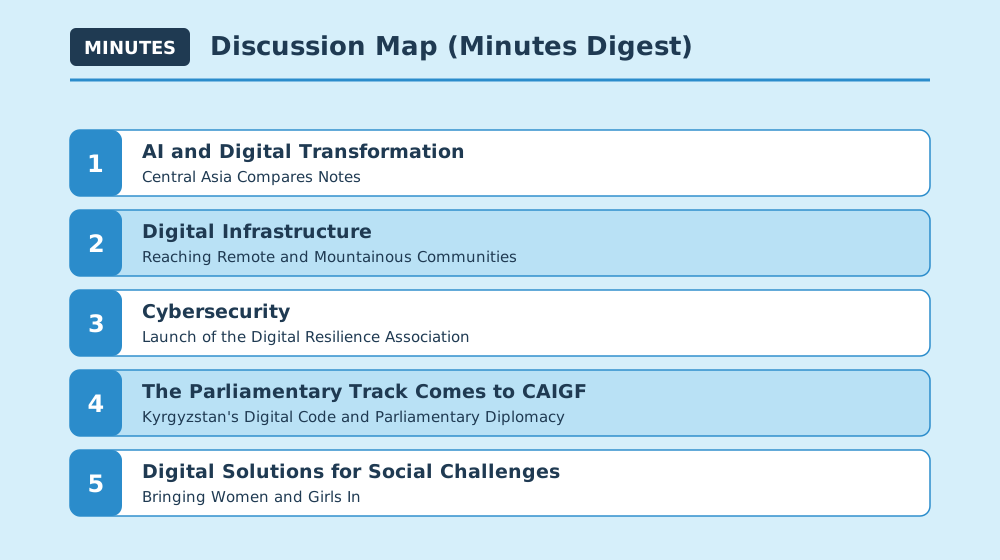
Key exchanges extracted from session records and transcripts.
1. AI and Digital Transformation — Central Asia Compares Notes
Sessions: Session 1 'Digital Transformation in Central Asia: Challenges and Opportunities for the State, Business, and Citizens' (21 June)
- Sherzod Shermatov, Uzbekistan's minister of digital technologies, opened the forum, framing it (per the official report) as a unique chance for the region's countries to compare notes on digital development and shape a regional digital agenda while balancing Internet security and accessibility [1]
- Google's government relations director for Central Asia, Ms Skorokhodova, presented on AI's potential, citing an Ipsos–Google study across 17 countries showing widespread optimism that AI will deliver major benefits, from faster work to better transport, education and quality of life [1]
- Estonia's ambassador Tomas Tiirs shared his country's digital-government and AI experience and IBM's Oleg Byakhov presented enterprise technologies for public-sector transformation; the session closed on the need for a flexible regulatory environment to enable AI, big data and cloud adoption [1]
2. Digital Infrastructure — Reaching Remote and Mountainous Communities
Sessions: Session 2 'Digital Infrastructure: Realizing the Potential of Central Asia in the Age of Technology'
- Moderated by Natalia Mochu, ITU regional director for the CIS, with speakers including Michel Rogy, World Bank digital development practice manager, ICANN's Mikhail Anisimov for Eastern Europe and Central Asia, the UNESCO office in Uzbekistan and Uzbekistan's IT Park [1]
- The focus fell on building reliable, affordable network infrastructure and on inclusive access, so the benefits of digitalisation reach all communities — including remote and mountainous areas [1]
3. Cybersecurity — Launch of the Digital Resilience Association
Sessions: Session 3 'A Secure Digital Future for Central Asia: Strategies, Initiatives, and Cooperation in an Era of Growing Cyber Threats'
- Olzhas Satiyev, head of the Center for Analysis and Investigation of Cyber Attacks (TSARKA), announced the creation of a Digital Resilience Association uniting industry, business and the state to build a secure digital future for Central Asia [1]
- Erkin Khalikov, head of incident investigation at Uzbekistan's UZCERT, traced the evolution of cyber threats and their impact on society and the state, urging cybersecurity policies tailored to the region's needs and capacities; the session called for national and regional strategies plus digital-hygiene education [1]
4. The Parliamentary Track Comes to CAIGF — Kyrgyzstan's Digital Code and Parliamentary Diplomacy
Sessions: Session 4 'Contributing to Digital Transformation: The Key Role of Parliamentarians in shaping the Digital Space' (21 June)
- The IGF's expanding Parliamentary Track reached the regional level with a dedicated session at CAIGF, joined by parliamentarians from Kyrgyzstan and Tajikistan and government representatives from Uzbekistan [1][2]
- Tattu Mambetalieva, director general of the NLC, presented Kyrgyzstan's Digital Code — a framework unifying all digital norms in one document, shaped with the experience of forty countries and thirty experts and soon to be submitted to the Kyrgyz Parliament [1][2]
- Armenian MP Alexei Sandikov underlined the value of parliamentary diplomacy, while Olivier Crépin-Leblond, coordinator of the IGF Dynamic Coalition on Core Internet Values, called on lawmakers to safeguard core Internet values — interoperability, decentralisation and the end-to-end principle — in legislation [1][2]
5. Digital Solutions for Social Challenges — Bringing Women and Girls In
Sessions: Session 5 'Digital Initiatives to Address Social Challenges in the Region' (22 June)
- Day 2 was opened by Oleg Pekos, Uzbekistan's first deputy minister of digital technologies, who per the official report stressed making digital opportunity available to all — including women and girls — and called investment in girls' education and technical training an investment in the future [1]
- Discussion covered telemedicine, online education and digital financial services as answers to social challenges, with speakers including TechnoWomen co-founder Ms Shuzheeva, TikTok's government relations director for Eastern Europe, a Yandex regional director and UNESCO — concluding that government, civil society and business must combine efforts [1]
Three-Minute Short Talk — Your Questions Answered
Q. Did the meeting actually decide anything?
A. It is not a decision-making body, but concrete initiatives emerged: the announcement of a regional Digital Resilience Association for cybersecurity, the unveiling of Kyrgyzstan's Digital Code consolidating its digital legislation, and the first regional edition of the UN IGF's Parliamentary Track.
Q. What was the most debated topic?
A. How to embrace AI. Optimism about AI's benefits (a Google–Ipsos study across 17 countries) and calls for flexible regulation ran alongside warnings about growing cyber threats and the balance between Internet security and accessibility.
Q. Why should I care?
A. Parliamentarians joining Internet governance debates is a worldwide trend, and a Central Asian forum that seats Google, IBM, TikTok, the ITU and the World Bank at one table signals a digital market — and rule-making arena — coming of age.
What Is CAIGF? (for first-time readers)
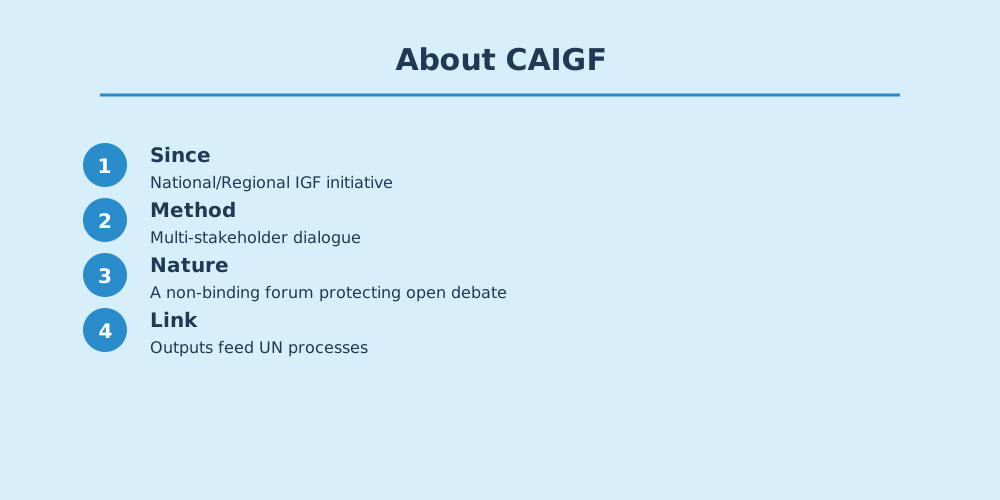
CAIGF is a National or Regional IGF Initiative (NRI), aligning local internet governance discussion with global IGF principles.
Why It Matters to You
What was discussed here becomes the baseline for national digital policy, platform rules and AI regulation worldwide within a few years. The principles confirmed at the 2024 meeting are the foundation of the "next rules" for the phones, social platforms and AI services you use every day.
Sources & References
- Report on the Eighth Central Asia Internet Governance Forum (CAIGF 2024) (PDF) — caigf.org (accessed 2026-07-11)
- IGF 2024 Parliamentary Track — UN IGF Secretariat (accessed 2026-07-11)
- Ташкент примет 8-ой Центрально-Азиатский Форум по Управлению Интернетом(タシケントが第8回CAIGFを開催) — Digital Rights Asia(ロシア語) (accessed 2026-07-11)
- Central Asian Internet Governance Forum CAIGF 2024 — CEMC, cemc.uz (accessed 2026-07-11)
- VIII Центрально-Азиатский форум по управлению интернетом: «Цифровые горизонты Центральной Азии»(第8回CAIGF告知) — namsb.tj、ロシア語 (accessed 2026-07-11)
- Центрально-Азиатский Форум по Управлению Интернетом 2023: Шаг Вперёд в Цифровое Будущее(CAIGF 2023はアルマトイ開催 — 2023年11月10日) — CIIP, キルギス、ロシア語 (accessed 2026-07-11)
Quotes are translated or condensed from the records listed above. Bracketed numbers [n] refer to the source list.
Related links
- IGF official (NRI list): https://www.intgovforum.org/en/content/national-and-regional-igf-initiatives
- Japan IGF: https://japanigf.jp/
- Yuki Nakazawa's blog: https://nkzw.jp/category/igf/
Revision History
Rev. 1 — published 15 September 2024, 15:00 (Article published)
Rev. 2 — updated 11 July 2026, 02:14 (Fully revised into the in-depth edition: added the 3-line summary, minutes digest, short talk, source list and diagrams (all quotes verified against the listed sources))
— 中澤祐樹