


The 3-Line Summary
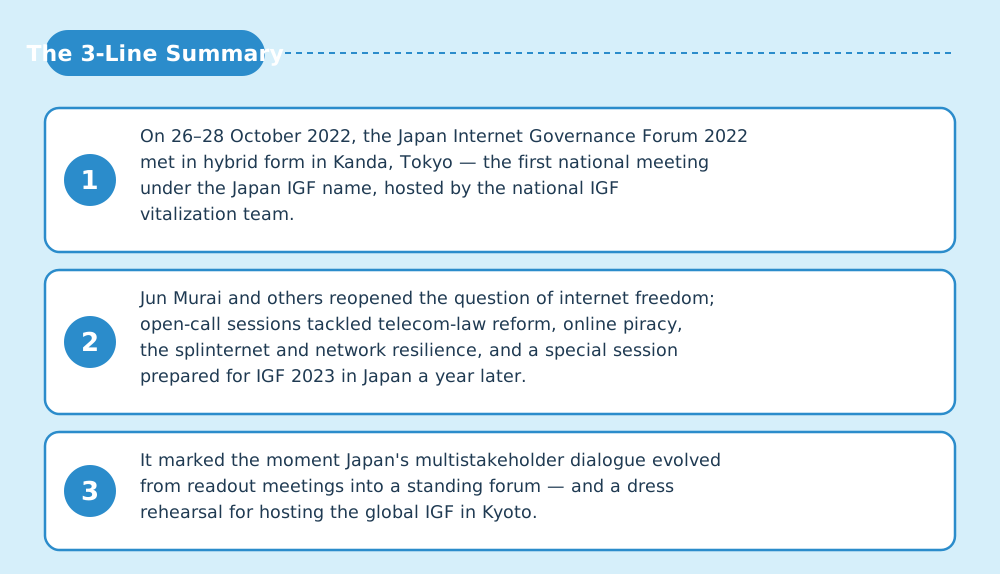
- On 26–28 October 2022, the Japan Internet Governance Forum 2022 met in hybrid form in Kanda, Tokyo — the first national meeting under the Japan IGF name, hosted by the national IGF vitalization team.
- Jun Murai and others reopened the question of internet freedom; open-call sessions tackled telecom-law reform, online piracy, the splinternet and network resilience, and a special session prepared for IGF 2023 in Japan a year later.
- It marked the moment Japan's multistakeholder dialogue evolved from readout meetings into a standing forum — and a dress rehearsal for hosting the global IGF in Kyoto.
Welcome — this is the Japan IGF Support Organization. This in-depth report on Japan Internet Governance Forum 2022 — Toward IGF 2023 in Japan draws on official outputs, session records and on-site reporting. In a hurry? The three lines above and the diagrams carry the gist.
📍 The pre-event (metaverse session) was held online only
Conference at a Glance (from official records)
| Item | Detail |
|---|---|
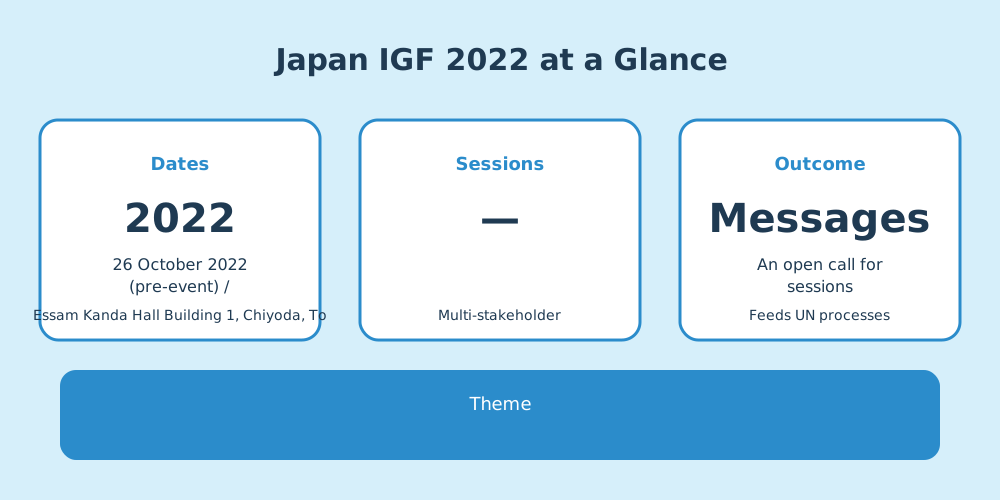
| Official name | Japan Internet Governance Forum 2022 — Toward IGF 2023 in Japan |
| Dates | 26 October 2022 (pre-event) / 27–28 October 2022 (main days) |
| Venue | Essam Kanda Hall Building 1, Chiyoda, Tokyo + online (Zoom) |
| Theme | Regional governance themes |
| Host | Team for Vitalizing Japan's National IGF Activities toward IGF 2023 |
| Outcome | An open call for sessions (May–June 2022) drew four proposals, all accepted |
| Milestone | The first national meeting held under the 'Japan Internet Governance Forum' name |
(See the source list at the end of this article.)
Discussion Digest — from the Session Records
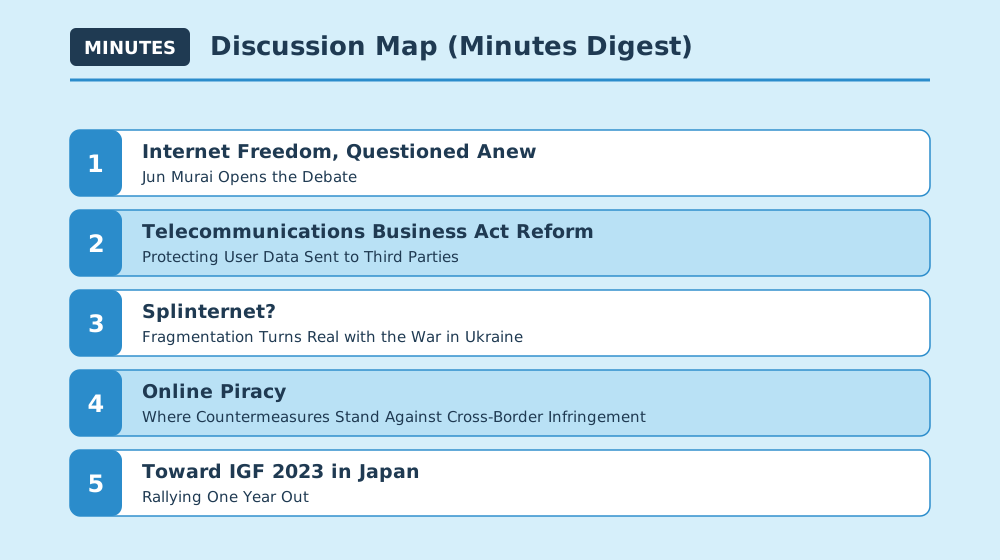
Key exchanges extracted from session records and transcripts.
1. Internet Freedom, Questioned Anew — Jun Murai Opens the Debate
Sessions: Opening session (27 October)
"The internet has become an infrastructure whose impact is simply too great"
— Jun Murai (Professor, Keio University) [2][3]
- Murai framed the issues: who steps in when abuse arises in this human-made global space, what role governments should play, and how to reconcile the merging of physical and cyber space (per JPNIC's meeting report) [2][3]
- The opening featured a video message from Chengetai Masango of the UN IGF Secretariat, and Osamu Onodera (Deputy Director-General, MIC Global Strategy Bureau) spoke about hosting IGF 2023 in Japan [2][3]
- Murai noted that 2023 would bring not only the IGF but also the G7 and IETF to Japan, urging the country to build its internet-governance capacity [2][3]
2. Telecommunications Business Act Reform — Protecting User Data Sent to Third Parties
Sessions: Theme Session 1: The Telecom Business Act Amendment and Internet Governance (27 October)
- Jun Inoue (MIC) explained the amended Telecommunications Business Act — enacted June 2022, effective June 2023 — introducing rules on proper handling of user information [2][3]
- Ryoji Mori (Eichi Law Offices) recounted how a job-hunting site had sold predictions of students declining offers based on browsing history, and how industry objections had watered down the original transmission-regulation proposal [2][3]
- Panellists sparred over whether such rules should be settled within MIC's remit at all, or handled through revision of the personal-data protection law [2][3]
3. Splinternet? — Fragmentation Turns Real with the War in Ukraine
Sessions: Theme Session 3: Splinternet? (28 October)
- Toshiya Jitsuzumi (Chuo University) noted the term 'fragmentation' dates to the 2000s, offering an economic analysis of why networks split — or don't — and mapping movements triggered by the war in Ukraine [2][3][4]
- Akinori Maemura (JPNIC) described what the war brought to internet-infrastructure bodies, including disconnection requests, and the dialogue highlighted the public-interest character of the technical community [2][3][4]
- Ichiro Mizukoshi (NTT East) distinguished 'splinternet 1.0 and 2.0' and ran thought experiments on geopolitics versus the free flow of information [2][3][4]
4. Online Piracy — Where Countermeasures Stand Against Cross-Border Infringement
Sessions: Theme Session 2: The State of Online Piracy and Its Countermeasures (27 October)
- George Shishido (University of Tokyo), Kuniko Ogawa (MIC) and panellists from publishing, law and the technical community reviewed anti-piracy efforts after Japan's site-blocking controversy [2][3]
- Concrete enforcement barriers were shared: the difficulty of mobilising foreign law enforcement, domain-name hopping, and WHOIS registrations filed with false information [2][3]
- Approaches beyond blocking were discussed, including steering users toward legitimate content [2][3]
5. Toward IGF 2023 in Japan — Rallying One Year Out
Sessions: Special session (28 October)
- Yoichi Iida (MIC), Junko Kawauchi (IGF Multistakeholder Advisory Group), Akinori Maemura and Rafik Dammak (ICANN GNSO NCSG) discussed preparations for IGF 2023 in Japan the following year [1][2][3][4]
- The forum itself was built from an open call — four session proposals, all accepted — serving as a rehearsal of Japan's multistakeholder machinery before welcoming the global IGF to Kyoto [1][2][3][4]
- JPNIC's report candidly noted that matching the global IGF's discussion-heavy format would require 'an entirely different approach' [1][2][3][4]
Three-Minute Short Talk — Your Questions Answered
Q. What exactly was a 'first' here?
A. It was the first national meeting held under the name Japan Internet Governance Forum. Until then, Japan's domestic activity had centred on readout and preparatory meetings, not a standing forum.
Q. What was the hottest topic?
A. Telecom-law reform. Starting from a job-site scandal — selling predictions of students declining offers — panellists frankly dissected how industry pushback watered down rules on sending user data to third parties.
Q. How does it connect to IGF 2023?
A. It was the dress rehearsal for IGF 2023 in Kyoto a year later, building Japan's multistakeholder machinery through an open session call and a dedicated preparatory session.
What Is Japan IGF? (for first-time readers)
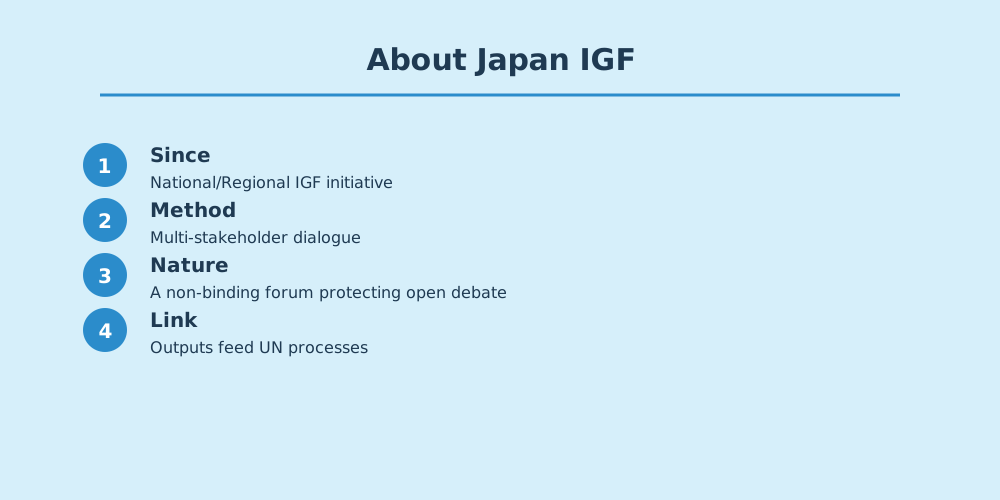
Japan IGF is a National or Regional IGF Initiative (NRI), aligning local internet governance discussion with global IGF principles.
Why It Matters to You
What was discussed here becomes the baseline for national digital policy, platform rules and AI regulation worldwide within a few years. The principles confirmed at the 2022 meeting are the foundation of the "next rules" for the phones, social platforms and AI services you use every day.
Sources & References
- 日本インターネットガバナンスフォーラム2022 ~ IGF2023日本開催を見据えて(開催案内) — Japan IGF(日本IGF公式サイト) (accessed 2026-07-11)
- 日本インターネットガバナンスフォーラム2022 ~ IGF2023日本開催を見据えて(プログラム・発表資料) — JPNIC (accessed 2026-07-11)
- JPNIC News & Views vol.1959 特集:「日本インターネットガバナンスフォーラム2022」開催報告 — JPNIC (accessed 2026-07-11)
- 今のインターネットは本当に一枚岩なのか? "スプリンターネット"問題など、IGF 2023に向けて議論 — INTERNET Watch(インプレス) (accessed 2026-07-11)
- 日本インターネットガバナンスフォーラム2022 ~IGF2023日本開催を見据えて~ 最終のご案内 — JPNIC (accessed 2026-07-11)
Quotes are translated or condensed from the records listed above. Bracketed numbers [n] refer to the source list.
Related links
- IGF official (NRI list): https://www.intgovforum.org/en/content/national-and-regional-igf-initiatives
- Japan IGF: https://japanigf.jp/
- Yuki Nakazawa's blog: https://nkzw.jp/category/igf/
Revision History
Rev. 1 — published 15 September 2022, 14:00 (Article published)
Rev. 2 — updated 16 July 2026, 20:09 (Fully revised into the in-depth edition: added the 3-line summary, minutes digest, short talk, source list and diagrams (all quotes verified against the listed sources))
— 中澤祐樹

