


The 3-Line Summary
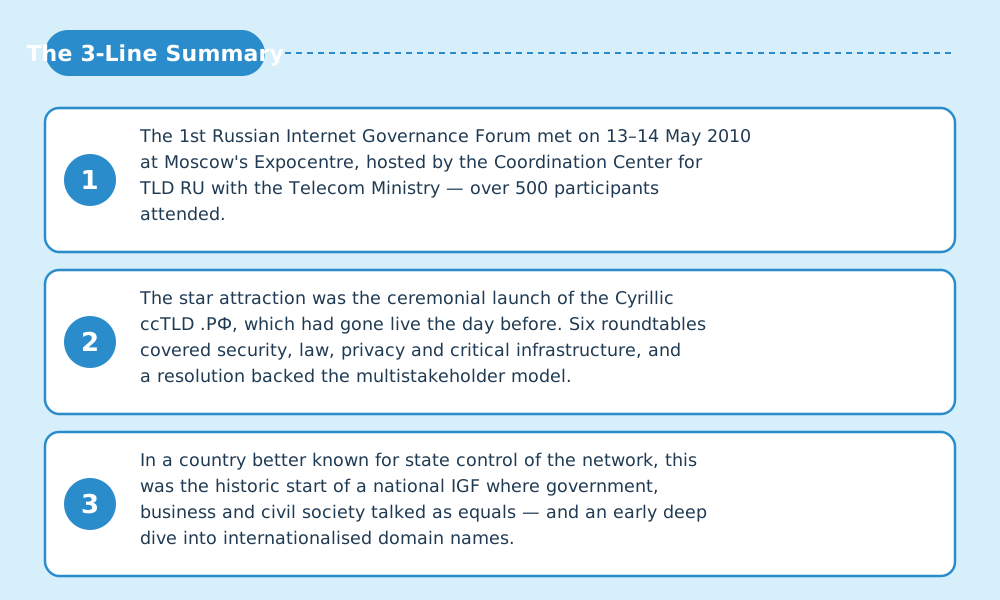
- The 1st Russian Internet Governance Forum met on 13–14 May 2010 at Moscow's Expocentre, hosted by the Coordination Center for TLD RU with the Telecom Ministry — over 500 participants attended.
- The star attraction was the ceremonial launch of the Cyrillic ccTLD .РФ, which had gone live the day before. Six roundtables covered security, law, privacy and critical infrastructure, and a resolution backed the multistakeholder model.
- In a country better known for state control of the network, this was the historic start of a national IGF where government, business and civil society talked as equals — and an early deep dive into internationalised domain names.
Welcome — this is the Japan IGF Support Organization. This in-depth report on 1st Russian Internet Governance Forum (RIGF 2010) draws on official outputs, session records and on-site reporting. In a hurry? The three lines above and the diagrams carry the gist.
Conference at a Glance (from official records)
| Item | Detail |
|---|---|
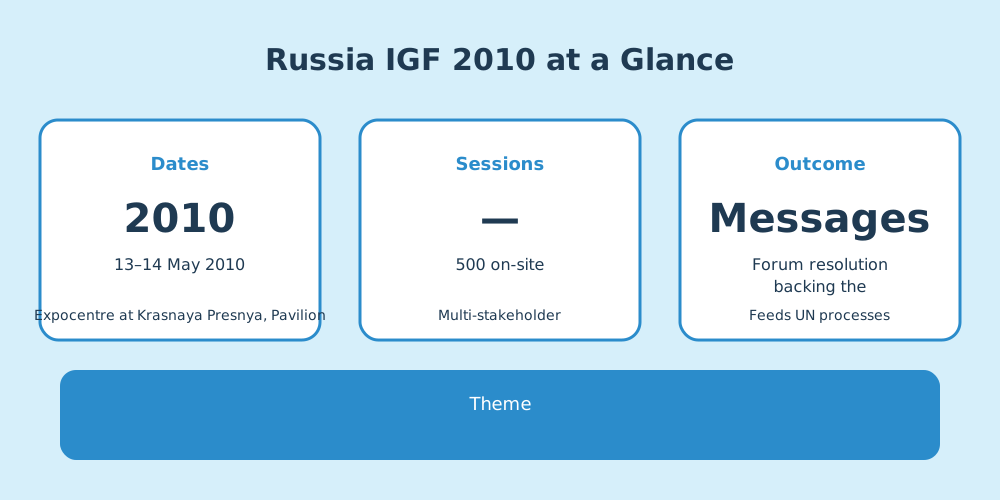
| Official name | 1st Russian Internet Governance Forum (RIGF 2010) |
| Dates | 13–14 May 2010 |
| Venue | Expocentre at Krasnaya Presnya, Pavilion 8, Moscow |
| Theme | Regional governance themes |
| Participants | 500 |
| Host | Coordination Center for TLD RU; co-organised by the RF Ministry of Telecom and Mass Media |
| Outcome | Forum resolution backing the multistakeholder model, bridging the digital divide, prioritising access and security, and supporting participation in the global IGF and ICANN |
| Milestone | Ceremonial launch of the Cyrillic ccTLD .РФ — billed as the first global domain-industry event in Russia and Eastern Europe |
(See the source list at the end of this article.)
Discussion Digest — from the Session Records
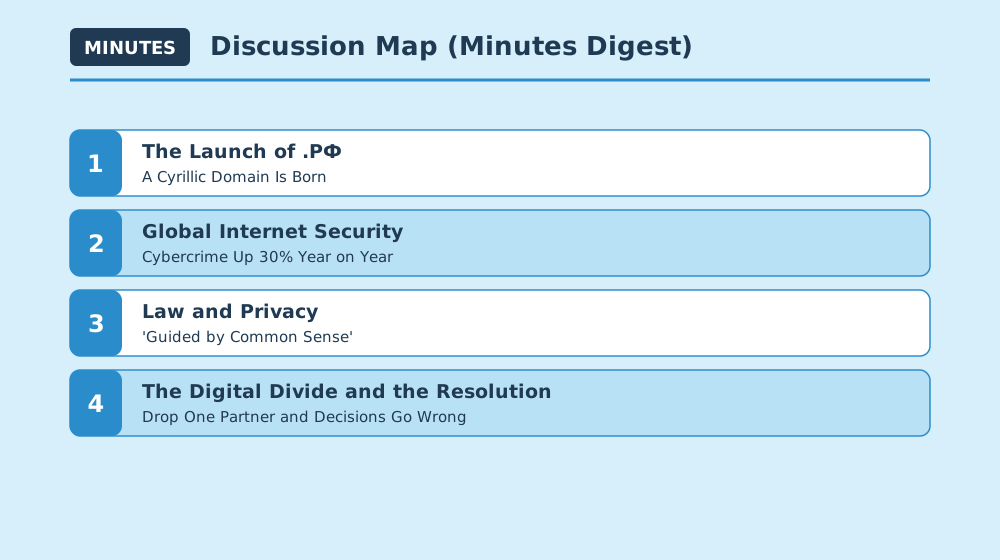
Key exchanges extracted from session records and transcripts.
1. The Launch of .РФ — A Cyrillic Domain Is Born
Sessions: Roundtable 4 'Internationalized Domain Names' (13 May, 16:00–17:30) and the launch ceremony
"I typed yesterday президент.рф – that's great! Seems I've been doing it all my life"
— Andrei Kolesnikov (Director, Coordination Center for TLD RU) [3][2]
- ICANN CEO Rod Beckstrom handed the .РФ commemorative certificate to Kolesnikov; the domain had gone live at 17:41 on 12 May, with the first sites up at 18:00 [3][2]
- Some 80,000 Russian trademarks had already applied for priority .РФ registration, signalling strong demand for Cyrillic domains [3][2]
- Mikhail Fedotov of the Russian Journalists Alliance asked whether non-Latin domains might drive 'nationalisation and defragmentation' of the internet [3][2]
2. Global Internet Security — Cybercrime Up 30% Year on Year
Sessions: Roundtable 2 'The Global Internet Security' (13 May, 14:00–15:30)
"Cybercrime has grown 30% compared with the previous year"
— Rod Beckstrom (CEO/President, ICANN) [3][2]
- The Conficker response — 100+ countries coordinating through ICANN against 3–5 million infected PCs — was presented as a model of international cooperation [3][2]
- The Friendly RUnet Foundation reported 9,700 child-exploitation reports in 2009, with 3,300 resources fully or partially removed [3][2]
- Kaspersky Lab's Andrey Yarnykh detailed black-market malware pricing, showing how organised cybercrime had become [3][2]
3. Law and Privacy — 'Guided by Common Sense'
Sessions: Roundtable 1 'Legal Issues of Internet Governance' and Roundtable 3 'Balance between Transparency and Protection of Privacy' (13 May)
"In the current volatile Internet reality, it is very hard to think up and enact promptly new laws, so we are also guided by common sense"
— Lesley Cowley (CEO, Nominet) [3][2]
- Mail.ru's Maxim Bobin put provider liability for user-generated content — then a gap in Russian law — squarely on the table [3][2]
- Practitioners from DENIC, Nominet and academia (Prof. Rolf Weber, Zurich) compared regulatory and self-regulatory balances across Europe [3][2]
- The closing wrap-up called for a Russian internet-governance glossary: untranslated English terms were causing genuine mutual misunderstanding [3][2]
4. The Digital Divide and the Resolution — Drop One Partner and Decisions Go Wrong
Sessions: Opening plenary 'Bridging the Digital Divide and the Future of the Internet' (13 May) and closing plenary (14 May)
"IG involves three partners, i.e. government, business and civil society. Once any of them falls out, the decisions made turn out to be flawed"
— Mikhail Yakushev (Chairman of the Council, Coordination Center for TLD RU) [1][3][2]
"Our country is most proactive in shaping the global information environment"
— Igor Schegolev (RF Minister of Telecom and Mass Media) [1][3][2]
- The adopted resolution called for nurturing the multistakeholder model, making affordable access a priority for regional regulators, keeping access and security on the agenda, and boosting participation in the global IGF and ICANN [1][3][2]
- The opening plenary seated US Assistant Secretary Lawrence Strickling, ICANN's Rod Beckstrom and State Duma security-committee members side by side — East and West on one stage [1][3][2]
- IGF Secretariat coordinator Markus Kummer announced the 5th global IGF (Vilnius, September 2010), plugging the Russian debate into the worldwide forum [1][3][2]
Three-Minute Short Talk — Your Questions Answered
Q. So what did the conference actually decide?
A. It adopted a resolution backing the multistakeholder model and affordable access. The bigger story: it celebrated the launch of the Cyrillic .РФ domain and started Russia's first national IGF where government, business and civil society talk as equals.
Q. What was the most contentious topic?
A. Whether native-script domains might fragment the internet along national lines — plus the unresolved question of whether providers are liable for what users post.
Q. Why should I care?
A. .РФ belongs to the same family as Japanese, Arabic or Chinese domain names: internationalised domain names that let people use the net in their own script. This forum toasted one of the first large-scale rollouts.
What Is Russia IGF? (for first-time readers)
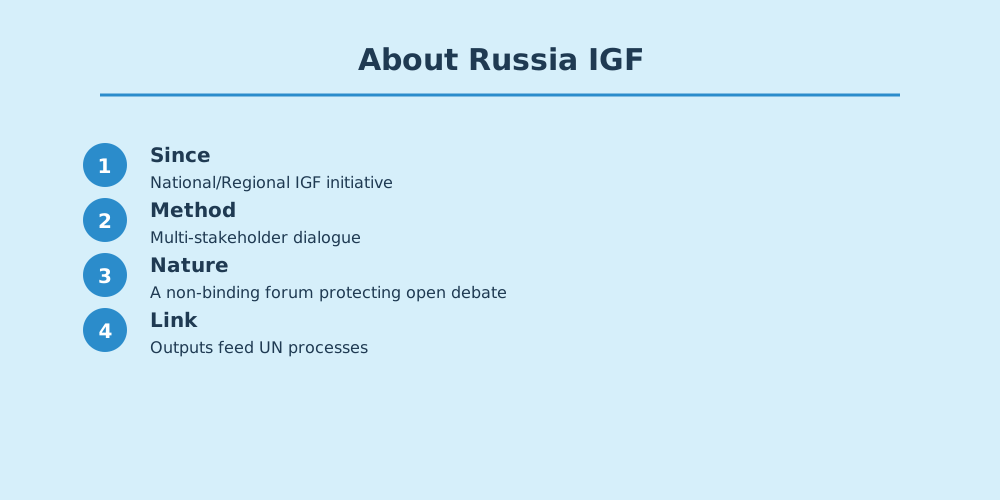
Russia IGF is a National or Regional IGF Initiative (NRI), aligning local internet governance discussion with global IGF principles.
Why It Matters to You
What was discussed here becomes the baseline for national digital policy, platform rules and AI regulation worldwide within a few years. The principles confirmed at the 2010 meeting are the foundation of the "next rules" for the phones, social platforms and AI services you use every day.
Sources & References
- First Russian Internet Governance Forum(公式サイト・決議要旨) — ロシア国別ドメイン調整センター(Coordination Center for TLD RU) (accessed 2026-07-11)
- RIGF 2010 Program(公式プログラム) — ロシア国別ドメイン調整センター(Coordination Center for TLD RU) (accessed 2026-07-11)
- RIGF 2010 Forum Report(公式フォーラム報告書) — ロシア国別ドメイン調整センター(Coordination Center for TLD RU) (accessed 2026-07-11)
- Russia IGF(国連IGFのNRIレコード。初回2010年開催の記載) — UN IGF Secretariat (accessed 2026-07-11)
Quotes are translated or condensed from the records listed above. Bracketed numbers [n] refer to the source list.
Related links
- IGF official (NRI list): https://www.intgovforum.org/en/content/national-and-regional-igf-initiatives
- Japan IGF: https://japanigf.jp/
- Yuki Nakazawa's blog: https://nkzw.jp/category/igf/
Revision History
Rev. 1 — published 5 June 2010, 13:00 (Article published)
Rev. 2 — updated 17 July 2026, 12:32 (Fully revised into the in-depth edition: added the 3-line summary, minutes digest, short talk, source list and diagrams (all quotes verified against the listed sources))
— 中澤祐樹

