


The 3-Line Summary
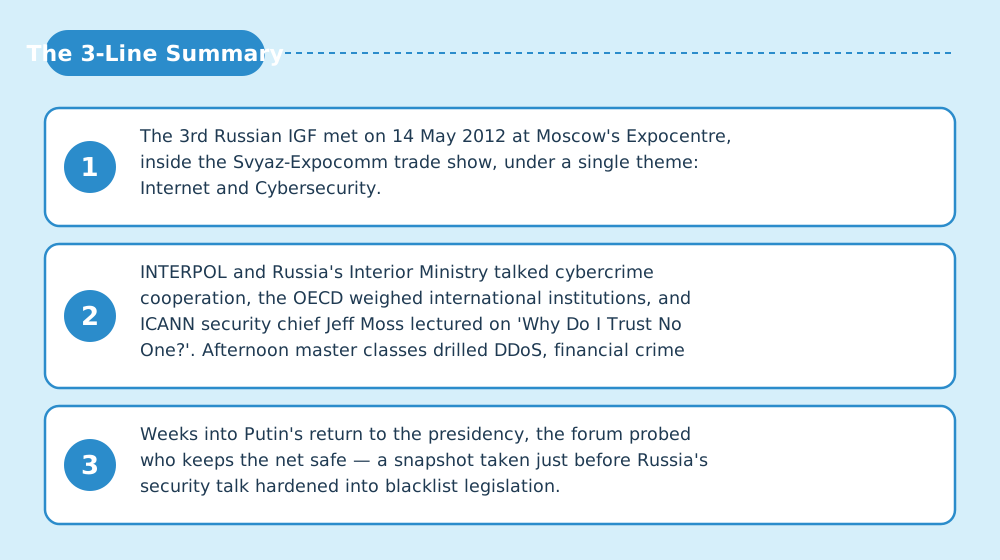
- The 3rd Russian IGF met on 14 May 2012 at Moscow's Expocentre, inside the Svyaz-Expocomm trade show, under a single theme: Internet and Cybersecurity.
- INTERPOL and Russia's Interior Ministry talked cybercrime cooperation, the OECD weighed international institutions, and ICANN security chief Jeff Moss lectured on 'Why Do I Trust No One?'. Afternoon master classes drilled DDoS, financial crime and spam defence.
- Weeks into Putin's return to the presidency, the forum probed who keeps the net safe — a snapshot taken just before Russia's security talk hardened into blacklist legislation.
Welcome — this is the Japan IGF Support Organization. This in-depth report on 3rd Russian Internet Governance Forum (RIGF 2012) draws on official outputs, session records and on-site reporting. In a hurry? The three lines above and the diagrams carry the gist.
📍 Held within the Svyaz-Expocomm 2012 trade show; admission free with registration
Conference at a Glance (from official records)
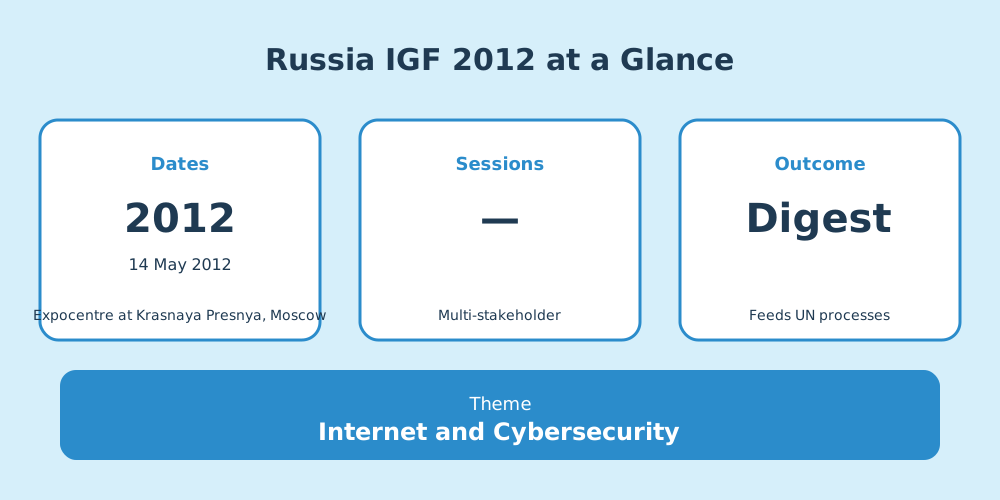
| Item | Detail |
|---|---|
| Official name | 3rd Russian Internet Governance Forum (RIGF 2012) |
| Dates | 14 May 2012 |
| Venue | Expocentre at Krasnaya Presnya, Moscow |
| Theme | Internet and Cybersecurity |
| Host | Coordination Center for TLD RU/РФ, supported by the RF Ministry of Communications and Mass Media |
(See the source list at the end of this article.)
Discussion Digest — from the Session Records
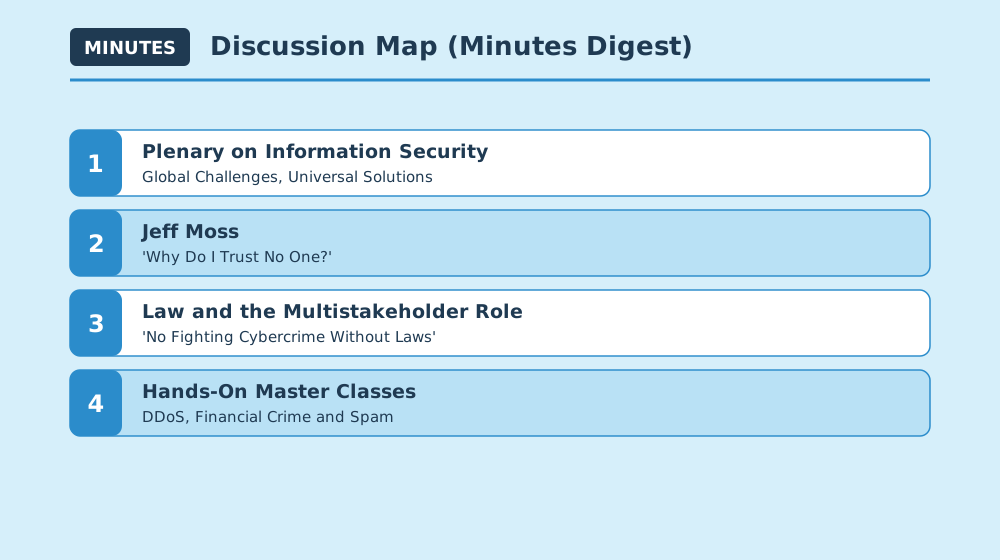
Key exchanges extracted from session records and transcripts.
1. Plenary on Information Security — Global Challenges, Universal Solutions
Sessions: Plenary 'Information Security: Global Challenges, Universal Solutions' (10:30–12:30)
"We can truly take pride in the Russian internet today (translated from Russian)"
— Igor Shchegolev (RF Minister of Communications and Mass Media) [2][3]
- INTERPOL's Michael Moran and Alexey Moshkov of the Russian Interior Ministry's Bureau for Special Technical Measures discussed cross-border cybercrime cooperation; the OECD's Andrew Wyckoff covered the role of international institutions [2][3]
- Minister Shchegolev noted that a patchwork of bilateral security agreements was complicating international cooperation (official press release, in Russian) [2][3]
- Closing the forum, Coordination Center director Andrey Kolesnikov declared Russia had become a leading internet power with Europe's largest internet business (translated from Russian) [2][3]
2. Jeff Moss — 'Why Do I Trust No One?'
Sessions: Cybersecurity Update (13:00–14:00)
- DEF CON founder and ICANN Chief Security Officer Jeff Moss delivered a solo lecture, 'Technological Aspects of Cybersecurity: Why Do I Trust No One?' [3][2]
- Moss argued that technology, more than regulation, is the first line of cyber defence — a trust-nothing design philosophy that anticipated today's zero-trust orthodoxy [3][2]
3. Law and the Multistakeholder Role — 'No Fighting Cybercrime Without Laws'
Sessions: Plenary segment 4 on multistakeholder initiatives and related discussions
"We cannot fight cybercrime without creating laws (with international foundations; translated from Russian)"
— Natalya Kasperskaya (CEO, InfoWatch) [3][2]
- ISOC's Andrey Robachevsky insisted security measures must not erode the internet's core values — connectivity, integrity and its collaborative potential [3][2]
- Young legislators — Federation Council member Ruslan Gattarov and Duma deputy Robert Shlegel — tested the distance between regulation and industry self-help [3][2]
- The DDoS segment paired the Global Cyber Security Center's Andrea Rigoni with ICANN's Jeff Moss on the practicalities of attack response [3][2]
4. Hands-On Master Classes — DDoS, Financial Crime and Spam
Sessions: Four concurrent interactive master classes (14:00–17:30)
- Four tracks — copyright and internet integrity, online financial crime, DDoS and hacks, spam and viruses — offered practical defence training, complete with prize contests [2][4]
- Co-location with the Svyaz-Expocomm 2012 trade show and free admission opened the forum to working engineers and businesses, not just policy insiders [2][4]
Three-Minute Short Talk — Your Questions Answered
Q. So what did the conference actually decide?
A. Nothing formal — it was a themed deep-dive. INTERPOL, the OECD, ICANN and Russian officials spent the day working out how international cybercrime cooperation should be built.
Q. What was the most contentious topic?
A. Laws versus technology. 'We cannot fight cybercrime without laws' clashed with Jeff Moss's technology-first, trust-no-one philosophy.
Q. Why should I care?
A. DDoS, phishing and spam exploded globally right after this period. And the security-first rhetoric aired here soon became the standard justification for internet restrictions in many countries.
What Is Russia IGF? (for first-time readers)
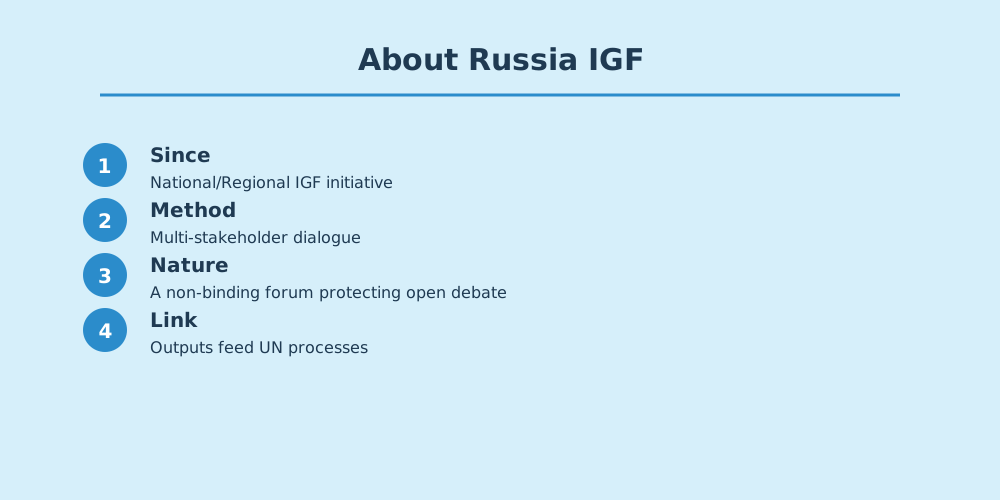
Russia IGF is a National or Regional IGF Initiative (NRI), aligning local internet governance discussion with global IGF principles.
Why It Matters to You
What was discussed here becomes the baseline for national digital policy, platform rules and AI regulation worldwide within a few years. The principles confirmed at the 2012 meeting are the foundation of the "next rules" for the phones, social platforms and AI services you use every day.
Sources & References
- Russian Internet Governance Forum – 2012(公式サイト) — ロシア国別ドメイン調整センター(Coordination Center for TLD RU/РФ) (accessed 2026-07-11)
- Program of Russian Internet Governance Forum 2012(公式プログラム) — ロシア国別ドメイン調整センター(Coordination Center for TLD RU/РФ) (accessed 2026-07-11)
- Вице-президент ICANN Джефф Мосс на RIGF-2012: «Почему я никому не доверяю?»(開催報告・ロシア語) — ロシア国別ドメイン調整センター(Coordination Center for TLD RU/РФ) (accessed 2026-07-11)
- Третий Российский форум по управлению интернетом(開催告知・ロシア語) — ロシア国別ドメイン調整センター(Coordination Center for TLD RU/РФ) (accessed 2026-07-11)
Quotes are translated or condensed from the records listed above. Bracketed numbers [n] refer to the source list.
Related links
- IGF official (NRI list): https://www.intgovforum.org/en/content/national-and-regional-igf-initiatives
- Japan IGF: https://japanigf.jp/
- Yuki Nakazawa's blog: https://nkzw.jp/category/igf/
Revision History
Rev. 1 — published 16 June 2012, 12:00 (Article published)
Rev. 2 — updated 17 July 2026, 12:32 (Fully revised into the in-depth edition: added the 3-line summary, minutes digest, short talk, source list and diagrams (all quotes verified against the listed sources))
— 中澤祐樹

