


The 3-Line Summary
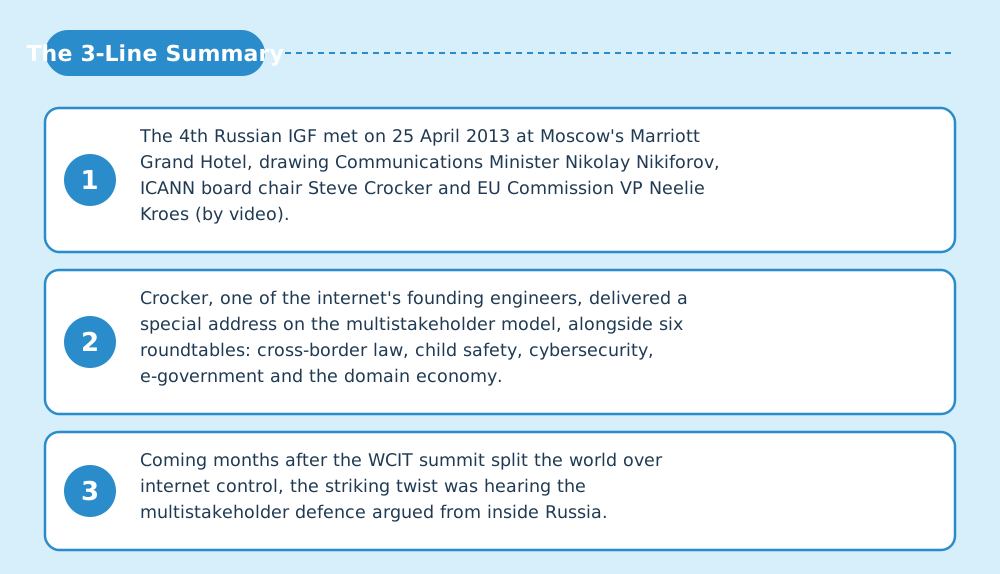
- The 4th Russian IGF met on 25 April 2013 at Moscow's Marriott Grand Hotel, drawing Communications Minister Nikolay Nikiforov, ICANN board chair Steve Crocker and EU Commission VP Neelie Kroes (by video).
- Crocker, one of the internet's founding engineers, delivered a special address on the multistakeholder model, alongside six roundtables: cross-border law, child safety, cybersecurity, e-government and the domain economy.
- Coming months after the WCIT summit split the world over internet control, the striking twist was hearing the multistakeholder defence argued from inside Russia.
Welcome — this is the Japan IGF Support Organization. This in-depth report on 4th Russian Internet Governance Forum (RIGF 2013) draws on official outputs, session records and on-site reporting. In a hurry? The three lines above and the diagrams carry the gist.
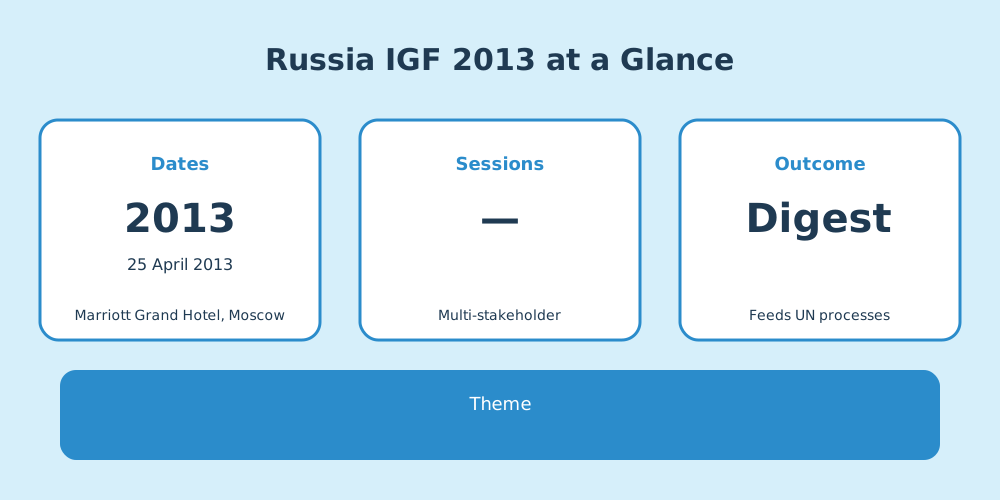
Conference at a Glance (from official records)
| Item | Detail |
|---|---|
| Official name | 4th Russian Internet Governance Forum (RIGF 2013) |
| Dates | 25 April 2013 |
| Venue | Marriott Grand Hotel, Moscow |
| Theme | Regional governance themes |
| Award | ICANN board chair Steve Crocker received the Coordination Center's internet merit award (Virtuti Interneti) |
| Host | Coordination Center for TLD RU/РФ, supported by RAEC and ICANN; general sponsor: Technical Center of Internet (TCI) |
(See the source list at the end of this article.)
Discussion Digest — from the Session Records
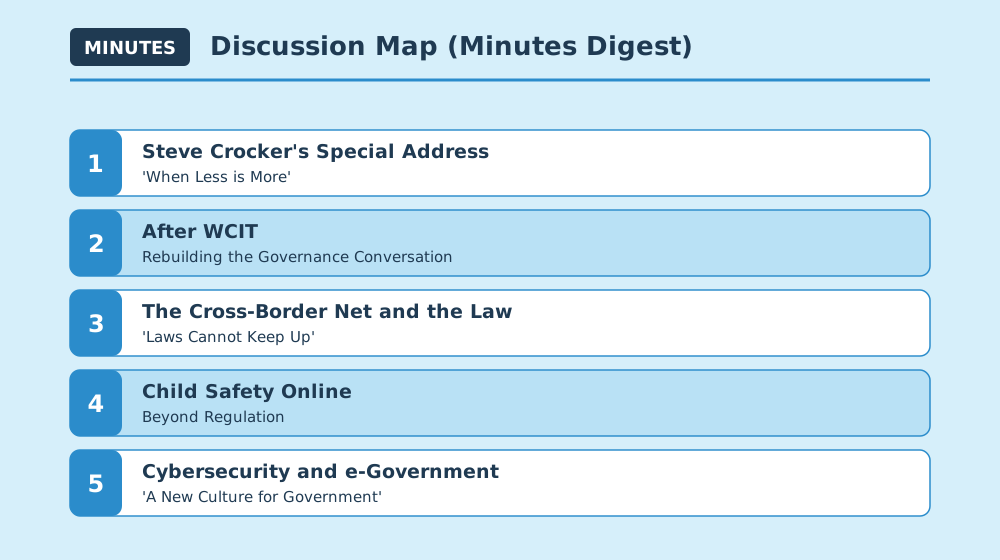
Key exchanges extracted from session records and transcripts.
1. Steve Crocker's Special Address — 'When Less is More'
Sessions: Special report 'When Less is More: The Past and Future of the Multi-Stakeholder Model of Internet Governance' (11:00–12:00)
"Since its introduction, the .РФ TLD is still a leading IDN in the entire world"
— Steve Crocker (Chair of the Board, ICANN) [3][2]
"Many things that seem common to us today have arisen from the assertiveness, minds and engineering skills of the like of Steve Crocker"
— Andrei Kolesnikov (Director, Coordination Center for TLD RU/РФ) [3][2]
- The Coordination Center honoured Crocker — creator of the RFC series and 'an Internet legend' — with its internet merit award [3][2]
- His address argued that light-touch, voluntary coordination rather than intergovernmental control had let the internet grow, and sketched the model's future [3][2]
2. After WCIT — Rebuilding the Governance Conversation
Sessions: Roundtable 5 'Prospects of the Internet governance system' (16:30–18:00)
"The differing opinions in Dubai show that all stakeholders are trying their best to facilitate Internet development (paraphrased from the official press release)"
— Veni Markovski (ICANN VP for stakeholder engagement) [2][4]
- Four months after WCIT-12 in Dubai split the world over the new telecom regulations — with Russia among the signatories — the post-mortem played out on a Moscow stage [2][4]
- Wolfgang Kleinwaechter, IFRI's Julien Nocetti and PIR Center's Oleg Demidov debated how the intergovernmental and multistakeholder camps could be reconciled [2][4]
3. The Cross-Border Net and the Law — 'Laws Cannot Keep Up'
Sessions: Roundtable 1 'Transborder or no borders: Internet and its legal aspects' (13:00–14:30)
"Laws are adopted at a very slow pace while the technology rushes forward"
— Lee Hibbard (Council of Europe) [2][3][4]
- Bertrand de la Chapelle of the Internet & Jurisdiction Project, ISOC, Microsoft and Russia's communications ministry wrestled with applying national law to a borderless network [2][3][4]
- Council of Europe director general Philippe Boillat declared 'there's no freedom without security,' listing child safety, cybercrime and personal data protection as priorities [2][3][4]
4. Child Safety Online — Beyond Regulation
Sessions: Roundtable 2 'Creating a playground in the Internet' (13:00–14:30)
- Moscow's children's ombudsman, UKCCIS council member John Carr, the creator of the hit cartoon Smeshariki, psychologists and educators discussed building positive online spaces for children rather than just blocking content [2][4]
- Russia's child-protection website blacklist law had taken effect in November 2012, making the regulate-or-cultivate balance an immediate policy question [2][4]
5. Cybersecurity and e-Government — 'A New Culture for Government'
Sessions: Roundtable 3 'Cybersecurity: evasive virtuality' and Roundtable 4 'e-Government: handiness made possible' (14:30–16:00)
"A new culture has to be created in the government sector"
— Barbara-Chiara Ubaldi (E-Government project leader, OECD) [2][4]
- The cybersecurity table seated the UK's Keir Giles and Li Yan of China's CICIR alongside ICANN's Jeff Moss, Cisco and Kaspersky Lab — a genuinely multipolar panel [2][4]
- The e-government table, with Estonia's e-Governance Academy, Moldova's deputy minister and the OECD, agreed that secure and convenient digital government requires public-private collaboration [2][4]
Three-Minute Short Talk — Your Questions Answered
Q. So what did the conference actually decide?
A. Nothing binding — its value was the timing. Right after WCIT split the world over who governs the internet, Russian officials, ICANN and European players held the post-mortem in one room.
Q. What was the most contentious topic?
A. Intergovernmental control versus the multistakeholder status quo. Russia had signed the intergovernmental side at WCIT, yet ICANN's chair defended the multistakeholder model from a Moscow podium.
Q. Why should I care?
A. The state-control-versus-multistakeholder fault line contested here still runs through UN negotiations on cybercrime and AI governance — debates that shape how free your internet stays.
What Is Russia IGF? (for first-time readers)
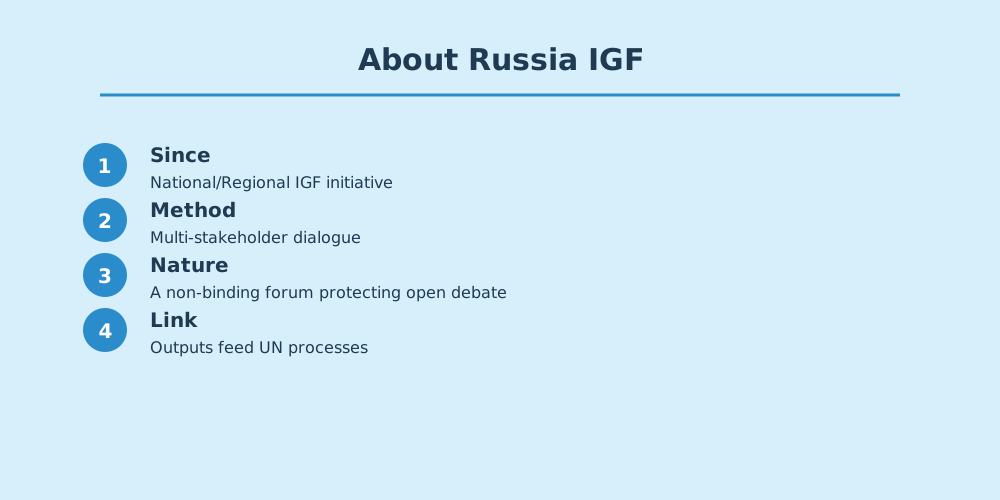
Russia IGF is a National or Regional IGF Initiative (NRI), aligning local internet governance discussion with global IGF principles.
Why It Matters to You
What was discussed here becomes the baseline for national digital policy, platform rules and AI regulation worldwide within a few years. The principles confirmed at the 2013 meeting are the foundation of the "next rules" for the phones, social platforms and AI services you use every day.
Sources & References
- Russian Internet Governance Forum – 2013(公式サイト) — ロシア国別ドメイン調整センター(Coordination Center for TLD RU/РФ) (accessed 2026-07-11)
- Program of Russian Internet Governance Forum 2013(公式プログラム) — ロシア国別ドメイン調整センター(Coordination Center for TLD RU/РФ) (accessed 2026-07-11)
- Steve Crocker: 'Since its introduction, the .РФ TLD is still a leading IDN in the entire world'(公式プレスリリース・開会報告) — ロシア国別ドメイン調整センター(Coordination Center for TLD RU/РФ) (accessed 2026-07-11)
- RIGF-2013 ends in Moscow, Russia(公式プレスリリース・閉会報告) — ロシア国別ドメイン調整センター(Coordination Center for TLD RU/РФ) (accessed 2026-07-11)
Quotes are translated or condensed from the records listed above. Bracketed numbers [n] refer to the source list.
Related links
- IGF official (NRI list): https://www.intgovforum.org/en/content/national-and-regional-igf-initiatives
- Japan IGF: https://japanigf.jp/
- Yuki Nakazawa's blog: https://nkzw.jp/category/igf/
Revision History
Rev. 1 — published 8 June 2013, 15:00 (Article published)
Rev. 2 — updated 17 July 2026, 12:32 (Fully revised into the in-depth edition: added the 3-line summary, minutes digest, short talk, source list and diagrams (all quotes verified against the listed sources))
— 中澤祐樹

