


The 3-Line Summary
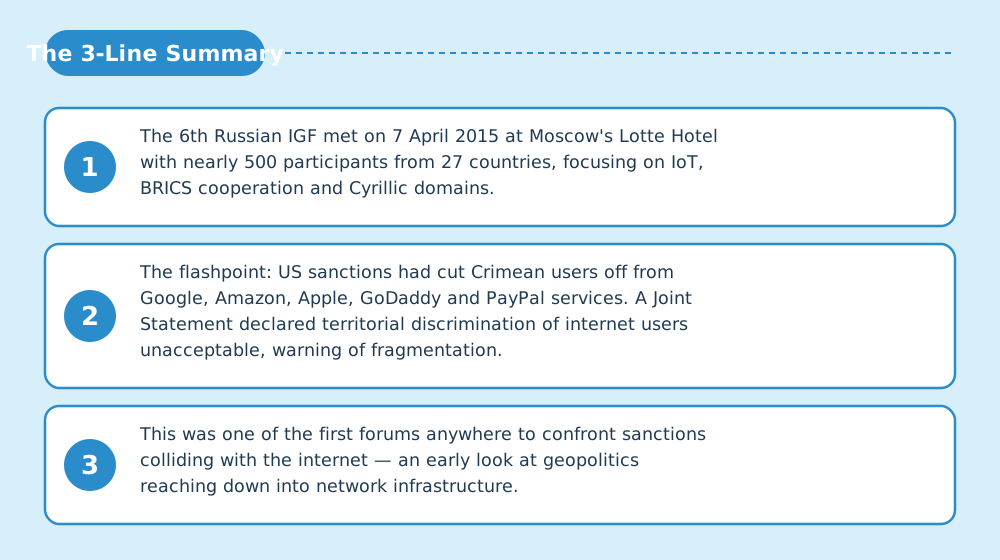
- The 6th Russian IGF met on 7 April 2015 at Moscow's Lotte Hotel with nearly 500 participants from 27 countries, focusing on IoT, BRICS cooperation and Cyrillic domains.
- The flashpoint: US sanctions had cut Crimean users off from Google, Amazon, Apple, GoDaddy and PayPal services. A Joint Statement declared territorial discrimination of internet users unacceptable, warning of fragmentation.
- This was one of the first forums anywhere to confront sanctions colliding with the internet — an early look at geopolitics reaching down into network infrastructure.
Welcome — this is the Japan IGF Support Organization. This in-depth report on 6th Russian Internet Governance Forum (RIGF 2015) draws on official outputs, session records and on-site reporting. In a hurry? The three lines above and the diagrams carry the gist.
Conference at a Glance (from official records)
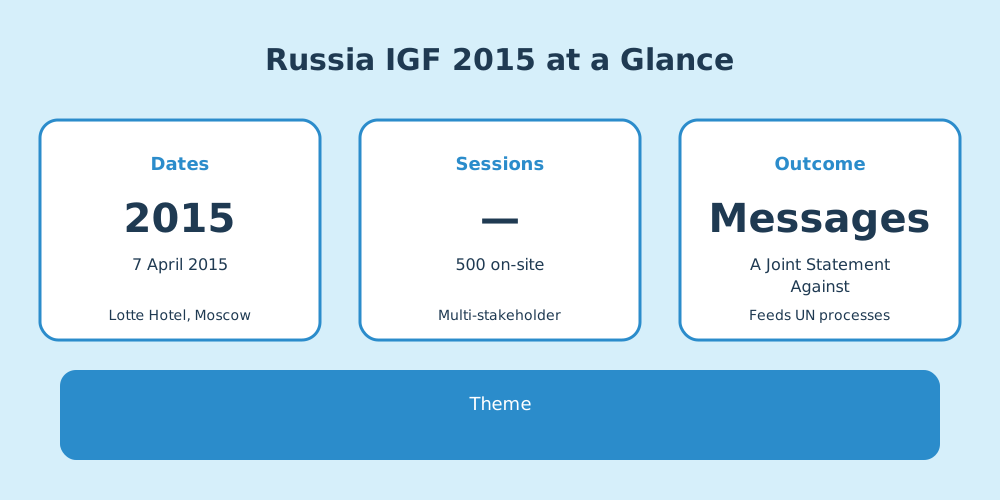
| Item | Detail |
|---|---|
| Official name | 6th Russian Internet Governance Forum (RIGF 2015) |
| Dates | 7 April 2015 |
| Venue | Lotte Hotel, Moscow |
| Theme | Regional governance themes |
| Participants | 500 |
| Award | Dr Paul Vixie received the forum's Order for Service to the Internet |
| Host | Coordination Center for TLD RU/РФ and the Technical Center of Internet, supported by the Telecom Ministry, ICANN, RAEC and Kaspersky Lab |
| Outcome | A Joint Statement Against Territorial Discrimination of Internet Users opened for signature |
(See the source list at the end of this article.)
Discussion Digest — from the Session Records
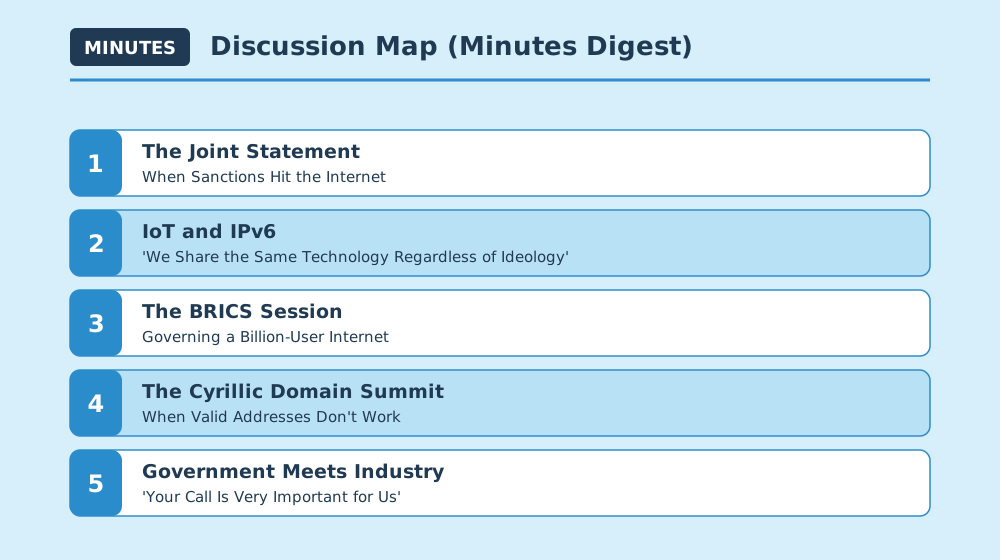
Key exchanges extracted from session records and transcripts.
1. The Joint Statement — When Sanctions Hit the Internet
Sessions: Joint Statement Against Territorial Discrimination of Internet Users (presented 7 April)
- Citing Google Apps' 23 January 2015 suspension notice to Crimea-based users — followed by Amazon, Apple, GoDaddy and PayPal — the statement argued access to the information space serves the public interest and should not be affected by sanctions [4][3][6]
- It declared 'territorial discrimination of Internet user rights is unacceptable' and warned of 'a serious threat in the form of the fragmentation of the common information space' [4][3][6]
- RIPE NCC's trip report likewise recorded registrars closing Crimean domain holders' accounts as 'a dangerous precedent' for global internet governance [4][3][6]
2. IoT and IPv6 — 'We Share the Same Technology Regardless of Ideology'
Sessions: Session 2 'We Share the Same Technology (Regardless of Ideology)' (13:30–15:15) and the special address (11:00)
- Former IETF chair Jari Arkko (Ericsson Research) gave the special address, with DNS pioneer Paul Vixie, RIPE NCC CIO Kaveh Ranjbar and Kaspersky Lab on the technology panel [2][5][6]
- Panellists saw IoT as inevitable but distant, hinging on IPv6 adoption — while privacy and security implications remained under-addressed, per RIPE NCC's report [2][5][6]
- Vixie received the forum's Order for Service to the Internet [2][5][6]
3. The BRICS Session — Governing a Billion-User Internet
Sessions: Session 1 'Bottom Up and Upside Down' (13:30–15:15)
"The BRICS countries account for 25 percent of global GDP and their aggregate Internet audience is approaching 1 billion people"
— Marina Nikerova (Technical Center of Internet) [5][2]
- Experts from Russia, China (CNNIC), India (IT for Change), Brazil (FGV) and South Africa (ZACR) compared governance approaches across the BRICS [5][2]
- Ahead of that July's BRICS summit in Ufa, the panel probed what a non-Western-led axis of internet governance might look like [5][2]
4. The Cyrillic Domain Summit — When Valid Addresses Don't Work
Sessions: Session 4 'Expanding the Cyrillic Universe' (15:30–17:00)
- Registry operators of Cyrillic ccTLDs from Russia, Bulgaria, Macedonia, Kazakhstan, Ukraine, Belarus and Serbia met in a first-ever 'summit' [5][2]
- The core issue was Universal Acceptance — Cyrillic domains and email addresses failing in software and services — precisely the problem Japanese-script domains face [5][2]
- Trademark protection within IDN spaces rounded out the agenda [5][2]
5. Government Meets Industry — 'Your Call Is Very Important for Us'
Sessions: Session 3 'Your call is very important for us' (15:30–17:00) and the opening plenary
"(Forums like this are) the most effective form of Internet governance and influence on international organizations"
— Raúl Echeberría (Vice President, Internet Society) [5][3][6]
- Net neutrality, jurisdiction, taxation of online companies and the data-localisation mandate taking effect that September framed the debate on whether industry's voice reaches policy [5][3][6]
- RIPE NCC's report noted the asymmetry: government stressed its feedback channels while actual industry engagement remained thin [5][3][6]
- Russia's 'internet ombudsman' Dmitry Marinichev, Duma and Federation Council members, and IFRI's Julien Nocetti joined the panel [5][3][6]
Three-Minute Short Talk — Your Questions Answered
Q. So what did the conference actually decide?
A. It put forward a Joint Statement declaring that internet users must not be discriminated against by territory — Russia's protest at sanctions cutting Crimean users off from US services.
Q. What was the most contentious topic?
A. Not the sanctions themselves, but whether sanctions should ever sever ordinary users' access. Framed as a fragmentation warning, it forced the question across political lines.
Q. Why should I care?
A. Sanctions and export controls hitting cloud services and apps later became a worldwide reality. This forum captured one of the first live collisions between geopolitics and everyday internet access.
What Is Russia IGF? (for first-time readers)
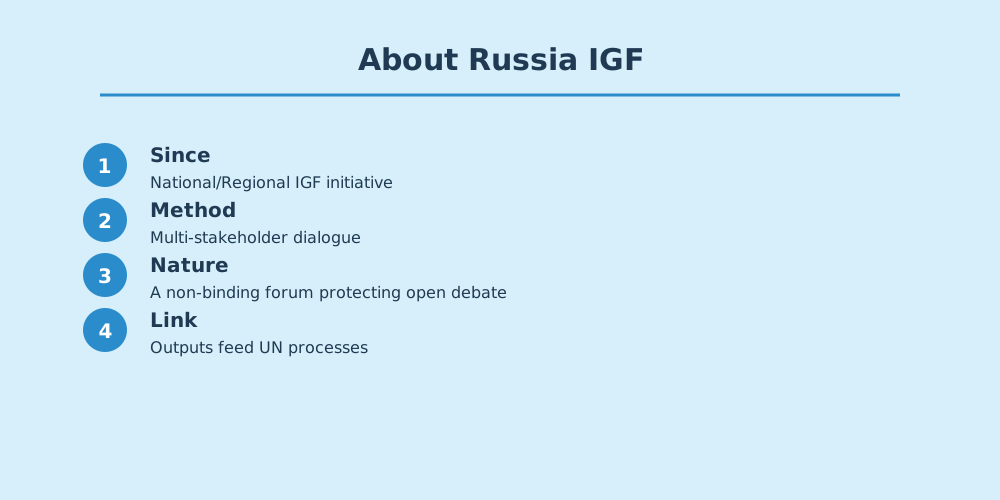
Russia IGF is a National or Regional IGF Initiative (NRI), aligning local internet governance discussion with global IGF principles.
Why It Matters to You
What was discussed here becomes the baseline for national digital policy, platform rules and AI regulation worldwide within a few years. The principles confirmed at the 2015 meeting are the foundation of the "next rules" for the phones, social platforms and AI services you use every day.
Sources & References
- RIGF 2015(公式サイト) — ロシア国別ドメイン調整センター(Coordination Center for TLD RU/РФ) (accessed 2026-07-11)
- Program of RIGF 2015(公式プログラム) — ロシア国別ドメイン調整センター(Coordination Center for TLD RU/РФ) (accessed 2026-07-11)
- RIGF slams territorial discrimination(公式プレスリリース・開会報告) — ロシア国別ドメイン調整センター(Coordination Center for TLD RU/РФ) (accessed 2026-07-11)
- Joint Statement Against Territorial Discrimination of Internet Users(共同声明本文) — RIGF 2015参加者有志 (accessed 2026-07-11)
- RIGF focused on the Internet of Things(公式プレスリリース・閉会報告) — ロシア国別ドメイン調整センター(Coordination Center for TLD RU/РФ) (accessed 2026-07-11)
- Report on the 2015 Russian IGF(RIPE NCC参加報告) — RIPE NCC (accessed 2026-07-11)
Quotes are translated or condensed from the records listed above. Bracketed numbers [n] refer to the source list.
Related links
- IGF official (NRI list): https://www.intgovforum.org/en/content/national-and-regional-igf-initiatives
- Japan IGF: https://japanigf.jp/
- Yuki Nakazawa's blog: https://nkzw.jp/category/igf/
Revision History
Rev. 1 — published 19 June 2015, 14:00 (Article published)
Rev. 2 — updated 17 July 2026, 12:32 (Fully revised into the in-depth edition: added the 3-line summary, minutes digest, short talk, source list and diagrams (all quotes verified against the listed sources))
— 中澤祐樹

