


The 3-Line Summary
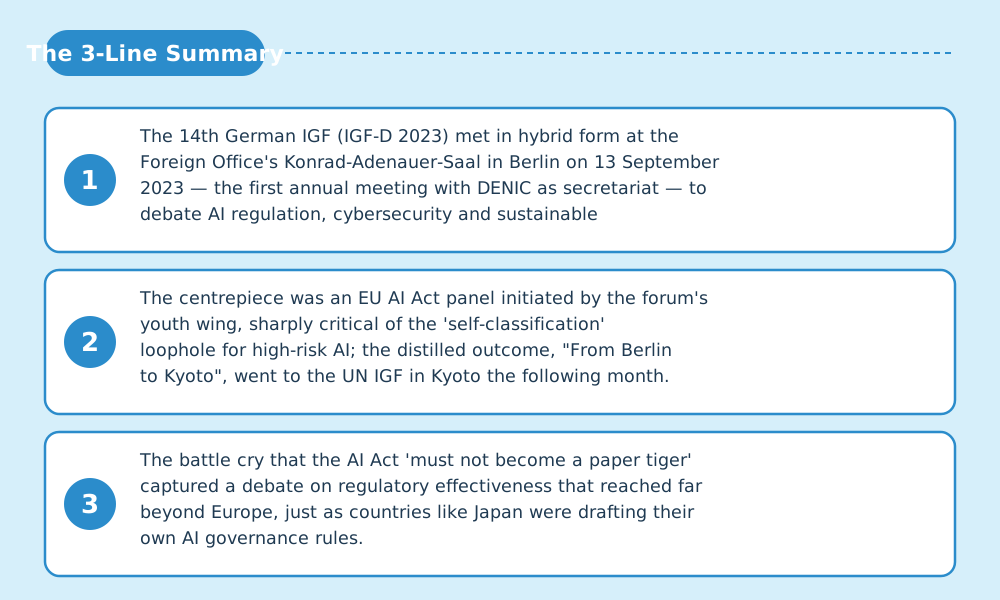
- The 14th German IGF (IGF-D 2023) met in hybrid form at the Foreign Office's Konrad-Adenauer-Saal in Berlin on 13 September 2023 — the first annual meeting with DENIC as secretariat — to debate AI regulation, cybersecurity and sustainable digitalisation.
- The centrepiece was an EU AI Act panel initiated by the forum's youth wing, sharply critical of the 'self-classification' loophole for high-risk AI; the distilled outcome, "From Berlin to Kyoto", went to the UN IGF in Kyoto the following month.
- The battle cry that the AI Act 'must not become a paper tiger' captured a debate on regulatory effectiveness that reached far beyond Europe, just as countries like Japan were drafting their own AI governance rules.
Welcome — this is the Japan IGF Support Organization. This in-depth report on IGF-D 2023 (14th German Internet Governance Forum / XIV. Internet Governance Forum Deutschland) draws on official outputs, session records and on-site reporting. In a hurry? The three lines above and the diagrams carry the gist.
Conference at a Glance (from official records)
| Item | Detail |
|---|---|
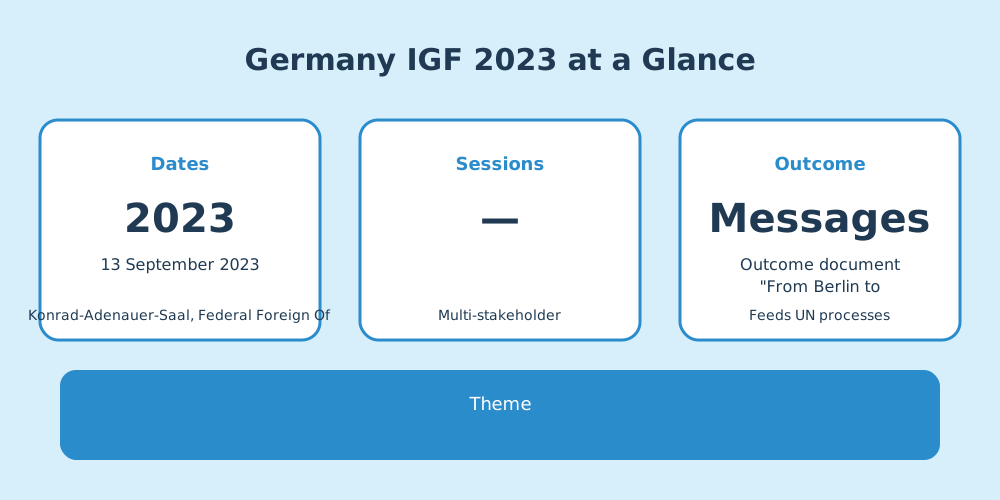
| Official name | IGF-D 2023 (14th German Internet Governance Forum / XIV. Internet Governance Forum Deutschland) |
| Dates | 13 September 2023 |
| Venue | Konrad-Adenauer-Saal, Federal Foreign Office (Werderscher Markt 1, Berlin), with online participation (hybrid) |
| Theme | Regional governance themes |
| Host | IGF-D, with DENIC eG (the .de registry) serving as secretariat — its first year in that role |
| Outcome | Outcome document "From Berlin to Kyoto — Messages from the Internet Governance Forum Germany", delivered to the UN IGF in Kyoto (October 2023) |
(See the source list at the end of this article.)
Discussion Digest — from the Session Records
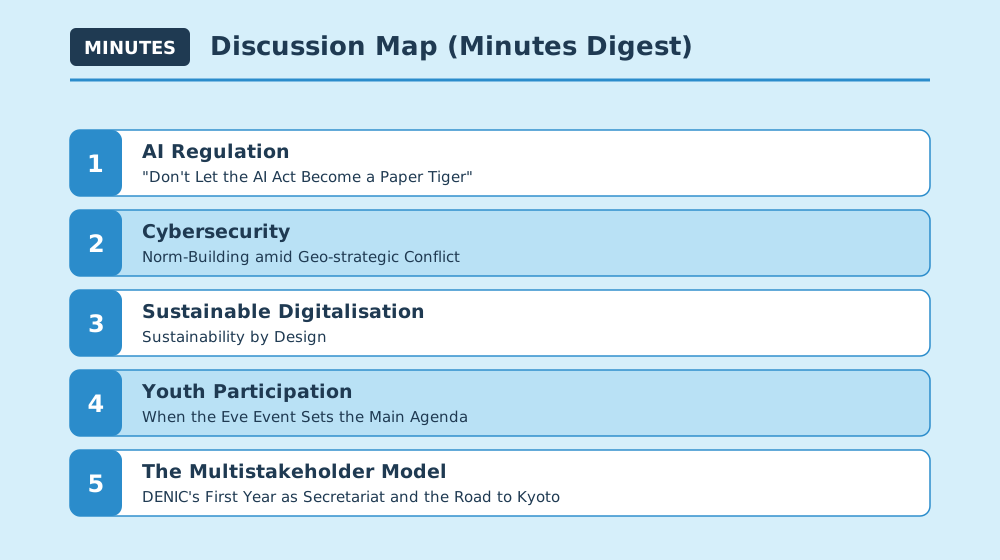
Key exchanges extracted from session records and transcripts.
1. AI Regulation — "Don't Let the AI Act Become a Paper Tiger"
Sessions: Panel on AI quality standards as catalysts for digital innovation in Germany and the EU (initiated by the Y-IGF; moderated by Julia Kloiber, Superrr Lab)
- Matthias Spielkamp (AlgorithmWatch) flagged the loophole of corporate 'self-classification' in high-risk areas — already opposed by 118 European civil-society organisations — and argued the AI Act must not degenerate into a 'paper tiger' but be used to safeguard human rights in AI development inside and outside Europe (the outcome document states: "We must be careful that the AI Act does not become a paper tiger") [3][2]
- Linda Schwarz (German Informatics Society) demanded more diverse participation in standardisation bodies often dominated by economic interests; Alexandra Wudel (FemAI) stressed identifying and progressively dismantling sources of discrimination; Rosanna Fanni (CEPS) called for education and broader participation, especially for young people [3][2]
- Markus Beckedahl (founder of netzpolitik.org) demanded institutional funding for public-interest actors and far-reaching promotion of open source and open data [3][2]
- The Messages concluded: 'it is not systems and data that determine the design of AI systems, but people — inclusion and diversity must be taken into account from the very beginning', and regulation 'must not be too concrete in order to remain flexible' [3][2]
2. Cybersecurity — Norm-Building amid Geo-strategic Conflict
Sessions: Panel on cybersecurity amid geo-strategic conflicts
- Notwithstanding rising international tensions, decreased trust between states and the war in Ukraine, the Messages call on governments and non-state stakeholders to support global cyber-security negotiations 'in a constructive spirit', with the UN OEWG focusing on implementing the eleven norms agreed by the UN GGE in 2015 [2][3]
- The UN cybercrime convention should focus on 'core crimes in cyberspace' and include adequate protection of individual rights — data protection and freedom of expression — under the rule of law: 'human rights and security must not be played off against each other' [2][3]
- 'The killing of humans must not be left to robots': negotiations on internet-based autonomous weapons systems should be accelerated and brought to a conclusion [2][3]
3. Sustainable Digitalisation — Sustainability by Design
Sessions: Workshop "How do sustainability and the digital economy go together?"
- The Messages demand a systematic, independently measured assessment of digitalisation's environmental impact across the entire life cycle, with results made publicly accessible; environmental sustainability must weigh as heavily as economics and performance in design (Sustainability by Design), and the most ecological mode of use should be the default setting for consumer technologies (Sustainability by Default) [2][3]
- The circular economy was framed as central to reducing political dependence on countries holding large critical raw-material reserves, with funding for applied circular-economy research 'key' — promising new growth and jobs for the German economy as well as environmental gains [2][3]
- On the social pillar: accountable AI manufacturers and early-childhood digital education, equitable access for older people, children and structurally discriminated groups, and support for victims of digital violence were major concerns [2][3]
4. Youth Participation — When the Eve Event Sets the Main Agenda
Sessions: Y-IGF pre-event (12 September, Wikimedia Deutschland) and the main-day AI Act panel
- At the eve workshop some 25 young people debated the three sustainability pillars — ecological (Verena Müller, TU Munich), social (Carolin Henze, German Informatics Society) and economic (Dirk Krischenowski, dotBerlin, on growing rare-earth dependence) — and carried demands such as universal informatics education and systematic device recycling into the main event [3][2][1]
- The main event's flagship AI Act panel was itself instigated by the Y-IGF, and the Messages call for 'effective youth participation in political decision-making processes on the use and regulation of artificial intelligence — especially in foreign policy and international forums' [3][2][1]
5. The Multistakeholder Model — DENIC's First Year as Secretariat and the Road to Kyoto
Sessions: Opening session (Peter Koch, DENIC; Cyber Ambassador Regine Grienberger, Foreign Office; Irina Soeffky, Federal Ministry for Digital and Transport; and others)
- DENIC, the .de registry, ran the IGF-D secretariat for the first time, with Peter Koch opening the forum; Cyber Ambassador Regine Grienberger (Foreign Office) and Irina Soeffky (Federal Ministry for Digital and Transport) repeatedly stressed the multistakeholder approach, cross-sector dialogue and above all the inclusion of civil society [3][4][2]
- Tobias B. Bacherle MP (Alliance 90/The Greens) advocated stronger NGO and civil-society participation in internet-governance processes and better (financial) resourcing of the IGF [3][4][2]
- The forum was marked by a clear commitment to the multistakeholder model, and its distilled conclusions travelled to the UN IGF in Kyoto that October as 'From Berlin to Kyoto' [3][4][2]
Three-Minute Short Talk — Your Questions Answered
Q. So what did it decide?
A. Nothing formally — it's a dialogue forum where government, business, civil society and academia meet as equals. But its conclusions were distilled into 'From Berlin to Kyoto' and handed to the UN IGF in Kyoto the following month.
Q. Most contentious point?
A. The EU AI Act. A loophole letting companies self-classify whether their AI is high-risk — opposed by 118 European civil-society organisations — dominated the debate, under the rallying cry that the Act must not become a paper tiger.
Q. Why should I care?
A. The AI Act was the world's first comprehensive AI law, and the effectiveness-versus-flexibility debate rehearsed here is the same one every country now faces when writing its own AI rules.
What Is Germany IGF? (for first-time readers)
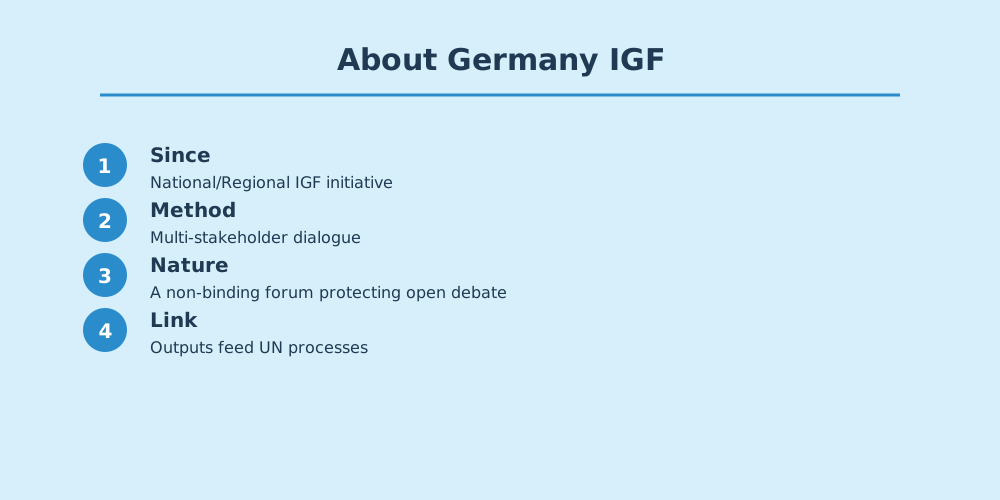
Germany IGF is a National or Regional IGF Initiative (NRI), aligning local internet governance discussion with global IGF principles.
Why It Matters to You
What was discussed here becomes the baseline for national digital policy, platform rules and AI regulation worldwide within a few years. The principles confirmed at the 2023 meeting are the foundation of the "next rules" for the phones, social platforms and AI services you use every day.
Sources & References
- Berlin – Das Deutsche Internet Governance Forum findet am 13.09.2023 statt — domain-recht.de (accessed 2026-07-16)
- From Berlin to Kyoto — Messages from the Internet Governance Forum Germany, 13th September 2023 (PDF) — IGF-D (accessed 2026-07-16)
- Alle an einem Tisch: GI-Vertreterinnen beim Internet Governance Forum Deutschland — Gesellschaft für Informatik e.V.(ドイツ情報学会・参加報告) (accessed 2026-07-16)
- Kontakte knüpfen, sichtbar werden: Ein Jahr IGF-D-Sekretariat unter der Leitung von DENIC — DENIC eG(公式ブログ) (accessed 2026-07-16)
- Downloads(Messages・報告書一覧) — IGF-D (accessed 2026-07-16)
Quotes are translated or condensed from the records listed above. Bracketed numbers [n] refer to the source list.
Related links
- IGF official (NRI list): https://www.intgovforum.org/en/content/national-and-regional-igf-initiatives
- Japan IGF: https://japanigf.jp/
- Yuki Nakazawa's blog: https://nkzw.jp/category/igf/
Revision History
Rev. 1 — published 5 June 2023, 14:00 (Article published)
Rev. 2 — updated 17 July 2026, 12:32 (Fully revised into the in-depth edition: added the 3-line summary, minutes digest, short talk, source list and diagrams (all quotes verified against the listed sources))
— 中澤祐樹

