

The 3-Line Summary
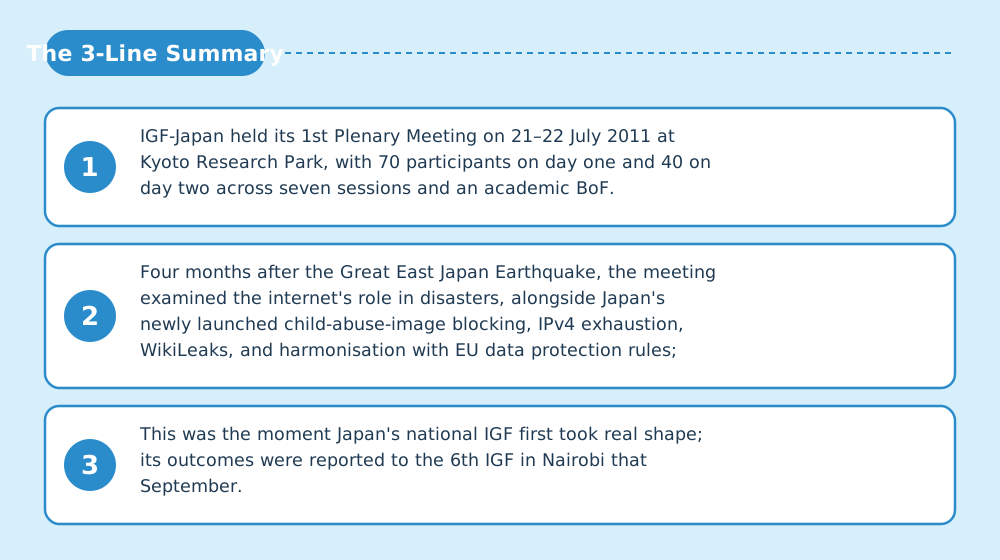
- IGF-Japan held its 1st Plenary Meeting on 21–22 July 2011 at Kyoto Research Park, with 70 participants on day one and 40 on day two across seven sessions and an academic BoF.
- Four months after the Great East Japan Earthquake, the meeting examined the internet's role in disasters, alongside Japan's newly launched child-abuse-image blocking, IPv4 exhaustion, WikiLeaks, and harmonisation with EU data protection rules; video messages arrived from the UN IGF Secretariat and the Kenya IGF chair.
- This was the moment Japan's national IGF first took real shape; its outcomes were reported to the 6th IGF in Nairobi that September.
Welcome — this is the Japan IGF Support Organization. This in-depth report on IGF-Japan 1st Plenary Meeting draws on official outputs, session records and on-site reporting. In a hurry? The three lines above and the diagrams carry the gist.
📍 Held in Kyoto, not Tokyo — both the official report and the announcement specify Kyoto Research Park
Conference at a Glance (from official records)
| Item | Detail |
|---|---|
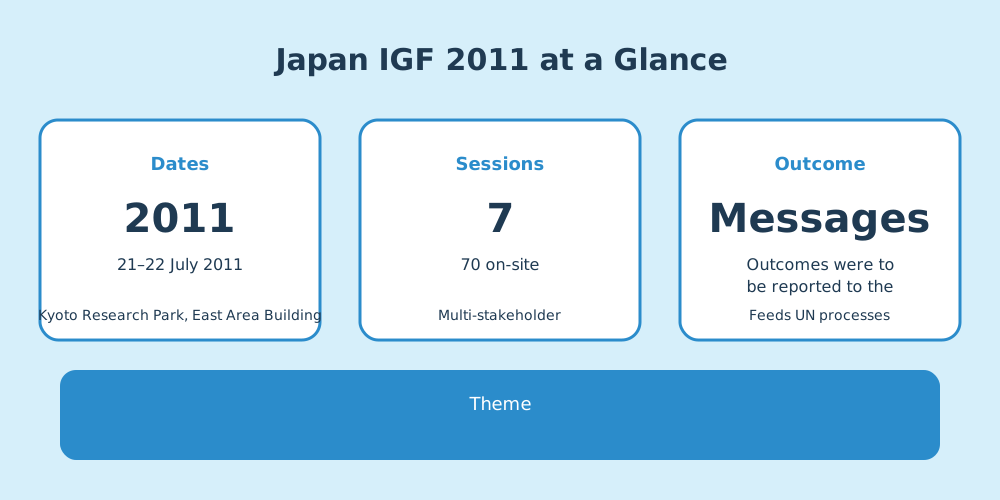
| Official name | IGF-Japan 1st Plenary Meeting |
| Dates | 21–22 July 2011 |
| Venue | Kyoto Research Park, East Area Building 1, Kyoto, Japan |
| Theme | Regional governance themes |
| Participants | 70 |
| Sessions | 7 |
| Supporters | Supported by the Ministry of Internal Affairs and Communications (MIC) |
| Host | IGF Japan (secretariat: Japan Internet Providers Association, JAIPA) |
| Outcome | Outcomes were to be reported to the 6th IGF in Nairobi (September 2011) as Japan's national IGF activity |
(See the source list at the end of this article.)
Discussion Digest — from the Session Records
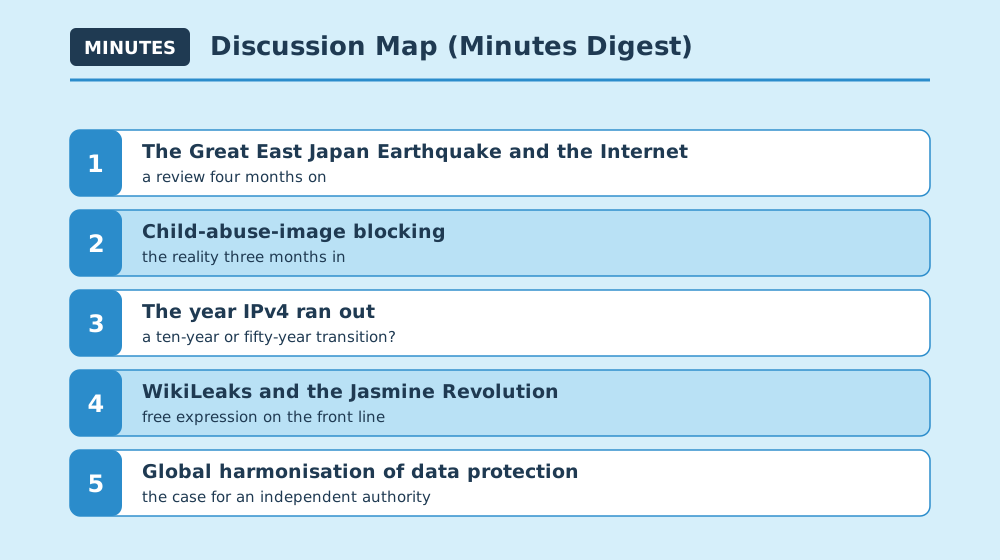
Key exchanges extracted from session records and transcripts.
1. The Great East Japan Earthquake and the Internet — a review four months on
Sessions: 'The Internet and ICT in Disaster Response and Recovery' (21 July, 10:45–12:30)
- MIC's Haruka Saito gave the keynote on the government response; KDDI's Hiroshi Kobayashi reported that the disaster message board went live within ten minutes but lacked smartphone support, and that data traffic was never throttled [1]
- iSPP co-chair Izumi Aizu described an 'information black hole' in the disaster zone, while Taisuke Matsuzaki drew lessons from handling Kobe's public communications after the 1995 quake [1]
- From the floor, an ISP operator from the affected region stressed public–private and private–private cooperation after losing power [1]
2. Child-abuse-image blocking — the reality three months in
Sessions: 'On Child Pornography Blocking' (22 July, 9:00–11:30)
- Japan's blocking scheme, launched in April 2011, was examined from three angles: legal issues (lawyer Ryoji Mori), operational reality (JAIPA's Takashi Kimura) and constitutional law (Kyoto University's Masahiro Sogabe) [1]
- Real figures were disclosed: at one ISP, roughly 10,000 DNS lookups a day — about one in 1.3 million — were being blocked as child abuse material [1]
- Questions poured in on joint tort liability for over-blocking, international comparisons and who should bear the costs — so many that the planned panel was converted into extended Q&A [1]
3. The year IPv4 ran out — a ten-year or fifty-year transition?
Sessions: 'Critical Internet Resources' (21 July, 13:20–16:20)
- In the year IANA's IPv4 pool ran dry, JPNIC's Susumu Sato explained the registries' new roles — address transfers after exhaustion and IPv6 allocation [1]
- JAIPA's Takashi Kimura reported the results of World IPv6 Day, held globally on 8 June 2011 [1]
- Panellists clashed over whether full IPv6 migration would take a decade or several decades, and mapped the technical, cost and security challenges of a long coexistence in an increasingly mobile internet [1]
4. WikiLeaks and the Jasmine Revolution — free expression on the front line
Sessions: Security sessions (21 July, 16:40–18:35)
- Koichiro Hayashi, president of the Institute of Information Security, argued in 'The World WikiLeaks Changes' that digitisation makes long-term secrecy untenable, yet forced disclosure of all secrets commands no consensus either [1]
- ICANN GNSO Council's Rafik Dammak joined by Skype at the last minute from post-revolution Tunisia, describing life in a transition with no constitution or parliament — and how Facebook had empowered citizens [1]
5. Global harmonisation of data protection — the case for an independent authority
Sessions: 'Japan's Data Protection and Global Harmonisation' (22 July, 15:30–17:30) and the chair's summary
"In internet governance, countries with all kinds of positions come together, so almost nothing gets decided. This meeting too was all speaking and listening with no conclusions — and that felt very much like the internet itself (translated)"
— Takenori Watanabe (IGF-Japan Chair / JAIPA President), from the chair's summary [1][2]
- Professor Emeritus Masao Horibe set out the costs of Japan's non-alignment with the EU Data Protection Directive and argued for an independent supervisory authority — a thread that led to Japan's Personal Information Protection Commission in 2016 [1][2]
- Video messages from the UN IGF Secretariat's Chengetai Masango and Kenya IGF chair Alice Munyua signalled the new body's connection to the global IGF network [1][2]
Three-Minute Short Talk — Your Questions Answered
Q. What did the meeting decide?
A. Nothing — by design. It was Japan's first national IGF plenary, where government, industry, academia and civil society talked as equals. The chair himself concluded that 'almost nothing gets decided — and that feels like the internet.'
Q. What was the highlight?
A. The disaster session, held four months after the March 2011 earthquake: first-hand accounts of launching the disaster message board, data networks that never throttled, and the 'information black hole' in the disaster zone.
Q. Does it still matter?
A. Yes. The independent data-protection authority argued for here became Japan's PPC in 2016, and the blocking debate returned with force in the 2018 piracy-site controversy. Many threads are still live.
What Is Japan IGF? (for first-time readers)
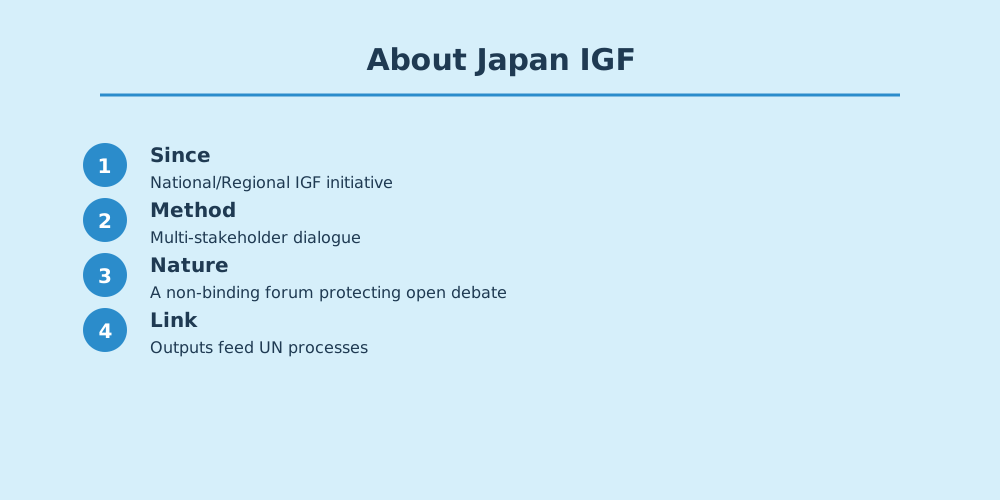
Japan IGF is a National or Regional IGF Initiative (NRI), aligning local internet governance discussion with global IGF principles.
Why It Matters to You
What was discussed here becomes the baseline for national digital policy, platform rules and AI regulation worldwide within a few years. The principles confirmed at the 2011 meeting are the foundation of the "next rules" for the phones, social platforms and AI services you use every day.
Sources & References
- IGF-Japan 第1回全体会議 報告書(PDF) — IGF-Japan事務局(JAIPA) (accessed 2026-07-11)
- IGF-Japan 第1回全体会議(開催告知) — 日本インターネットプロバイダー協会(JAIPA) (accessed 2026-07-11)
- IGF-Japanアーカイブ — 日本インターネットプロバイダー協会(JAIPA) (accessed 2026-07-11)
- 日本におけるインターネットガバナンス関連活動の経験と課題 — 日本ネットワークインフォメーションセンター(JPNIC) (accessed 2026-07-11)
Quotes are translated or condensed from the records listed above. Bracketed numbers [n] refer to the source list.
Related links
- IGF official (NRI list): https://www.intgovforum.org/en/content/national-and-regional-igf-initiatives
- Japan IGF: https://japanigf.jp/
- Yuki Nakazawa's blog: https://nkzw.jp/category/igf/
Revision History
Rev. 1 — published 13 September 2011, 14:00 (Article published)
Rev. 2 — updated 16 July 2026, 20:09 (Fully revised into the in-depth edition: added the 3-line summary, minutes digest, short talk, source list and diagrams (all quotes verified against the listed sources))
— 中澤祐樹