


The 3-Line Summary
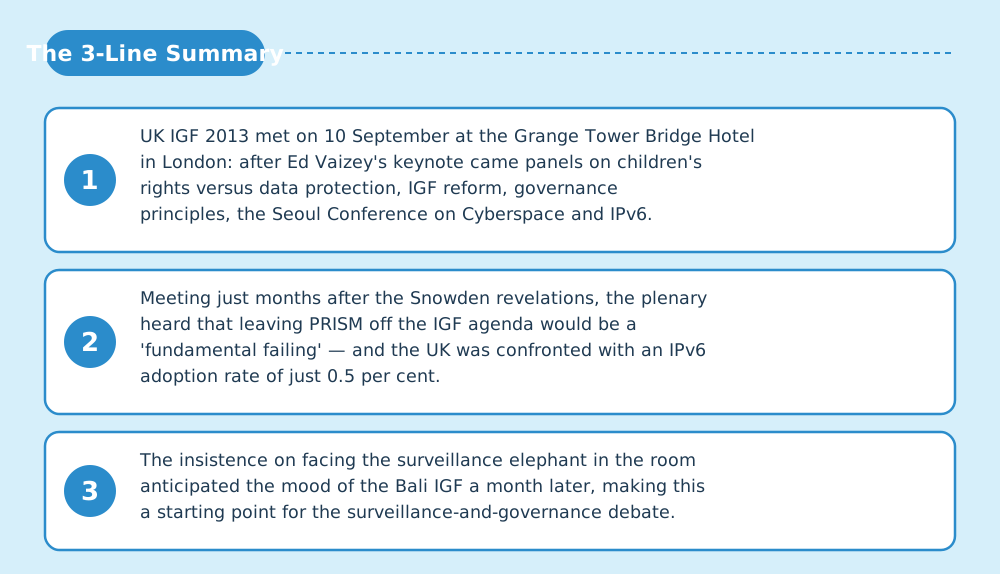
- UK IGF 2013 met on 10 September at the Grange Tower Bridge Hotel in London: after Ed Vaizey's keynote came panels on children's rights versus data protection, IGF reform, governance principles, the Seoul Conference on Cyberspace and IPv6.
- Meeting just months after the Snowden revelations, the plenary heard that leaving PRISM off the IGF agenda would be a 'fundamental failing' — and the UK was confronted with an IPv6 adoption rate of just 0.5 per cent.
- The insistence on facing the surveillance elephant in the room anticipated the mood of the Bali IGF a month later, making this a starting point for the surveillance-and-governance debate.
Welcome — this is the Japan IGF Support Organization. This in-depth report on UK IGF 2013 draws on official outputs, session records and on-site reporting. In a hurry? The three lines above and the diagrams carry the gist.
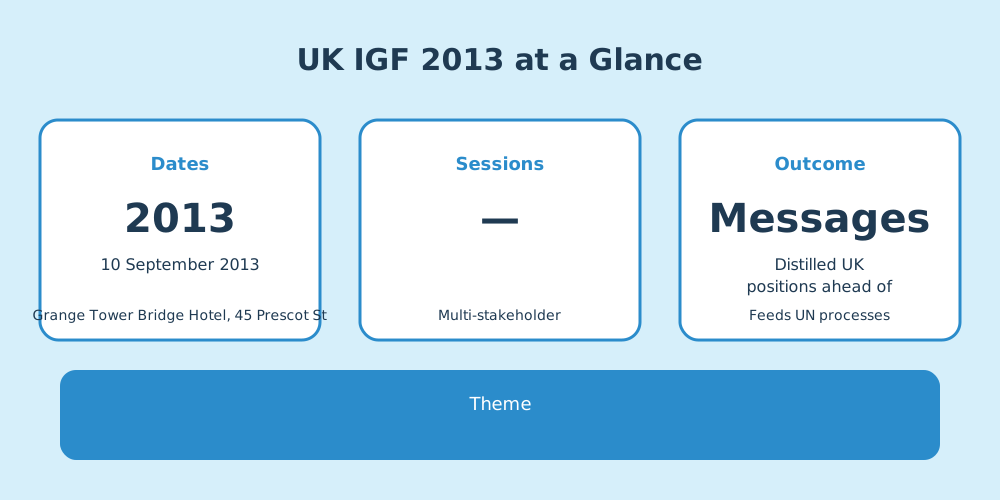
Conference at a Glance (from official records)
| Item | Detail |
|---|---|
| Official name | UK IGF 2013 |
| Dates | 10 September 2013 |
| Venue | Grange Tower Bridge Hotel, 45 Prescot Street, London |
| Theme | Regional governance themes |
| Workshops | 3 |
| Keynote | Ed Vaizey, Minister for Culture, Communications and the Creative Industries |
| Chair | Alun Cairns MP (event chair) |
| Host | UK IGF (secretariat: Nominet) |
| Outcome | Distilled UK positions ahead of the Bali IGF and the Seoul Conference on Cyberspace in October; session reports were published on the UK IGF blog |
(See the source list at the end of this article.)
Discussion Digest — from the Session Records
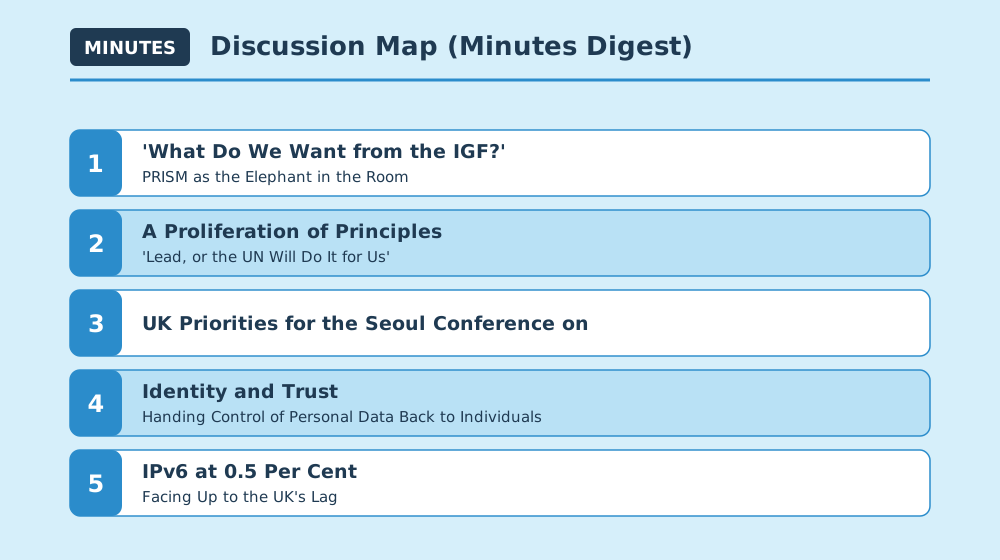
Key exchanges extracted from session records and transcripts.
1. 'What Do We Want from the IGF?' — PRISM as the Elephant in the Room
Sessions: Plenary 'What do we want from the IGF?' (from 12.00, moderated by Dr Vicki Nash, Oxford Internet Institute)
- Panellists (including Mark Carvell of DCMS, Lesley Cowley of Nominet and Andrew Puddephatt of Global Partners) wanted clearer leadership from the IGF, an annual state-of-the-internet assessment, evidence-based policy options, a far better website and marketing, and the vacant Special Advisor post filled [2]
- From the floor came strong feeling that PRISM and WikiLeaks could not be swept under the carpet: leaving them off the agenda would be a fundamental failing that reduced the IGF to a mechanism for saying no to ITU control — and would leave the field to conspiracy theorists [2]
- The suggestion that the UK take the lead on transparency around data law-enforcement requests won support [2]
2. A Proliferation of Principles — 'Lead, or the UN Will Do It for Us'
Sessions: Workshop 'Internet governance principles in a changing international environment' (convened by Global Partners, moderated by Matthew McDermott)
- The IGF's forthcoming analysis of 28 sets of principles from around the world was previewed, along with worries about who gets included in selecting them [3]
- International law should be the starting point, it was argued: principles must not be written in ways that jeopardise rights businesses rely on every day [3]
- One camp urged a single universal set — warning that unless supporters of the multistakeholder model take the lead, the UN will do it for us — while another saw principles as answers to national concerns; all agreed on avoiding a balkanised internet [3]
3. UK Priorities for the Seoul Conference on Cyberspace
Sessions: Workshop 'UK priorities for the Seoul Conference on Cyberspace' (convened by the FCO, moderated by Jamie Saunders)
- The anticipated Seoul outcomes fell into three buckets — policies, capacity building and cooperation — with security framed as an enabler of growth and progress, not an end in itself [4]
- High-level principles were not enough: countries needed practical policy models implementable in their local contexts [4]
- Many stressed promoting progressive policies on freedom of expression and privacy, ensuring calls for necessary security were not subverted into calls for censorship and control [4]
4. Identity and Trust — Handing Control of Personal Data Back to Individuals
Sessions: Workshop 'Identity & Trust' (convened by BCS, moderated by Andy Smith)
"You have absolute certainty you know who you are dealing with"
— John Bullard (IdenTrust) [6]
- William Heath of Mydex advocated a new personal data ecosystem in which individuals control their data through trusted third parties — a shift from organisation-centric to user-centric data models [6]
- Participants agreed people unknowingly 'pay' for free services with their personal data, and debated the balance between over-collection and funding internet services [6]
- Social networks unilaterally changing privacy policies, and archived youthful content affecting future prospects, were flagged as problems [6]
5. IPv6 at 0.5 Per Cent — Facing Up to the UK's Lag
Sessions: Infrastructure session on IPv6 and spam (organised by Olivier Crépin-Leblond, ISOC England, from 15.45)
- The IPv6 Matrix project, which checks IPv6 connectivity across the world's top one million websites, showed only 0.5 per cent of the UK server pool on dual stack — against 6.99 per cent for Germany and 13.94 per cent for European leader Slovakia [5]
- Blame fell on government's failure to mandate IPv6 in IT procurement and a false sense of comfort from still-available IPv4 addresses; the 6UK initiative had failed to change perceptions [5]
- Without widespread roll-out, the UK developer community would be disadvantaged against its European neighbours — attendees were urged to promote IPv6 in their own organisations [5]
Three-Minute Short Talk — Your Questions Answered
Q. What was discussed?
A. A one-day sweep of UK positions ahead of the Bali IGF and the Seoul Conference on Cyberspace: a panel with the IWF, Facebook and the Open Rights Group on the tension between child protection and data protection, youth voices from Childnet, plus IGF reform, governance principles and IPv6.
Q. What was the most heated issue?
A. PRISM. The floor insisted that leaving mass surveillance off the IGF agenda would be a fundamental failing — and that the UK should lead on transparency around data requests.
Q. Why should I care?
A. Surveillance versus governance and child protection versus privacy are still live global debates, and the call to drive IPv6 through government procurement applies to every country still lagging on the transition.
What Is UK IGF? (for first-time readers)
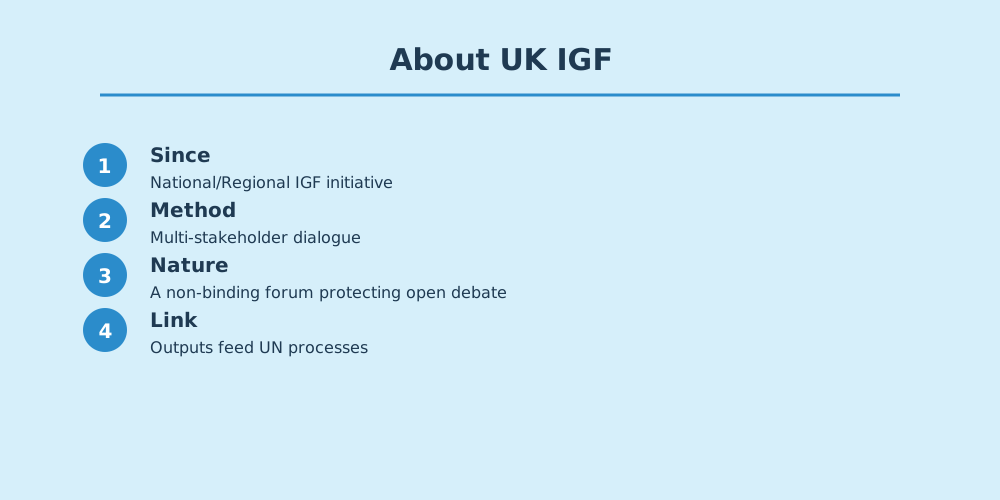
UK IGF is a National or Regional IGF Initiative (NRI), aligning local internet governance discussion with global IGF principles.
Why It Matters to You
What was discussed here becomes the baseline for national digital policy, platform rules and AI regulation worldwide within a few years. The principles confirmed at the 2013 meeting are the foundation of the "next rules" for the phones, social platforms and AI services you use every day.
Sources & References
- UK IGF 2013 full agenda(公式サイト掲載の当日アジェンダ) — UK IGF (accessed 2026-07-16)
- Report from the plenary session on 'What do we want from the IGF?'(Word文書) — UK IGF(Wayback Machine) (accessed 2026-07-16)
- Internet governance principles in a changing international environment session at UK IGF 2013 — UK IGF(Wayback Machine) (accessed 2026-07-16)
- Chair's summary of the Seoul Cyberspace Planning session at the UK IGF 2013 — UK IGF(Wayback Machine) (accessed 2026-07-16)
- Report from IPv6 Session at UK-IGF 2013 — UK IGF(Wayback Machine) (accessed 2026-07-16)
- Report from UKIGF Identity & Trust Workshop – 10th September 2013 — UK IGF (accessed 2026-07-16)
Quotes are translated or condensed from the records listed above. Bracketed numbers [n] refer to the source list.
Related links
- IGF official (NRI list): https://www.intgovforum.org/en/content/national-and-regional-igf-initiatives
- Japan IGF: https://japanigf.jp/
- Yuki Nakazawa's blog: https://nkzw.jp/category/igf/
Revision History
Rev. 1 — published 1 June 2013, 09:00 (Article published)
Rev. 2 — updated 16 July 2026, 20:09 (Fully revised into the in-depth edition: added the 3-line summary, minutes digest, short talk, source list and diagrams (all quotes verified against the listed sources))
— 中澤祐樹

