


The 3-Line Summary
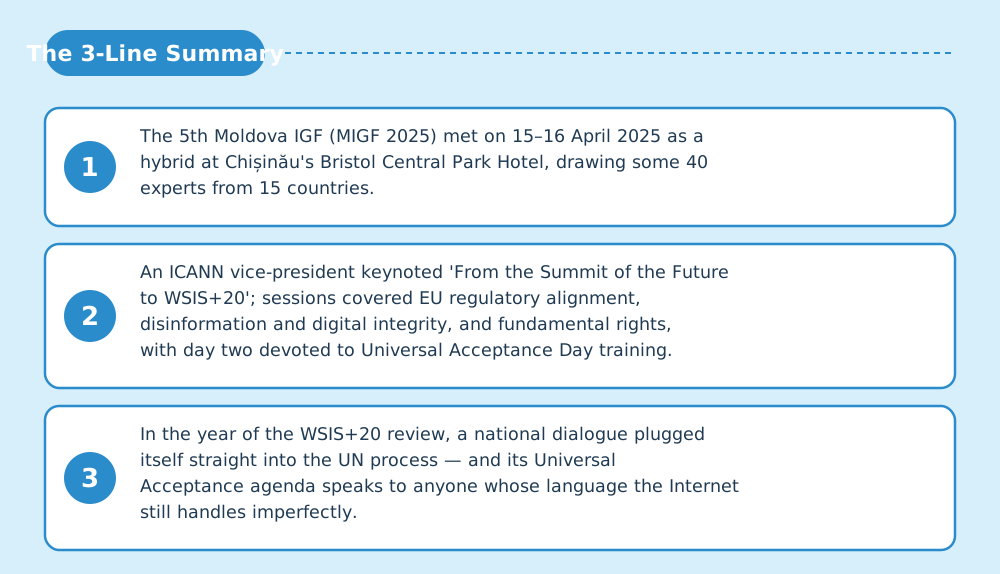
- The 5th Moldova IGF (MIGF 2025) met on 15–16 April 2025 as a hybrid at Chișinău's Bristol Central Park Hotel, drawing some 40 experts from 15 countries.
- An ICANN vice-president keynoted 'From the Summit of the Future to WSIS+20'; sessions covered EU regulatory alignment, disinformation and digital integrity, and fundamental rights, with day two devoted to Universal Acceptance Day training.
- In the year of the WSIS+20 review, a national dialogue plugged itself straight into the UN process — and its Universal Acceptance agenda speaks to anyone whose language the Internet still handles imperfectly.
Welcome — this is the Japan IGF Support Organization. This in-depth report on Moldova IGF 2025 (MIGF 2025) — 5th Moldova Internet Governance Forum draws on official outputs, session records and on-site reporting. In a hurry? The three lines above and the diagrams carry the gist.
Conference at a Glance (from official records)
| Item | Detail |
|---|---|
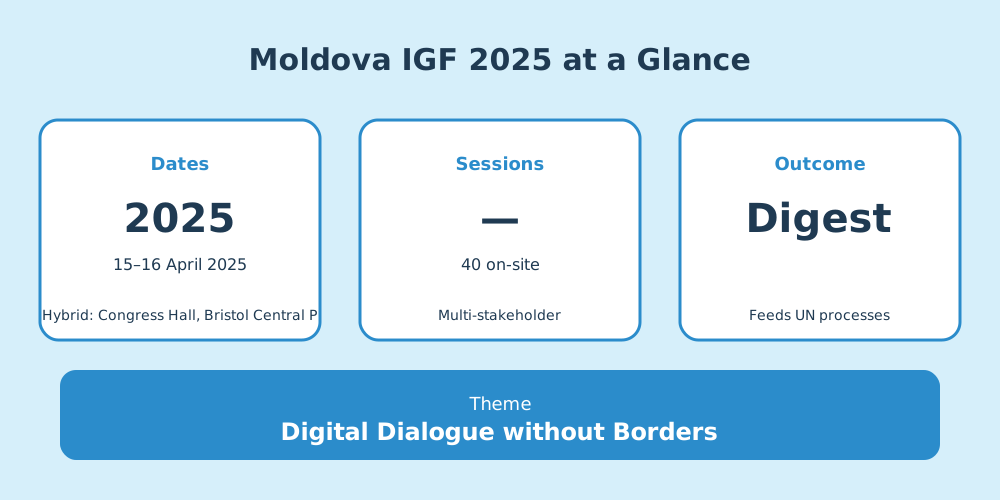
| Official name | Moldova IGF 2025 (MIGF 2025) — 5th Moldova Internet Governance Forum |
| Dates | 15–16 April 2025 |
| Venue | Hybrid: Congress Hall, Bristol Central Park Hotel (32 Alexander Pushkin St), Chișinău, plus online participation |
| Theme | Digital Dialogue without Borders |
| Participants | 40 |
| Languages | Romanian, Russian and English |
| Host | Association 'Comunitatea Internet' (chairman and MIGF coordinator: Alexei Marciuc), co-organised with the regulator ANRCETI and the government IT and cybersecurity service STISC |
(See the source list at the end of this article.)
Discussion Digest — from the Session Records
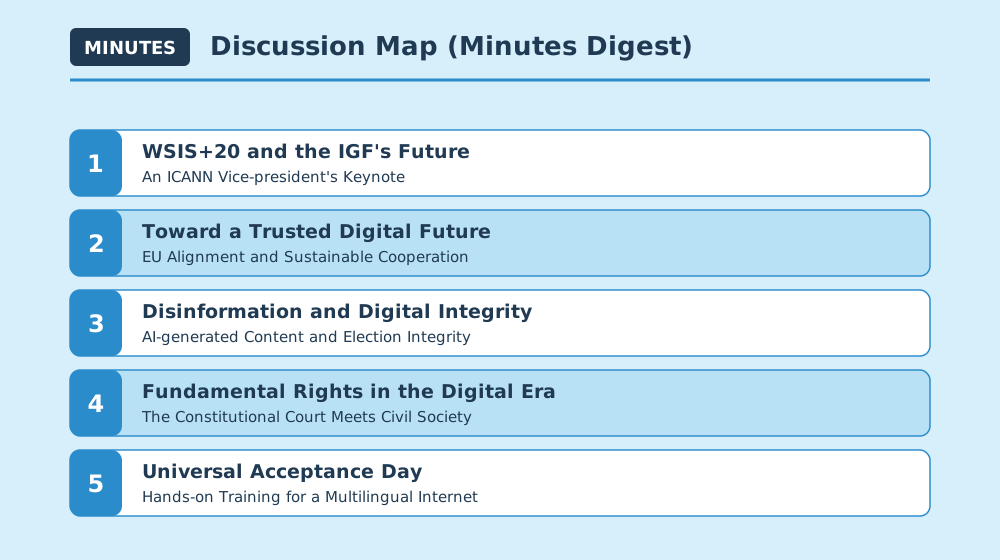
Key exchanges extracted from session records and transcripts.
1. WSIS+20 and the IGF's Future — An ICANN Vice-president's Keynote
Sessions: Keynote 'From the Summit of the Future to WSIS+20' (15 April, 10:20–10:50)
- ICANN vice-president Veni Markovski's keynote 'From the Summit of the Future to WSIS+20' traced the line from the UN's Summit of the Future and Global Digital Compact to the WSIS+20 review due at the end of 2025 — and where a national dialogue plugs in [1][2]
- Anja Gengo of the UN IGF Secretariat joined the opening, underscoring the role of national IGFs in a milestone year for WSIS+20 and Global Digital Compact processes [1][2]
2. Toward a Trusted Digital Future — EU Alignment and Sustainable Cooperation
Sessions: Session 1: 'Strategic Frameworks and Partnerships for a Trusted Digital Future' (15 April, 10:50–12:10)
"Digital development requires not only technological solutions, but also sustainable models of cooperation"
— Alexei Marciuc (MIGF Coordinator; Chairman, Comunitatea Internet) [1][2]
- Cross-sector collaboration on security standards, data protection and alignment with European regulation was the session's core, with ANRCETI director Sergiu Gaibu, Vitalie Tarlev, RIPE NCC's Oleksiy Semenyaka and CAIGF chair Tattu Mambetalieva on the panel [1][2]
- MP Victor Spînu framed building the digital ecosystem as a political priority tied to EU integration (per local press) [1][2]
3. Disinformation and Digital Integrity — AI-generated Content and Election Integrity
Sessions: Session 2: 'Toward a Trustworthy Online Information Environment: Strengthening Digital Integrity in Moldova' (15 April, 12:10–13:20)
- Misinformation and disinformation, AI-generated content, election integrity, media literacy and child protection were tackled together, moderated by Realitatea Media Group CEO Dumitru Tira [1]
- With Access Now's Anastasiya Zhyrmont and ARTICLE 19's Joanna Szymańska on the panel, the tension between cleaning up the information environment and protecting free expression was front and centre [1]
4. Fundamental Rights in the Digital Era — The Constitutional Court Meets Civil Society
Sessions: Session 3: 'Fundamental Rights and Freedoms in the Era of Digital Innovation' and Session 4: 'Integrated Digital Safety' (15 April, afternoon)
- A legal panel moderated by the Constitutional Court's Valeriu Kuciuk took up constitutional rights, the digital divide and rural access, AI regulation and digital sovereignty [1]
- A following session moderated by the SecDev Foundation's Michael L. Gray addressed cyber threats against civil-society organisations, digital hygiene and building a culture of institutional resilience [1]
5. Universal Acceptance Day — Hands-on Training for a Multilingual Internet
Sessions: Side event: Universal Acceptance Day (16 April, with ICANN, UNESCO and the Universal Acceptance Steering Group)
- Day 2 became Universal Acceptance Day, opened by ICANN board chair Tripti Sinha, senior vice-president Theresa Swinehart, UASG chair Anil Kumar Jain and Nicoleta Colomeeț of the e-Governance Agency [1]
- ICANN UA programme manager Arnt Gulbrandsen led technical training on internationalised domain names (IDNs) and email address internationalisation (EAI), complete with Java, JavaScript and Python workshops and certificates for finishers [1]
Three-Minute Short Talk — Your Questions Answered
Q. What was discussed?
A. With the UN's WSIS+20 review due at year's end, the forum debated EU regulatory alignment, countering disinformation, and fundamental rights in the digital era — then spent day two on hands-on Universal Acceptance training to make domains and email work in every language.
Q. How big was it?
A. A compact dialogue of some 40 experts from 15 countries — but with ICANN's board chair and the UN IGF Secretariat in the room, the guest list punched far above its size.
Q. Why should I care?
A. If your language's domain names or email addresses ever get rejected by a website, that is exactly the Universal Acceptance problem this forum trained people to fix — and its WSIS+20 timing shows how a national dialogue feeds the UN process deciding the IGF's future.
What Is Moldova IGF? (for first-time readers)
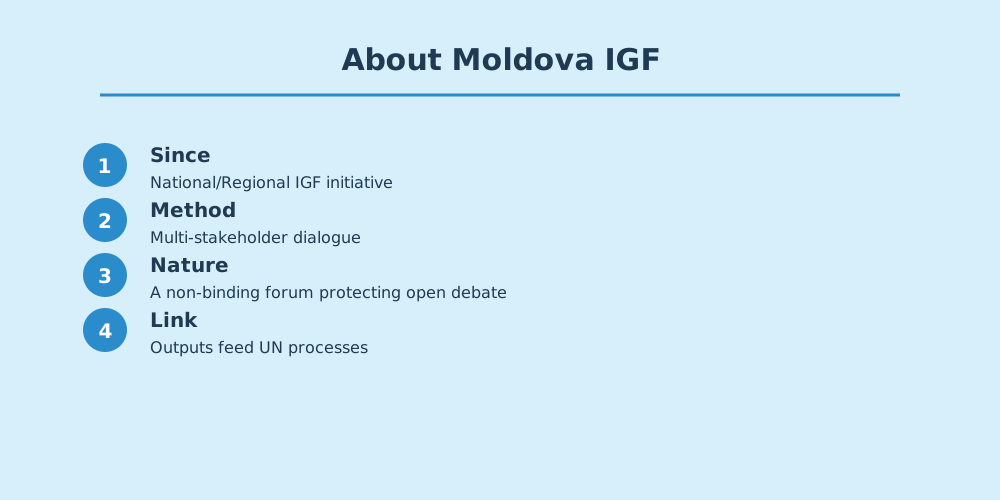
Moldova IGF is a National or Regional IGF Initiative (NRI), aligning local internet governance discussion with global IGF principles.
Why It Matters to You
What was discussed here becomes the baseline for national digital policy, platform rules and AI regulation worldwide within a few years. The principles confirmed at the 2025 meeting are the foundation of the "next rules" for the phones, social platforms and AI services you use every day.
Sources & References
- Moldova Internet Governance Forum 2025(第5回公式サイト) — Comunitatea Internet協会(MIGF事務局) (accessed 2026-07-11)
- Moldova IGF 2025: digital dialogue without borders — Logos Press(モルドバ、英語版) (accessed 2026-07-11)
- Moldova Internet Governance Forum 2025 — IGF Events grant — Internet Society Foundation (accessed 2026-07-11)
- Moldova IGF — NRI record — UN IGF Secretariat (accessed 2026-07-11)
- Moldova Internet Governance Forum 2024(第4回公式サイト・2025年4月15〜16日開催予定の告知を掲載) — Comunitatea Internet協会(MIGF事務局) (accessed 2026-07-11)
Quotes are translated or condensed from the records listed above. Bracketed numbers [n] refer to the source list.
Related links
- IGF official (NRI list): https://www.intgovforum.org/en/content/national-and-regional-igf-initiatives
- Japan IGF: https://japanigf.jp/
- Yuki Nakazawa's blog: https://nkzw.jp/category/igf/
Revision History
Rev. 1 — published 5 June 2025, 16:00 (Article published)
Rev. 2 — updated 17 July 2026, 12:32 (Fully revised into the in-depth edition: added the 3-line summary, minutes digest, short talk, source list and diagrams (all quotes verified against the listed sources))
— 中澤祐樹

