


The 3-Line Summary
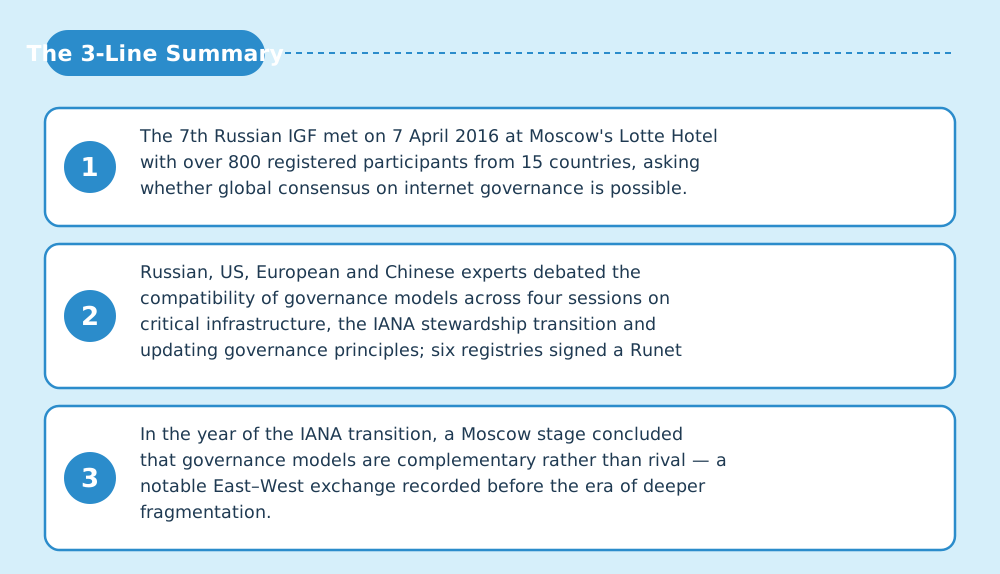
- The 7th Russian IGF met on 7 April 2016 at Moscow's Lotte Hotel with over 800 registered participants from 15 countries, asking whether global consensus on internet governance is possible.
- Russian, US, European and Chinese experts debated the compatibility of governance models across four sessions on critical infrastructure, the IANA stewardship transition and updating governance principles; six registries signed a Runet development memorandum.
- In the year of the IANA transition, a Moscow stage concluded that governance models are complementary rather than rival — a notable East–West exchange recorded before the era of deeper fragmentation.
Welcome — this is the Japan IGF Support Organization. This in-depth report on 7th Russian Internet Governance Forum (RIGF 2016) draws on official outputs, session records and on-site reporting. In a hurry? The three lines above and the diagrams carry the gist.
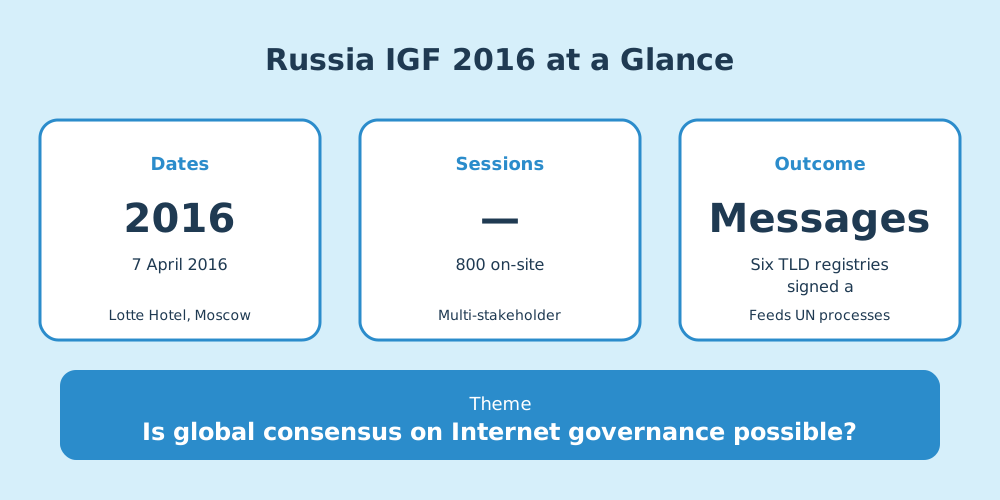
Conference at a Glance (from official records)
| Item | Detail |
|---|---|
| Official name | 7th Russian Internet Governance Forum (RIGF 2016) |
| Dates | 7 April 2016 |
| Venue | Lotte Hotel, Moscow |
| Theme | Is global consensus on Internet governance possible? |
| Participants | 800 |
| Award | Professor Wolfgang Kleinwaechter (University of Aarhus) received the Order for Merits to the Internet |
| Host | Coordination Center for TLD RU/РФ, in cooperation with ICANN, RIPE NCC, Kaspersky Lab, APTLD, ROCIT, the Internet Development Institute and RAEC |
| Outcome | Six TLD registries signed a memorandum on developing the Runet address space |
(See the source list at the end of this article.)
Discussion Digest — from the Session Records
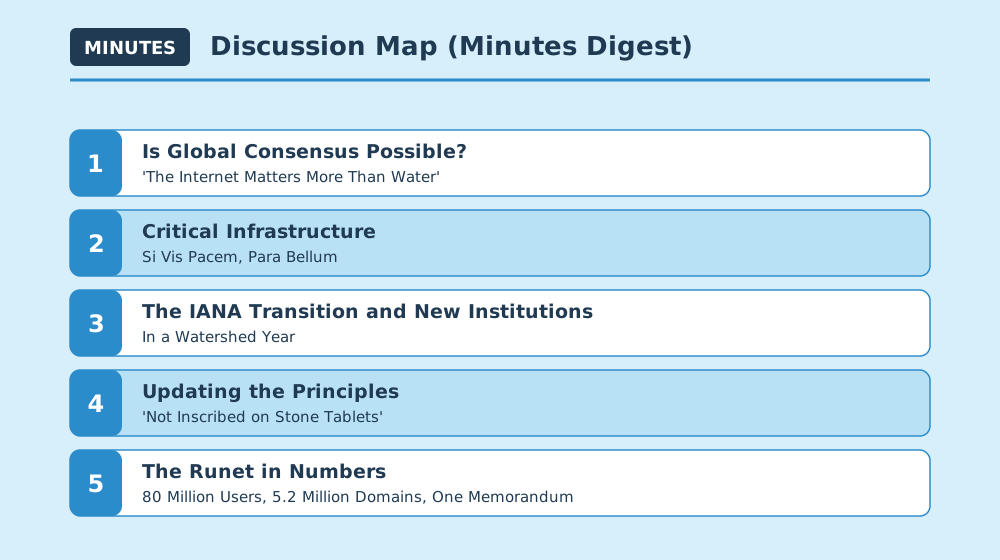
Key exchanges extracted from session records and transcripts.
1. Is Global Consensus Possible? — 'The Internet Matters More Than Water'
Sessions: Opening plenary (10:00) and Session 2 'East is East? and West is West?' (13:30–15:15)
"The first thing I want to know is whether or not it has Wi-Fi. The Internet matters more to us than water"
— Dirk Van Eeckhout (Council of Europe) [4][3][2]
- William Drake of the University of Zurich argued national governance models are 'complementary' rather than mutually exclusive — effectively the forum's headline finding [4][3][2]
- The EU delegation's Anna Murzina presented the EU vision of an open international internet, while Diplomatic Academy professor Madina Kasenova called for multi-level governance structures [4][3][2]
- Participants endorsed the UN GGE's proposed norms for state conduct online, while flagging the implementation challenge [4][3][2]
2. Critical Infrastructure — Si Vis Pacem, Para Bellum
Sessions: Session 1 'Para Bellum? Si vis pacem!' (13:30–15:15)
- Yelena Voronina of MSK-IX pressed for clarity on what 'critical internet infrastructure' even means before deciding how to protect it [4][2]
- Georgiy Gritsai of the Open Network Association reported findings from Runet resilience exercises, while Kaspersky Lab's Andrei Yarnykh addressed cyber-weapon threats [4][2]
- The session captured, in participants' own words, the technical groundwork of what would become Russia's 'sovereign internet' agenda [4][2]
3. The IANA Transition and New Institutions — In a Watershed Year
Sessions: ICANN's plenary report, Session 4 'Internets and Institutions' (15:30–17:15) and the live IETF link-up (17:30)
- ICANN VP Mikhail Yakushev briefed the plenary on the IANA stewardship transition — completed that October, the governance event of the year — and on Russian representation in internet institutions [3][2][5]
- Session 4 put RIPE NCC, ISOC, William Drake and internet ombudsman Dmitry Marinichev to work on what institutions the internet still needs [3][2][5]
- A live video link to the IETF meeting in Buenos Aires connected the forum to the standards community [3][2][5]
4. Updating the Principles — 'Not Inscribed on Stone Tablets'
Sessions: Session 3 'Rocking your ten commandments' (15:30–17:15) and Kleinwaechter's special address (11:00)
"Internet governance principles cannot be inscribed on stone tablets once and forever"
— Patrick Penninckx (Council of Europe) [4][3][2]
- Post-Snowden, panellists from the Council of Europe, ICANN, telecom operator MTS and the State Duma agreed governance principles must evolve and be harmonised [4][3][2]
- Special-address speaker Wolfgang Kleinwaechter received the Order for Merits to the Internet, recalling Kofi Annan's advice that internet governance needs 'political innovation' [4][3][2]
5. The Runet in Numbers — 80 Million Users, 5.2 Million Domains, One Memorandum
Sessions: Opening plenary (10:00) and the registry memorandum signing ceremony
- The communications ministry's Dmitry Chernov put Russia fourth worldwide with 80 million internet users, prioritising access for remote regions and people with disabilities [3][2]
- Coordination Center director Andrey Vorobyov reported .RU at almost 5.2 million registered domain names [3][2]
- Six national TLD registries signed a memorandum on developing the Runet address space, creating a cooperation framework for the domestic domain industry [3][2]
Three-Minute Short Talk — Your Questions Answered
Q. So what did the conference actually decide?
A. Six Russian registries signed a memorandum on developing the Runet — the tangible outcome. On substance, the forum concluded that different governance models are complementary, not rivals.
Q. What was the most contentious topic?
A. Whether East and West can ever agree on who governs the internet. With US, Chinese, Russian and European voices in one room, the answer that day was a qualified yes.
Q. Why should I care?
A. 2016 was the year IANA — the internet's address book — moved out of US government oversight. Today's no-single-owner internet rests on the consensus-building this forum was part of.
What Is Russia IGF? (for first-time readers)
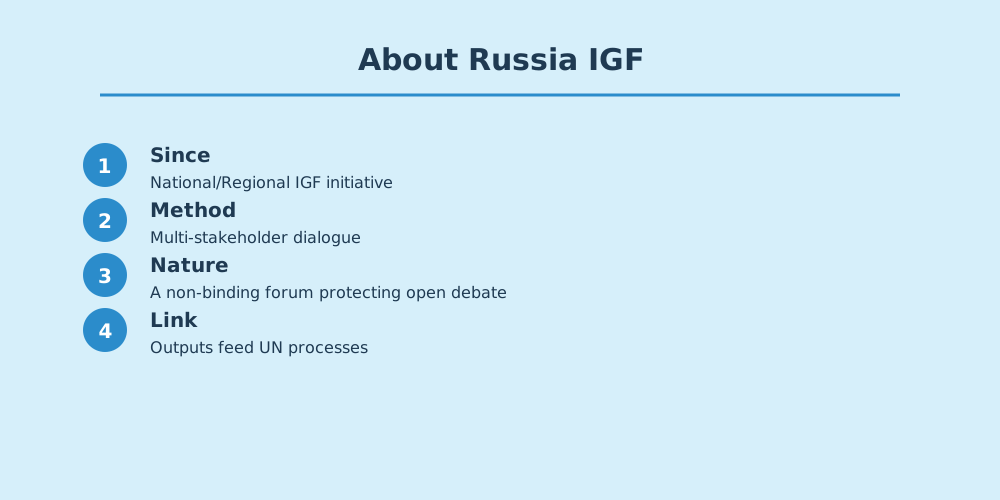
Russia IGF is a National or Regional IGF Initiative (NRI), aligning local internet governance discussion with global IGF principles.
Why It Matters to You
What was discussed here becomes the baseline for national digital policy, platform rules and AI regulation worldwide within a few years. The principles confirmed at the 2016 meeting are the foundation of the "next rules" for the phones, social platforms and AI services you use every day.
Sources & References
- RIGF-2016(公式サイト) — ロシア国別ドメイン調整センター(Coordination Center for TLD RU/РФ) (accessed 2026-07-11)
- Agenda of Russian Internet Governance Forum 2016(公式プログラム) — ロシア国別ドメイン調整センター(Coordination Center for TLD RU/РФ) (accessed 2026-07-11)
- RIGF 2016: 'Internet has become more important to us than other conveniences'(公式プレスリリース・開会報告) — ロシア国別ドメイン調整センター(Coordination Center for TLD RU/РФ) (accessed 2026-07-11)
- Different Internet governance models are complementary(公式プレスリリース・閉会報告) — ロシア国別ドメイン調整センター(Coordination Center for TLD RU/РФ) (accessed 2026-07-11)
- 7th Russian Internet Governance Forum(イベント記録) — DiploFoundation (accessed 2026-07-11)
Quotes are translated or condensed from the records listed above. Bracketed numbers [n] refer to the source list.
Related links
- IGF official (NRI list): https://www.intgovforum.org/en/content/national-and-regional-igf-initiatives
- Japan IGF: https://japanigf.jp/
- Yuki Nakazawa's blog: https://nkzw.jp/category/igf/
Revision History
Rev. 1 — published 11 June 2016, 10:00 (Article published)
Rev. 2 — updated 17 July 2026, 12:32 (Fully revised into the in-depth edition: added the 3-line summary, minutes digest, short talk, source list and diagrams (all quotes verified against the listed sources))
— 中澤祐樹

