


The 3-Line Summary
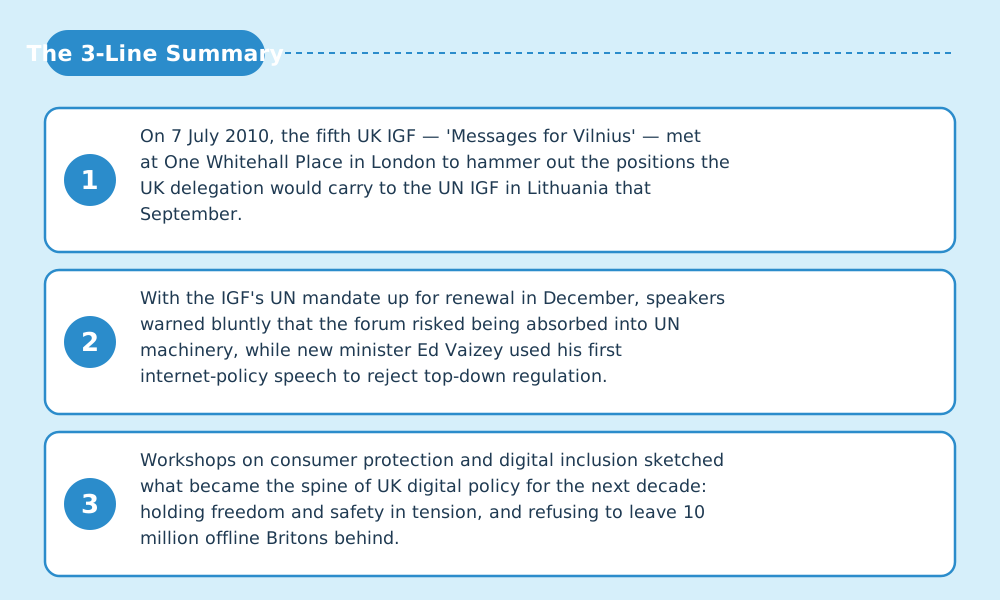
- On 7 July 2010, the fifth UK IGF — 'Messages for Vilnius' — met at One Whitehall Place in London to hammer out the positions the UK delegation would carry to the UN IGF in Lithuania that September.
- With the IGF's UN mandate up for renewal in December, speakers warned bluntly that the forum risked being absorbed into UN machinery, while new minister Ed Vaizey used his first internet-policy speech to reject top-down regulation.
- Workshops on consumer protection and digital inclusion sketched what became the spine of UK digital policy for the next decade: holding freedom and safety in tension, and refusing to leave 10 million offline Britons behind.
Welcome — this is the Japan IGF Support Organization. This in-depth report on UK IGF 2010 draws on official outputs, session records and on-site reporting. In a hurry? The three lines above and the diagrams carry the gist.
Conference at a Glance (from official records)
| Item | Detail |
|---|---|
| Official name | UK IGF 2010 |
| Edition | The Fifth Meeting of the UK Internet Governance Forum (per the official meeting report) |
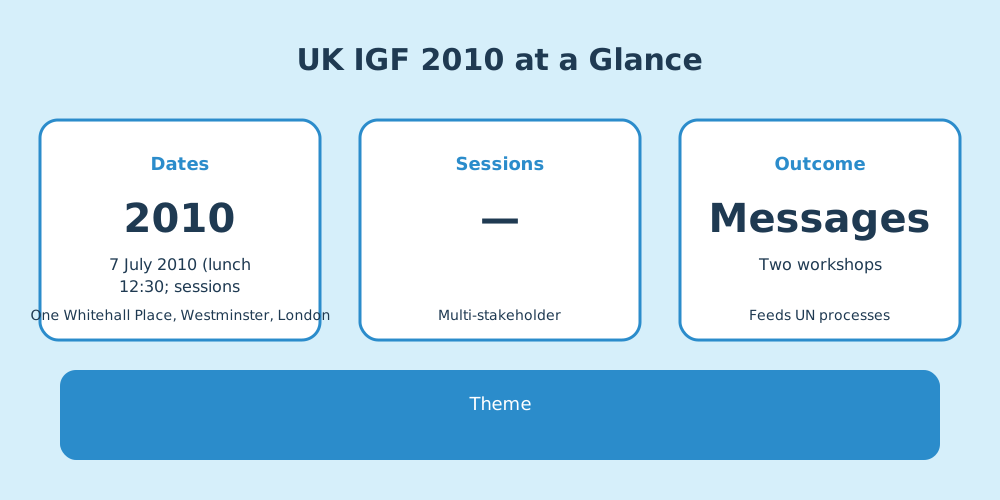
| Dates | 7 July 2010 (lunch 12:30; sessions 13:30–17:30) |
| Venue | One Whitehall Place, Westminster, London |
| Theme | Regional governance themes |
| Purpose | To formulate the 'UK Messages' the UK delegation would take to the UN IGF in Vilnius, Lithuania, that September |
| Host | Secretariat by Nominet (the UK ccTLD registry); chaired by Rt Hon Alun Michael MP |
| Outcome | Two workshops (protecting the consumer; digital inclusion) reported back to plenary and fed the UK Messages; plenary video was published on Nominet's site |
(See the source list at the end of this article.)
Discussion Digest — from the Session Records
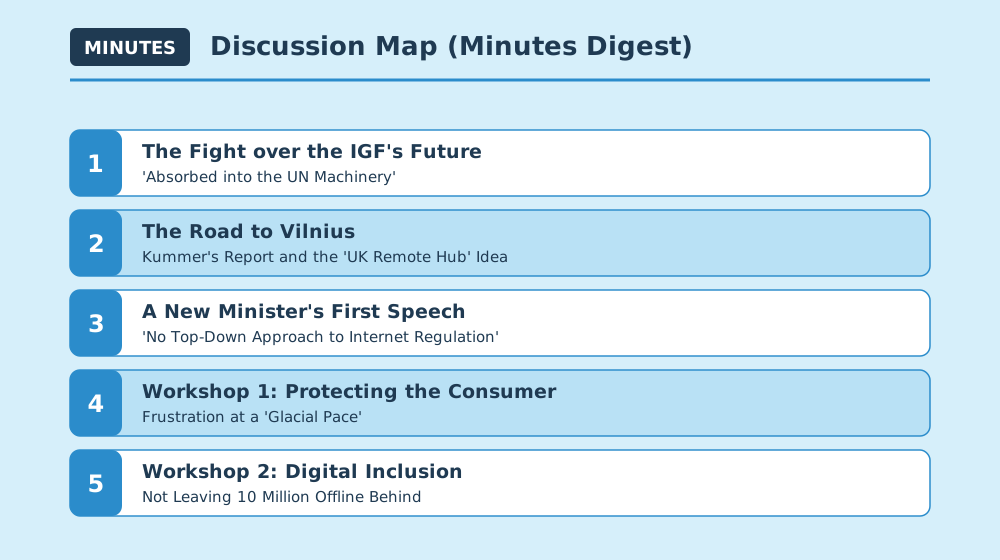
Key exchanges extracted from session records and transcripts.
1. The Fight over the IGF's Future — 'Absorbed into the UN Machinery'
Sessions: Opening session: reports from Emily Taylor (IGF MAG member) and former ambassador Nick Thorne CMG
"The bad news is that the report lays the foundations for the IGF to be absorbed into the UN machinery, with a bureau and budget, and more formal outcomes."
— Emily Taylor (member, IGF Multistakeholder Advisory Group) [3]
"The IGF is a multi-stakeholder organisation, but unfortunately only one stakeholder will have a say in its future, and that is governments."
— Nick Thorne CMG (former UK Ambassador to the UN, Geneva) [3]
- Taylor challenged the UN Secretary-General's preparatory note — which suggested over 60% of respondents wanted change — with her own analysis that some 87% were happy for the IGF to continue unchanged [3]
- 'The winners would be countries which want a firmer regulatory hand; the losers would be business and the technical community' — hence her call for business funding to keep the secretariat independent [3]
- Thorne predicted 'we will win on the IGF, but we will not win on money', mapping the General Assembly dynamics of China and the G-77 and naming China as the state keenest to impose regulation on the net [3]
2. The Road to Vilnius — Kummer's Report and the 'UK Remote Hub' Idea
Sessions: Opening session: Markus Kummer, Executive Co-ordinator of the IGF Secretariat
"If Vilnius is a disaster, it will have an impact on the general assembly – and if a success, as I hope and believe, it will also have an impact."
— Markus Kummer (Executive Co-ordinator, IGF Secretariat) [2][3]
- Kummer contrasted the treaty-based, top-down route of climate policy with the IGF's bottom-up route, arguing that for a borderless internet 'the sharing of ideas, and the sharing of best practices, seems to represent the best approach' [2][3]
- Answering complaints about the 106 parallel workshops at Sharm el-Sheikh, he confessed 102 were already planned for Vilnius — 'and the Lithuanians want some more: as hosts, we cannot deny them' — offering instead to feed workshop topics back into the main sessions [2][3]
- His parting suggestion — 'Why not create a remote hub in the UK?' — prefigured the remote-participation hubs that later spread worldwide [2][3]
- Opening the day, Nominet chair Baroness Rennie Fritchie had noted that 'criminals can be innovative too', urging responses in harmony with the net's global nature and capacity for positive innovation [2][3]
3. A New Minister's First Speech — 'No Top-Down Approach to Internet Regulation'
Sessions: Ministerial address (5:00 pm): Ed Vaizey MP, Minister for Culture, Communications and Creative Industries
"We do not want a top-down approach to Internet regulation, though of course we must recognise legitimate interests of governments in such areas as law enforcement."
— Ed Vaizey MP (Minister for Culture, Communications and Creative Industries) [2][3]
"I do not see, for example, why government or Brussels should, as some advocate, need to impose so-called 'Net Neutrality' legislation."
— Ed Vaizey MP [2][3]
- It was Vaizey's first ministerial speech on internet issues under the two-month-old Cameron coalition government [2][3]
- Against blanket ISP blocking he set the 'UK model': self-regulation through the Internet Watch Foundation and giving users the tools to make their own choices [2][3]
- He criticised the belief 'within parts of some organisations – such as the ITU' that naming, addressing, cybersecurity and child protection are for governments alone, warning of an ITU 'land grab' and of two internets emerging from such a confrontation [2][3]
- He committed the UK to backing a five-year extension of the IGF mandate at the UN General Assembly in December [2][3]
4. Workshop 1: Protecting the Consumer — Frustration at a 'Glacial Pace'
Sessions: Parallel workshop 1 (3:00–4:45 pm), with Lisa Horner, John Carr and Lucinda Fell; summed up by chair Alun Michael
"(The IGF process and the UN's processes in general are moving) at a glacial pace, while the internet is changing at a much faster pace."
— John Carr (Secretary, UK Children's Charities' Coalition on Internet Safety) [3]
"It's not just about responding to the risks, it's also about championing the great things that young people can do online… Empowering the user is absolutely key to enabling them to protect themselves."
— Lucinda Fell (Policy and Communications Manager, Childnet International) [3]
- Carr asked why IWF-style filtering of child-abuse images was replicated only in Nordic countries, North America and Australia, and why ICANN had deemed verified registrant details 'too controversial' — gaps that, he said, undermine confidence in governance arrangements [3]
- Lisa Horner of Global Partners pressed a human-rights framing of internet governance, while a delegate countered that rights language 'politicises the debate and plays straight into the hands of those who want to regulate' — a genuine clash of approaches [3]
- Philip Virgo's proposal for paid trusted-registrar verification services was rebuffed by Nominet's Lesley Cowley as a barrier to entry that would raise registration costs [3]
- Chair Alun Michael closed by quoting a young speaker's 'I want to be totally free and I want to be safe' — two priorities to be held in tension, not traded away [3]
5. Workshop 2: Digital Inclusion — Not Leaving 10 Million Offline Behind
Sessions: Keynote by Graham Walker (Race Online 2012) and parallel workshop 2 with Ian Clifford, Ellen Ferguson, Andrea Saks and others
"We'll all be better off if we're all online."
— Graham Walker (Director of Policy, Office of the UK Digital Champion / Race Online 2012) [3]
"Kids hate having websites blocked, but they want to be safe."
— Ellen Ferguson (Education Manager, Childnet International) [3]
- Walker put the numbers on the table: 10 million Britons never online, four million of them among the most socially vulnerable; moving one government contact per person online would save £1bn a year, with at least £22bn in total benefits [3]
- UK Online Centres' Ian Clifford quoted a Bristol centre manager: the hardest part is 'the part that happens in the car park — getting them to walk through the door for the first time' [3]
- The ITU's Andrea Saks insisted 'one size does not fit all' for disabled users, demanding interoperability and universal-design education, while BCS's Dr Louise Bennett declared herself 'appalled by the quality of legislation in this area' [3]
- Manoraj Sivantharajah, a 15-year-old work-experience student at Childnet, told the room young people want to be trusted — his school blocked even Google Images — a voice preserved in the official report [3]
Three-Minute Short Talk — Your Questions Answered
Q. What was this meeting for?
A. A 'messaging' session to settle what the UK would argue at the UN IGF in Vilnius that September. Government, Parliament, business and civil society spent an afternoon distilling the 'UK Messages' the delegation carried to Lithuania.
Q. Where was the real tension?
A. Over the IGF's own survival. With the UN mandate review due in December, a MAG member and a former UK ambassador warned bluntly that the forum could be absorbed into UN machinery — to the benefit of states wanting a firmer regulatory hand.
Q. Why should I care?
A. Ed Vaizey's first internet speech — self-regulation and user choice over top-down rules, scepticism of net-neutrality legislation — set a policy line whose echoes ran through UK digital policy for a decade, and the digital-inclusion arguments apply to every ageing, unevenly connected society.
What Is UK IGF? (for first-time readers)
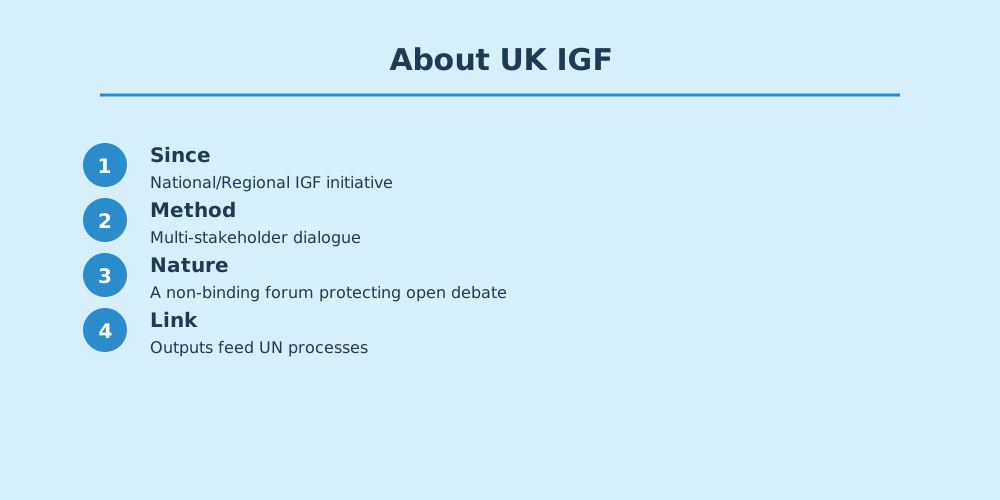
UK IGF is a National or Regional IGF Initiative (NRI), aligning local internet governance discussion with global IGF principles.
Why It Matters to You
What was discussed here becomes the baseline for national digital policy, platform rules and AI regulation worldwide within a few years. The principles confirmed at the 2010 meeting are the foundation of the "next rules" for the phones, social platforms and AI services you use every day.
Sources & References
- UKIGF Events — 7 July 2010イベント告知(One Whitehall Place・ワークショップ構成・趣旨。Wayback Machine) — UK IGF(ukigf.org.uk) (accessed 2026-07-16)
- 7 Jul 2010 UK IGF agenda(議事次第PDF。Wayback Machine) — UK IGF(ukigf.org.uk) (accessed 2026-07-16)
- UK Internet Governance Forum Summer Session – 'Messages for Vilnius' Meeting Report(公式会合報告書PDF・13ページ。Wayback Machine) — Nominet/UK IGF(執筆:Dan Jellinek, Headstar) (accessed 2026-07-16)
- United Kingdom IGF(NRI記録:英国国別IGFの性格と事務局) — intgovforum.org (accessed 2026-07-16)
Quotes are translated or condensed from the records listed above. Bracketed numbers [n] refer to the source list.
Related links
- IGF official (NRI list): https://www.intgovforum.org/en/content/national-and-regional-igf-initiatives
- Japan IGF: https://japanigf.jp/
- Yuki Nakazawa's blog: https://nkzw.jp/category/igf/
Revision History
Rev. 1 — published 9 October 2010, 14:00 (Article published)
Rev. 2 — updated 17 July 2026, 12:32 (Fully revised into the in-depth edition: added the 3-line summary, minutes digest, short talk, source list and diagrams (all quotes verified against the listed sources))
— 中澤祐樹

