


The 3-Line Summary
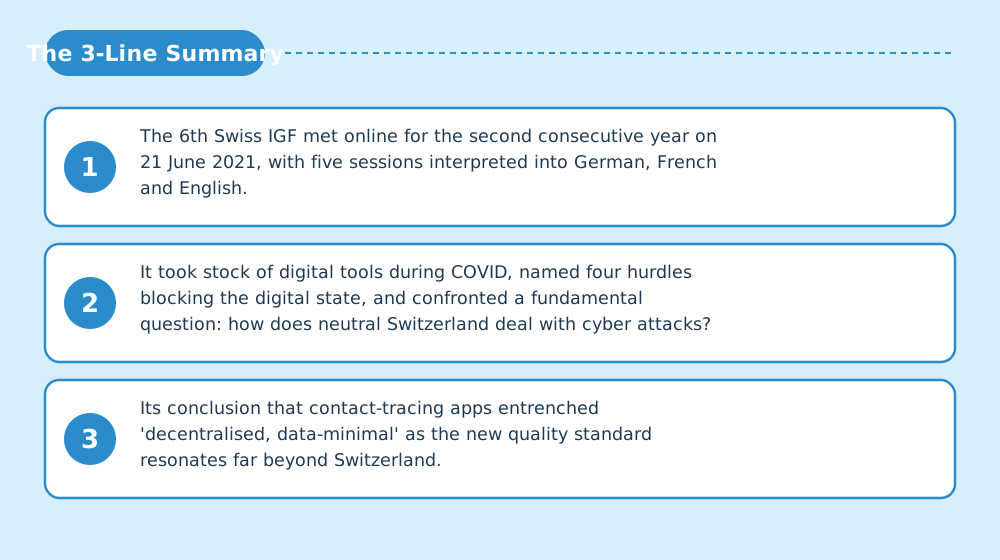
- The 6th Swiss IGF met online for the second consecutive year on 21 June 2021, with five sessions interpreted into German, French and English.
- It took stock of digital tools during COVID, named four hurdles blocking the digital state, and confronted a fundamental question: how does neutral Switzerland deal with cyber attacks?
- Its conclusion that contact-tracing apps entrenched 'decentralised, data-minimal' as the new quality standard resonates far beyond Switzerland.
Welcome — this is the Japan IGF Support Organization. This in-depth report on Swiss IGF 2021 (6th Swiss Internet Governance Forum) draws on official outputs, session records and on-site reporting. In a hurry? The three lines above and the diagrams carry the gist.
Conference at a Glance (from official records)
| Item | Detail |
|---|---|
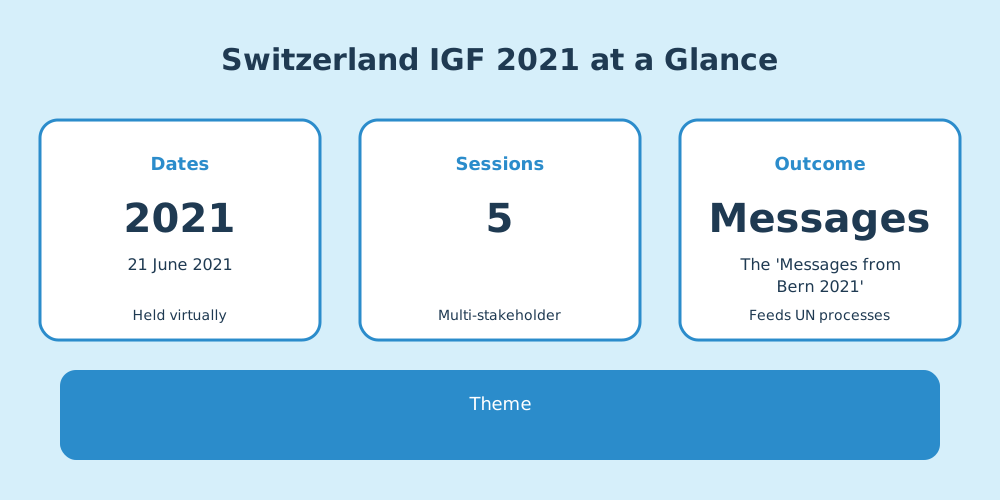
| Official name | Swiss IGF 2021 (6th Swiss Internet Governance Forum) |
| Dates | 21 June 2021 |
| Venue | Held virtually |
| Theme | Regional governance themes |
| Sessions | 5 (Five sessions: the digital state, digitalisation during COVID, inclusive digital governance, cyber attacks and neutrality, and a new role for media) |
| Host | Multistakeholder steering group under OFCOM patronage |
| Outcome | The 'Messages from Bern 2021', submitted to the UN IGF and EuroDIG |
(See the source list at the end of this article.)
Discussion Digest — from the Session Records
Key exchanges extracted from session records and transcripts.
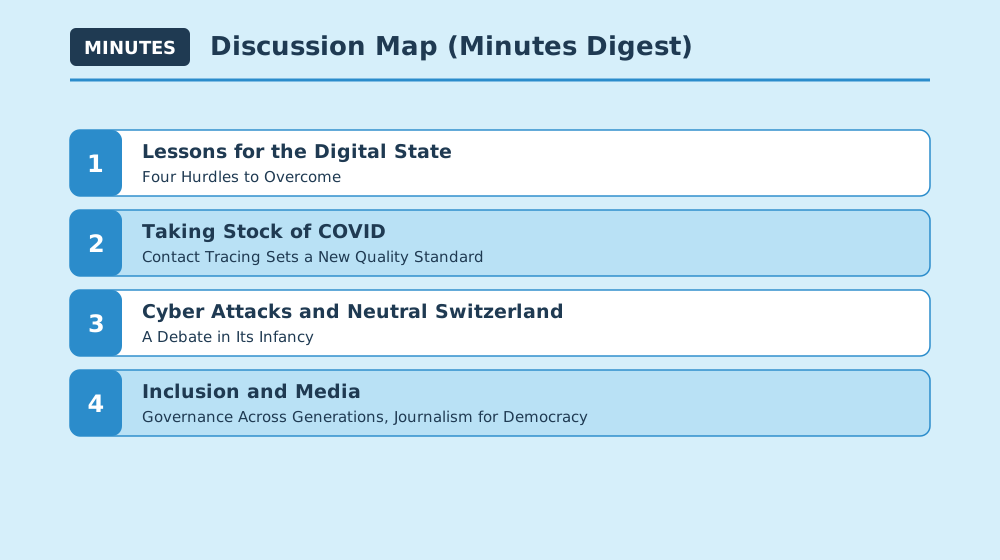
1. Lessons for the Digital State — Four Hurdles to Overcome
Sessions: Session 1 'Lessons for the digital state'
- Switzerland has every prerequisite for digital success yet ranks only average; four hurdles were named — distrust of government agencies, political over-emotionalism, insufficient risk appetite, and actors' lack of self-confidence [1]
- Success factors: courage to change with tolerance for mistakes, processes for direct citizen involvement, and new tools that create real added value for society and policymaking [1]
- Public-private and public-civic partnerships (e.g. with foundations) can get pilots off the ground; cost-effective proofs of concept should precede large-scale government contracts [1]
2. Taking Stock of COVID — Contact Tracing Sets a New Quality Standard
Sessions: Session 2 'Digitalisation for society during the corona period'
- The tools existed, but basic understanding and solid infrastructure were lacking — the whole ecosystem, not individual tools, must be brought forward [1]
- Contact-tracing apps and the URL-based COVID certificate established principles — decentralised approach, minimal data use — now anchored in legislation and constituting the new standard of quality [1]
- 'Data protection' and 'protection of privacy' are interrelated but not equivalent — a conceptual distinction often blurred in political debate; data-access management models are needed [1]
3. Cyber Attacks and Neutral Switzerland — A Debate in Its Infancy
Sessions: Session 4 'Cyber attacks and neutral Switzerland'
- The debate on how the new technical reality affects Swiss neutrality is at a very early stage with many open questions — which creates space for a fundamental discussion of Switzerland's digital security policy [1]
- Several participants argued for strengthening defensive capabilities and expanding international cooperation — the only way to build the trust a secure cyberspace requires [1]
- Private sector and state share responsibility for securing cyberspace; Geneva's international presence positions Switzerland to contribute to the global debate [1]
4. Inclusion and Media — Governance Across Generations, Journalism for Democracy
Sessions: Session 3 'Digital governance' / Session 5 'A new role for media?'
- Digital governance must encompass all generations, not just the usual stakeholder segments; people with impairments and speakers of different languages have been left out — free accessibility of data 'should no longer be a feature but a right' [1]
- As tech platforms gain power and local media fight for subscribers and advertising, media was framed as a sector like no other, since its structure affects society as a whole [1]
- If media is to promote democracy, targeted support for independent, trustworthy platforms enabling good and investigative journalism is paramount — with the courage to experiment [1]
Three-Minute Short Talk — Your Questions Answered
Q. What did it decide?
A. Nothing binding — the 'Messages from Bern 2021' went to the UN IGF and EuroDIG, centred on a COVID-era digital-policy stocktake.
Q. Highlight?
A. How a neutral country handles cyber attacks — a genuinely new question for 200 years of neutrality policy, and one the session admitted is still wide open.
Q. Why care?
A. The legal anchoring of 'decentralised, data-minimal' principles from contact-tracing apps is a reference point for pandemic-tech debates everywhere.
What Is Switzerland IGF? (for first-time readers)
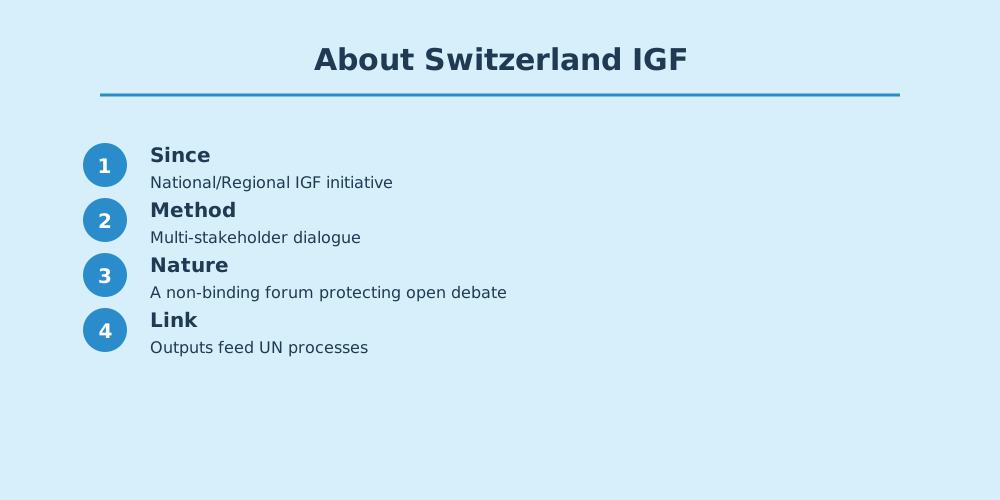
Switzerland IGF is a National or Regional IGF Initiative (NRI), aligning local internet governance discussion with global IGF principles.
Why It Matters to You
What was discussed here becomes the baseline for national digital policy, platform rules and AI regulation worldwide within a few years. The principles confirmed at the 2021 meeting are the foundation of the "next rules" for the phones, social platforms and AI services you use every day.
Sources & References
- Messages from Bern (Swiss IGF 2021) — Swiss IGF (accessed 2026-07-23)
- Swiss IGF 2021(大会ページ) — igf.swiss (accessed 2026-07-23)
- About the Swiss IGF — igf.swiss (accessed 2026-07-23)
- National IGFs — Western European and Others Regional Group (WEOG) — 国連IGF事務局(Waybackアーカイブ) (accessed 2026-07-23)
Quotes are translated or condensed from the records listed above. Bracketed numbers [n] refer to the source list.
Related links
- IGF official (NRI list): https://www.intgovforum.org/en/content/national-and-regional-igf-initiatives
- Japan IGF: https://japanigf.jp/
- Yuki Nakazawa's blog: https://nkzw.jp/category/igf/
更新履歴
第1稿投稿 2026年8月5日 13時42分(記事コンテンツアップ)
— 中澤祐樹

