
I run Egosaru, a free tool that collects search suggestions (autocomplete) from Google, YouTube, Amazon and other search engines in one go. It now works in 20 languages, and people in Taiwan, Korea, Thailand and other countries have started to use it.
While preparing the overseas editions, I decided to show a local name next to the logo. I took the chance to write down where the name “Egosaru” actually comes from. To be honest, I am not the one who named it.
The name is “ego search” plus the “ru” of the verb “suru”
“Egosaru” (エゴサる) takes “egosa”, the short form of the Japanese word “egosāchi” (ego search), and adds “ru”, the ending of the verb “suru” (to do). It is built the same way as “guguru” (ググる), the Japanese slang for “to google”. So “egosaru” simply means “to ego-search”.
“Ego search” means searching for your own name or your company’s services to see what people say about them. It is a Japanese coinage made from the English words “ego” and “search”. In English, the same thing is usually called ego surfing or a vanity search.
It started as a monitoring system for private schools
The tool began as a monitoring system for private schools in Japan. Its purpose was to watch how a school’s name was searched online and which words appeared with it. I developed it on commission from a business partner at the time.
The development was done by a team in Vietnam. In fact, no Japanese engineer was ever involved. My part was writing the requirements, and I never looked at the source code myself.
The part of that monitoring system that collected search suggestions became the basis of today’s Egosaru.
Named by a former business partner I can no longer reach
The name Egosaru was given by the business partner who commissioned that work. He also made the logo.
He was neither a professional designer nor a naming specialist. Even so, he had a real knack for coming up with names and sketching logos quickly.
Later, his company’s business in online reputation management and digital risk almost disappeared. We have lost touch, and I can no longer reach him. Only the name and the logo remain.
I learned the word “ego search” from Oshi no Ko
This is a little embarrassing, but I only really learned the word “ego search” from the anime Oshi no Ko. Episode 6 of the first season is even titled “Ego Search” (エゴサーチ), aired on 17 May 2023.
The first season of the TV anime Oshi no Ko is based on the manga by Aka Akasaka and Mengo Yokoyari, produced by Doga Kobo, and aired from 12 April to 28 June 2023 (11 episodes).
The tool itself was made before that. In other words, the name came first, and I only properly learned what the word meant afterwards.
Because I work in SEO, I searched for my own company’s services and my own name every day. But I was not in the reputation management business myself, so I was not familiar with the vocabulary of that field. It probably also matters that “ego search” started out as something close to slang.
The “ru” is now a monkey
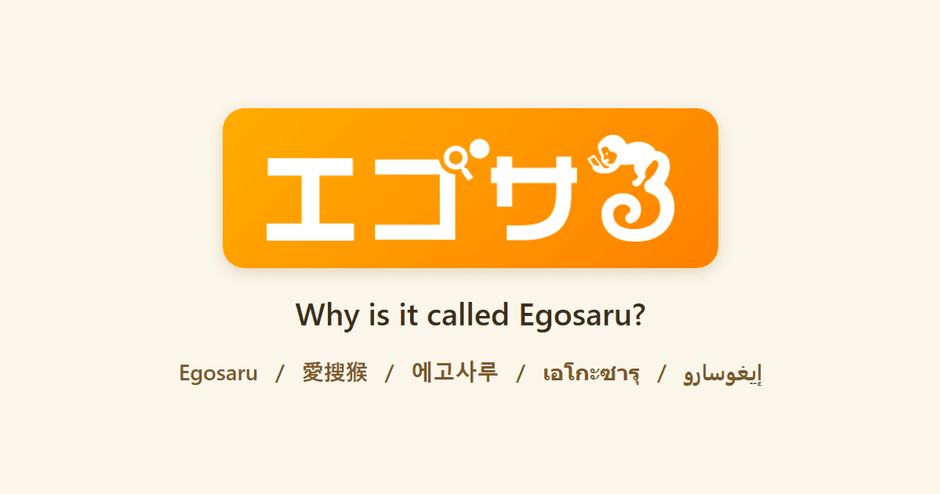
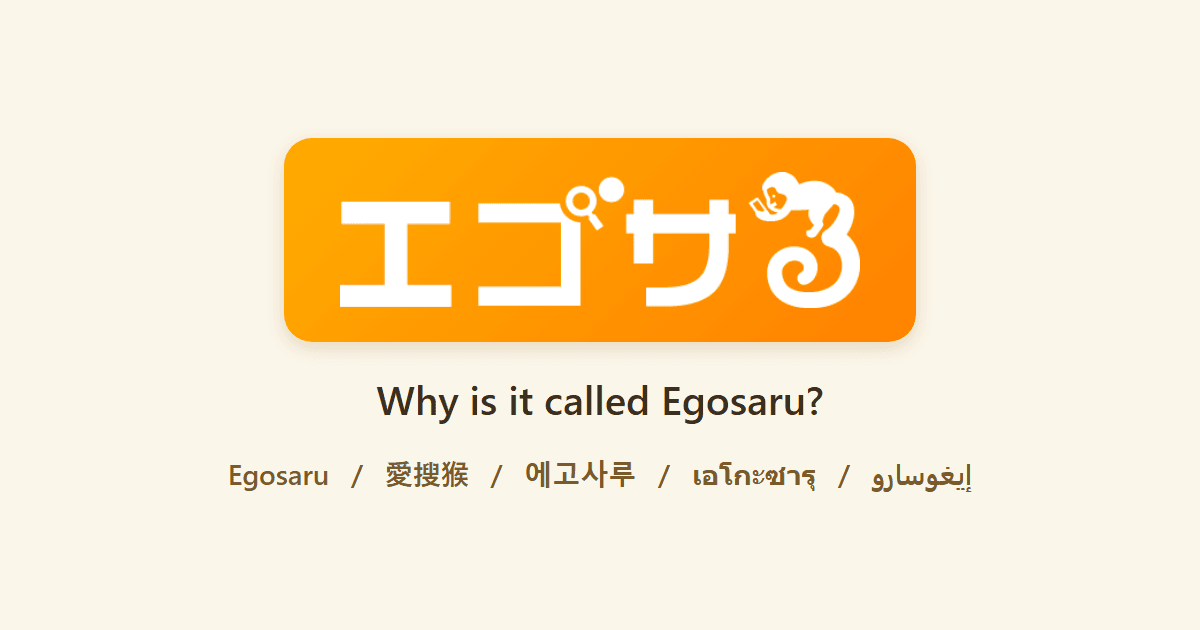
Look closely at the logo. The two dots on “go” (ゴ) form a magnifying glass, and the final “ru” (る) is shaped like a monkey. It looks like a monkey holding a smartphone.
After the katakana “egosa” comes “ru”, which in the design has become a monkey. And if you read the last two sounds as “saru”, that is the Japanese word for monkey. The real origin of the name is “ego search + ru”, but I see the monkey as a fitting second meaning that came along later.
I think this also shows the sense of the person who named it.
Local names next to the logo in the overseas editions
The overseas editions use the same logo. Egosaru was born in Japan, so I thought the Japanese logo was fine as it is.
Instead, so that people who cannot read Japanese can still tell what the tool is called, each edition shows its local name next to the logo.
| Language | Name shown |
|---|---|
| Traditional Chinese (Taiwan) | 愛搜猴 |
| Simplified Chinese | 爱搜猴 |
| Korean | 에고사루 |
| Thai | เอโกะซารุ |
| Russian | Эгосару |
| Ukrainian | Еґосару |
| Arabic | إيغوسارو |
| Hindi | एगोसारु |
| English and other Latin-alphabet languages | Egosaru |
Korean, Thai and the others simply write the sound “egosaru” in the local script. Only Chinese was named for its meaning: 愛 (love), 搜 (search) and 猴 (monkey) together make “the monkey who loves to search”. It also matches the monkey in the logo, and I like it.
Taiwan is a special focus for me. Many people there can read Japanese text, and it is a country with warm feelings toward Japan. The Taiwan edition collects suggestions from Google, Yahoo奇摩 and Shopee in one go.
The names shown next to the logo in each edition

Summary
- “Egosaru” is “ego search” plus the “ru” of the verb “suru”.
- It was named by a former business partner I can no longer reach, and the logo is his work too.
- I learned the word “ego search” from the anime Oshi no Ko, after the tool already existed.
- The “ru” in the logo looks like a monkey. That is not the origin, but a second meaning that came later.
- The overseas editions keep the logo and show a local name next to it. In Taiwan it is 愛搜猴.
It is a pity I cannot thank him in person, but the name and logo he gave are now used in 20 languages. I would be glad if this post reached him someday.
There is also an article on the same topic in 20 languages on Egosaru itself.
References
- Egosaru (bulk search suggestion tool)
- Egosaru Taiwan edition (愛搜猴)
- Why Is It Called Egosaru? (Egosaru article, 20 languages)
- Japanese original of this post
- Oshi no Ko anime official site
更新履歴
- 第1稿投稿 2026年10月24日 18時28分(記事コンテンツアップ)